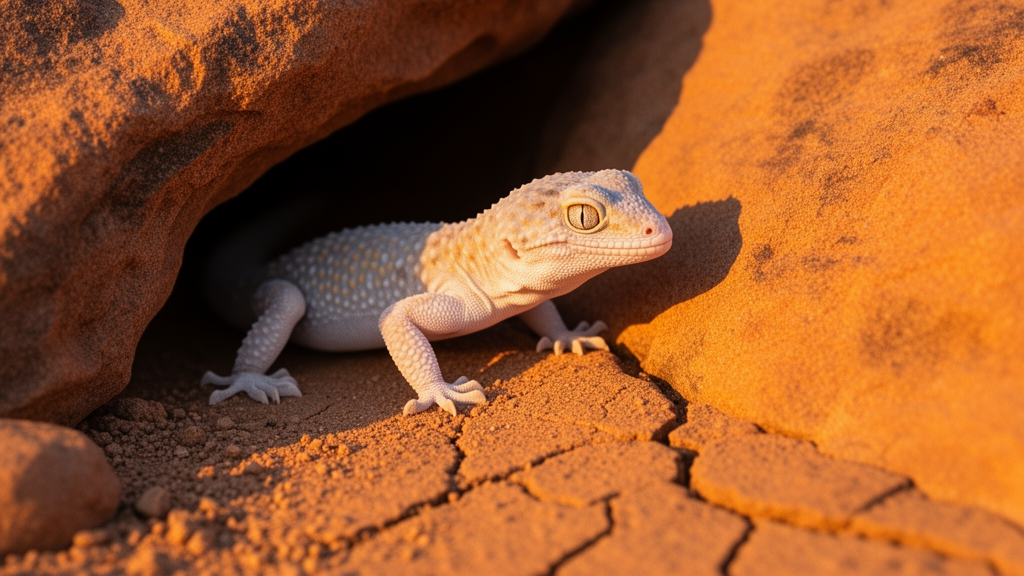
A small field and laboratory study of the South American leaf-toed gecko Phyllodactylus gerrhopygus found that its body temperature was more strongly associated with substrate temperature than with air temperature, consistent with a thigmothermic strategy. The study, involving 20 geckos from coastal northern Chile, also found that the animals selected warmer temperatures in the evening than in the morning, with no detectable difference between adults and juveniles.
Researchers captured geckos manually beneath rocks and debris during four hours of fieldwork in spring 2023 at the Huayquique Campus near Huayquique Beach in Iquique, Tarapacá Region, Chile. The coastal Atacama site contains dunes, rocks and limited vegetation. The sample included 11 juveniles and nine adults, classified by snout-to-vent length: individuals measuring 50 mm or less were treated as juveniles, while those longer than 50 mm were classified as adults.
Field measurements were made with a non-invasive infrared thermometer with stated accuracy of ±0.2 °C. Dorsal skin temperature was recorded within five seconds of finding each gecko, substrate temperature was measured at the observation site, and air temperature was recorded 5 cm above the substrate. The animals were subsequently weighed and measured. Mean body mass was 1.69 ± 0.72 g, and mean snout-to-vent length was 47.21 ± 7.5 mm.
Mean field body temperature was 26.1 ± 4.05 °C, compared with a mean substrate temperature of 25.81 ± 5.13 °C. Body temperature had a strong positive association with substrate temperature (r = 0.88, p < 0.05) and a weaker association with air temperature (r = 0.44, p < 0.05). Linear regression attributed 78% of the variation in body temperature to substrate temperature and 21% to air temperature. These relationships supported the authors’ classification of the gecko as thigmothermic, in which body temperature is associated primarily with direct contact with the substrate rather than direct solar heating.
The investigators compared field body temperature with preferred temperature measured under laboratory conditions. After two weeks of laboratory acclimatisation, the geckos were fasted for three days and placed individually in a calibrated thermal gradient ranging from 10 to 40 °C. The gradient included sand and refuges and was checked with a type-K thermocouple; infrared and thermocouple substrate measurements did not differ significantly (t-test = 0.71, p = 0.49).
The geckos were observed for one hour in the morning, between 10:30 and 11:30, and for one hour in the evening, between 19:30 and 20:30. Dorsal temperature was recorded every five minutes. Across both periods, mean preferred temperature was 28.63 ± 9.41 °C, with observed selections ranging from 9.2 to 41 °C. The middle 50% of selected temperatures extended from 25.55 to 35.77 °C, and the frequency distribution was bimodal.
Preferred temperature was higher in the evening, averaging 32.23 ± 5.91 °C, than in the morning, when it averaged 25.2 ± 9.02 °C; the repeated-measures analysis found a significant difference between the two periods (F1,17 = 18.36, p = 0.0005). No significant difference was detected between adults and juveniles (F1,17 = 0.14, p = 0.71). Preferred temperature also was not significantly related to snout-to-vent length (p = 0.16) or body mass (p = 0.15).
Field body temperature did not differ significantly from preferred temperature (paired t-test, t18 = 1.45, p = 0.15), nor did substrate temperature differ significantly from preferred temperature (t18 = 1.5, p = 0.14). Air temperature differed significantly from preferred temperature (t18 = 2.36, p = 0.02), although the reported comparison did not specify the direction of that difference. The mean absolute deviation index, db, was 5.82 ± 4.3, which the authors interpreted as low thermoregulatory accuracy, or thermoconformity.
The results indicate that P. gerrhopygus can select temperatures across a wide range and appears to gain much of its heat from refuge substrates. The authors linked its evening preference for warmer temperatures to a strategy associated with nocturnal activity, including locomotion, prey capture and digestion, while noting that high daytime refuge temperatures may help complete temperature-dependent processes. They described similar thermal responses in the related Phyllodactylus bordai as evidence consistent with possible phylogenetic inertia. The absence of measurable differences between adults and juveniles was consistent with earlier observations that the species does not compete for suitable rocks, although the reasons for this similarity remain unresolved.
The study involved only 20 animals from one coastal site during spring and measured dorsal temperature as a representation of body temperature, so its results do not establish how the species responds across seasons, populations or the full range of habitats occupied in Chile and Peru. The authors described the work as the first published investigation of the species’ thermal ecology and identified climate-change effects on the gecko and its distribution as a subject for further study.
Subject of Research: Thermal ecology of Phyllodactylus gerrhopygus in coastal northern Chile
Article Title: Thermal ecology of the South American leaf-toed gecko Phyllodactylus gerrhopygus (Wiegmann, 1834) ( Gekkota , Phyllodactylidae ) in northern Chile
Article References: Taucare‐Ríos, A., Leiva, D., Mendez-Yovera, J., & Reyes-Olivares, C. (2025). Thermal ecology of the South American leaf-toed gecko Phyllodactylus gerrhopygus (Wiegmann, 1834) (Gekkota, Phyllodactylidae) in northern Chile. Herpetozoa, 38, 245-252. https://doi.org/10.3897/herpetozoa.38.e162512
Image Credits: AI Generated
DOI: 10.3897/herpetozoa.38.e162512
Keywords: Phyllodactylus gerrhopygus, leaf-toed gecko, thermal ecology, thermoconformity, thigmothermy, body temperature, northern Chile, Atacama Desert, preferred temperature, Thermal, ecology, South
News Source: Drew Townsend. (October 20, 2026). Northern Chile leaf-toed geckos track refuge substrate temperatures, study finds. Scienmag.