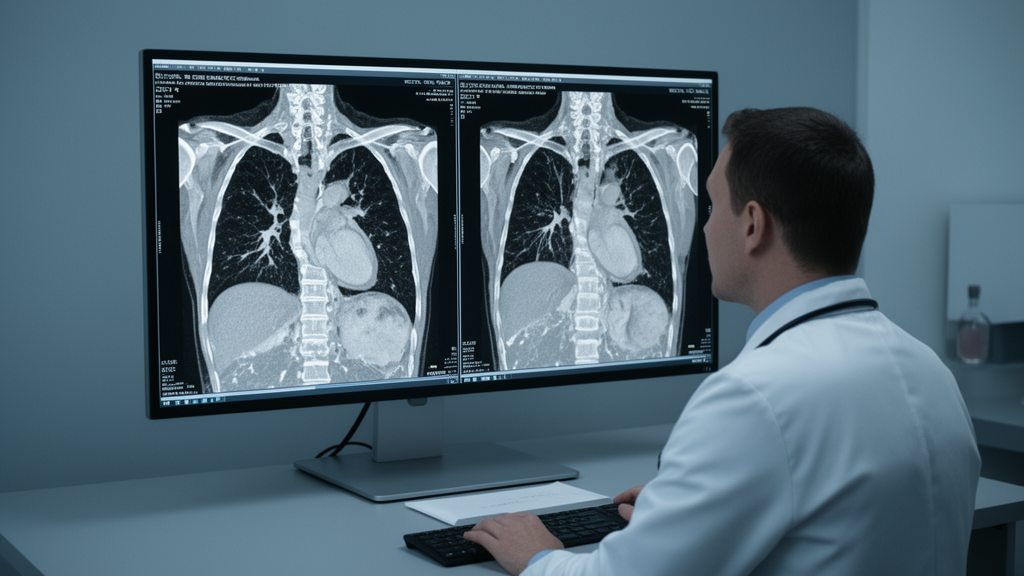
In a retrospective landmark cohort of 352 participants who underwent repeat coronary computed tomography angiography, changes in adipose tissue and skeletal muscle measures were associated with subsequent major adverse cardiovascular events, or MACE. After adjustment for clinical risk factors, baseline body mass index and the corresponding baseline imaging measure, greater annualized increases in epicardial adipose tissue volume index, epicardial adipose tissue density, intermuscular adipose tissue index, visceral adipose tissue index and visceral adipose tissue density were associated with higher MACE risk. Higher skeletal muscle density was associated with lower risk. Epicardial adipose tissue density had the largest reported point estimate, with a hazard ratio of 1.85 per one-standard-deviation increase and a 95% confidence interval of 1.49–2.29. The corresponding hazard ratio for skeletal muscle density was 0.65, with a 95% confidence interval of 0.54–0.78.
The study, reported as accepted research in BMC Medical Imaging on 20 October 2026, examined prognostic associations in a selected population receiving clinically indicated CCTA examinations. Participants needed at least two quality-eligible scans separated by more than one year. For the primary analysis, the first eligible examination was designated as baseline, while the latest eligible examination became the index date and the start of follow-up for cardiovascular outcomes. Investigators quantified epicardial, visceral, intermuscular and subcutaneous adipose tissue, together with skeletal muscle, at both examinations. They then calculated annualized changes and standardized those changes for evaluation in separate Cox models adjusted for clinical risk factors, baseline body mass index and the relevant baseline imaging measure. During follow-up, 74 participants experienced MACE.
These findings connect longitudinal changes measured on routine clinical scans with a later composite cardiovascular outcome, but the observational analysis does not establish that the measured changes caused the events. The investigators also stated that the results do not demonstrate prognostic value independent of coronary atherosclerotic disease burden. That distinction is important because the cohort came from one center and included patients whose examinations were already clinically indicated, rather than participants recruited for research imaging or selected to represent the general population. The analysis was further limited by the selected repeat-CCTA population and the number of observed events, while sensitivity analyses assessed robustness to interscan duration. The study therefore supports further evaluation of the prognostic information that may be available in existing CCTA examinations, but it does not establish a standalone cardiovascular test or a preventive intervention.
The central result is that several changes in adipose tissue measures were associated with higher subsequent MACE risk, whereas a higher skeletal muscle density was associated with lower risk. Epicardial adipose tissue density produced the largest point estimate among the reported associations, while the inverse association for skeletal muscle density had a hazard ratio of 0.65 per one-standard-deviation increase. The researchers did not incorporate detailed coronary disease burden as a basis for establishing that the imaging measures provide prognostic information independently of atherosclerosis. They concluded that the results justify larger multicenter cohorts incorporating detailed coronary disease burden, together with external validation, to determine whether the associations hold beyond this single-center cohort. The evidence also points toward further assessment of opportunistic cardiometabolic phenotyping using body-composition information extracted from CCTA examinations already acquired for clinical reasons, rather than additional CT acquisition performed solely for body-composition measurement.
Subject of Research: Associations between longitudinal CCTA-derived body-composition changes and major adverse cardiovascular events in a single-center retrospective cohort
Article Title: Longitudinal coronary CT angiography-derived body composition changes and subsequent cardiovascular events: a landmark cohort study
Article References: Zhao, Y., Geng, L., Wang, Z., Liang, J., Li, Q., Zhang, Q., Cui, T., Liu, W., Jin, Y., Ma, H., Li, X., Li, J., & Huang, S. (2026). Longitudinal coronary CT angiography-derived body composition changes and subsequent cardiovascular events: a landmark cohort study. BMC Medical Imaging. https://doi.org/10.1186/s12880-026-02951-7
Image Credits: AI Generated
DOI: 10.1186/s12880-026-02951-7
Keywords: coronary CT angiography, body composition, epicardial adipose tissue, visceral adipose tissue, skeletal muscle density, cardiovascular events, MACE, medical imaging, retrospective cohort, longitudinal change, Longitudinal, coronary
News Source: Ophelia Keating. (October 20, 2026). Repeat CCTA body-composition changes linked to cardiovascular events in retrospective cohort. Scienmag.