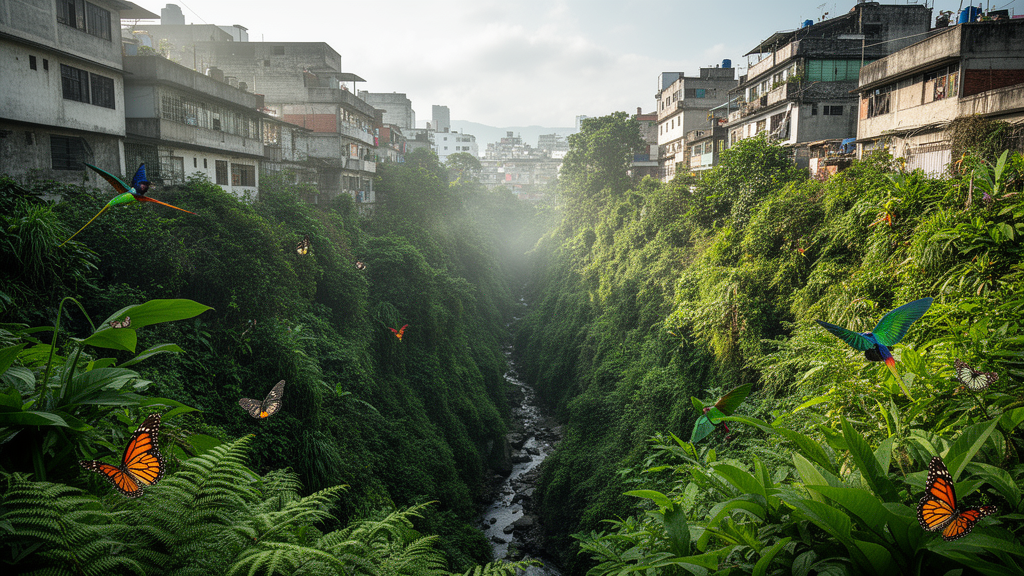
A short field survey combined with records from previous studies and biodiversity databases produced a checklist of 1,688 terrestrial species with known records in Guatemala City. The synthesis included 1,359 native species, 85 migratory species and 244 introduced species, but the authors cautioned that it is not a final inventory of all species inhabiting the city.
The Urban Biodiversity Project surveyed six sites within the city’s Municipal Ecological Green Belt, or Cinturón Ecológico Municipal, from August through November 2023. The sites were Guatemala Country Club, Pamplona Ecological Park, Jungla Urbana Ecological Park, Los Montañistas Park, Siwan Raxché Ecological Park and La Península Municipal Plant Nursery. The survey was based on the IUCN Urban Nature Indexes.
Researchers made observations during morning and night hours to search for vertebrates and actively collected invertebrates and plants. Target animal groups included diurnal Lepidoptera, arachnids, bees and wasps, birds, reptiles and amphibians. Field methods comprised transect surveys, entomological nets, round plots for vegetation and non-systematic sampling. Preserved specimens were deposited in the USCG Herbarium and the Biological Collections of the School of Biology at Universidad de San Carlos in Guatemala City.
The researchers also consulted the Guatemala Biodiversity Portal and the Global Biodiversity Information Facility for records from literature, preserved specimens and observations. They selected records with voucher specimens and ancillary data, used only research-grade iNaturalist records and verified entries, discarding records with incorrect identifications or locations. Previous studies were also reviewed to compile species records within Guatemala City’s municipal limits.
Information from biodiversity portals and specialized scientific literature was used to classify species as native, migratory or introduced. Protection and extinction-risk status was identified from CITES, the IUCN Red List and Guatemala’s List of Threatened Species, known as LEA. Records were organized using Darwin Core fields, while scientific names were curated against the Guatemalan Catalog of Taxonomic Authorities for vertebrates and the GBIF Backbone Taxonomy for other groups.
The resulting checklist contained 463 invertebrate species in 112 families, 348 vertebrate species in 77 families, 90 fungal species in 29 families and 787 plant species in 132 families. Researchers observed or collected 308 species, or 18% of the checklist, during the 2023 surveys. A further 694 species, representing 41% of the total, were represented only by observation records, including 173 arthropods that are often difficult to identify without specimens.
At least 113 species, or 7% of the documented total, had some degree of protection or extinction risk under international or national lists. Thirty-two of these were observed or collected during the field survey. The recorded examples included the yellow-naped Amazon, Amazona auropalliata, classified as Critically Endangered by the IUCN and Endangered on the LEA; Bombus mexicanus, classified as Vulnerable by the IUCN and included on the LEA; and the lizard Corytophanes percarinatus and butterflies Catasticta nimbice and Dircenna klugii, each classified as Endangered on the LEA.
The checklist has clear limits because it synthesizes records generated by the field project, earlier studies and digital biodiversity platforms rather than providing a definitive count of the city’s species. At least 20 species recorded by earlier work in the Municipal Ecological Green Belt were not found during the Urban Biodiversity Project or on biodiversity platforms. The authors note that earlier studies used methods targeting different groups, including dung-beetle sampling and Sherman-type traps for small mammals, as well as a greater sampling effort and areas outside municipal limits. They do not establish why those species were absent from the new records.
The field survey itself was restricted in duration, did not cover every taxonomic group and omitted some green spaces, including cemeteries, gardens and plazas. The authors also note that many specimens in national natural-history collections remain inaccessible digitally, so consulting physical collections remains important. Community-science platforms such as iNaturalist and eBird complement field sampling by documenting conspicuous groups, while specimen collection and examination support more accurate identification of difficult taxa. The project’s results were used to estimate Urban Nature Indexes used in monitoring and evaluating conservation measures and the impact of consumption at the city level.
Subject of Research: Urban biodiversity checklist for Guatemala City based on field surveys and digital records
Article Title: Contribution to the knowledge of urban biodiversity in Central America: A checklist to the species of Guatemala City
Article References: Castillo-Cabrera, F. J., Roldán, R. A., Barrios, M., Burgos-Barrios, C. L., Grajeda, A. L., García, M. J., Cruz, H., Morales-Mérida, J. R., Tenez, D., Vásquez, M., Agreda, E. O., Velásquez, I., Eufragio, A., Barahona-Fong, R., Yurrita, C. L., & Orellana, K. S. (2025). Contribution to the knowledge of urban biodiversity in Central America: A checklist to the species of Guatemala City. Neotropical Biology and Conservation, 20(1), 59-66. https://doi.org/10.3897/neotropical.20.e135435
Image Credits: AI Generated
DOI: 10.3897/neotropical.20.e135435
Keywords: urban biodiversity, Guatemala City, species checklist, biodiversity surveys, Municipal Ecological Green Belt, iNaturalist, GBIF, CITES, IUCN Red List, conservation status, Contribution, knowledge
News Source: Margaret Porter. (October 20, 2026). Urban biodiversity synthesis documents 1,688 species in Guatemala City. Scienmag.