A study of three subterranean ground beetle species from continental Portugal found that mitochondrial DNA did not separate them into a distinct lineage, even though their morphology showed clear differences. In the maximum-likelihood analysis of mitochondrial cytochrome c oxidase subunit I (cox1) sequences, Trechus gamae, T. lunai and T. tatai were nested among surface and underground populations of the widespread Trechus fulvus clade on the Iberian Peninsula. The relationships within the relevant Iberian subclades had bootstrap support below 70%, leaving the evolutionary placement of these taxa unresolved.
The research focused on three of the four hypogean Trechus species known from mainland Portugal. T. gamae and T. lunai occur in caves and mesovoid shallow substratum in different sub-units of the Estremenho karst massif, while T. tatai is restricted to the Montejunto karst massif, about 40 km southwest. T. machadoi was not included in the phylogenetic analysis because no new specimens were collected from its type locality, and male T. machadoi were unavailable for the comparative genital analysis.
Specimens came from Portuguese and German entomological collections and from field sampling in the known habitats of the four Portuguese species in the Lusitanian group. Researchers used pitfall traps baited with pig liver and partially filled with 1,2-propanediol for caves and mesovoid shallow substratum. Following DNA extraction, they amplified and sequenced the mitochondrial cox1 fragment, edited and aligned the sequences, selected a TPM1uf+I+G4 substitution model with ModelTest-NG and inferred the tree with maximum likelihood in RAxML. Ten independent runs searched for the best-scoring tree, 200 bootstrap replications evaluated its reliability, and T. obtusus served as the outgroup.
The resulting tree showed genetic structure associated with geography, with clusters corresponding to Madeira Island, Morocco, France and the Iberian Peninsula. Within the T. fulvus-group, T. lallemantii from northern Morocco formed a separate clade with 95% bootstrap support, while the remaining species formed a clade supported at 100%. Northern French T. fulvus was distinct from the Iberian group. The Iberian assemblage was divided into two weakly supported clades: T. fulvus and T. tatai specimens appeared in one, while southern Iberian T. fulvus, T. gamae, T. lunai and another T. tatai specimen appeared in the other.
These results did not support the Portuguese subterranean species as a monophyletic group, but the low support for both Iberian subclades means they also do not establish a definitive alternative relationship. The authors considered several non-exclusive possibilities. The recognized subterranean species could be synonyms of T. fulvus with the observed differences representing intraspecific variation, although the stable and geographically correlated morphology did not strongly support that explanation. Mitochondrial introgression or limitations of cox1 could also contribute to the mismatch between the molecular and morphological data.
A further possibility is that T. fulvus contains morphologically similar but evolutionarily distinct cryptic species. The study notes that T. fulvus occurs in both surface and subterranean habitats, has a fragmented distribution and displays localized variation. The authors state that a multilocus approach using rapidly evolving nuclear genes, or whole-genome sequencing, would allow the introgression hypothesis to be tested and improve species delimitation. Broader sampling of surface and underground populations across the group’s range would also help clarify its evolutionary relationships.
Morphometric analysis covered 28 specimens representing five species of the T. fulvus-group—T. fulvus, T. gamae, T. lunai, T. tatai and T. lallemantii—and the subspecies T. fulvus andalusiacus. Measurements included body length, maximum pronotum width and eye dimensions. One-way analysis of variance found no statistically significant difference in body length among biotope categories (p = 0.149), but detected differences in pronotum width (p = 0.015) and eye width (p = 1.07 × 10⁻⁹).
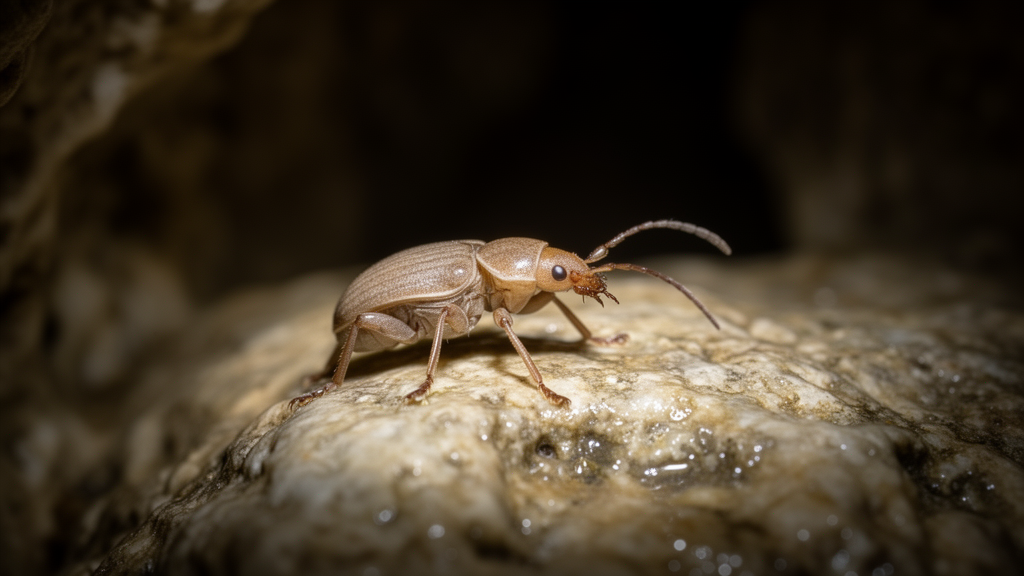
Portuguese subterranean species had significantly smaller eyes than T. fulvus and T. lallemantii in Tukey’s HSD comparisons (adjusted p < 0.0001). Specimens of T. gamae, T. lunai and T. tatai all had eye widths below 0.20 mm, whereas no other analyzed taxon reached that level. Cave-associated T. fulvus also had smaller eyes than surface-dwelling conspecifics, which the authors described as potentially consistent with phenotypic plasticity or incipient troglomorphic evolution.
Male genitalia nevertheless distinguished the analyzed species. T. gamae, T. lunai and T. tatai exhibited consistent differences in the shapes of the aedeagus basal margin and apex, the number of paramere setae and endophallus structures, with no overlap between species. These traits were consistent with earlier taxonomic descriptions. Taxonomic uncertainty nevertheless affects conservation because all four hypogean species in mainland Portugal are listed as Endangered or Critically Endangered in the Red Book of Invertebrates of Mainland Portugal. The authors therefore consider maintaining their current status prudent until additional genetic data improve taxonomic resolution, noting that premature synonymization could weaken protections for species with very restricted ranges, including T. machadoi and the single-cave endemic T. tatai.
Subject of Research: Phylogeny and morphology of three subterranean Trechus ground beetle species in continental Portugal
Article Title: Phylogeny of subterranean ground beetles (genus Trechus , Coleoptera , Carabidae ) from continental Portugal
Article References: Gomes, M. M., Faille, A., & Reboleira, A. S. P. S. (2026). Phylogeny of subterranean ground beetles (genus Trechus, Coleoptera, Carabidae) from continental Portugal. Subterranean Biology, 55, 57-75. https://doi.org/10.3897/subtbiol.55.176926
Image Credits: AI Generated
DOI: 10.3897/subtbiol.55.176926
Keywords: Trechus beetles, subterranean fauna, Portugal, mitochondrial cox1, maximum-likelihood phylogeny, morphometrics, karst habitats, species delimitation, conservation status, Phylogeny, subterranean, ground
News Source: Juliet Wilcox. (October 20, 2026). Mitochondrial phylogeny and morphology leave taxonomy of three subterranean Trechus beetles in Portugal unresolved. Scienmag.