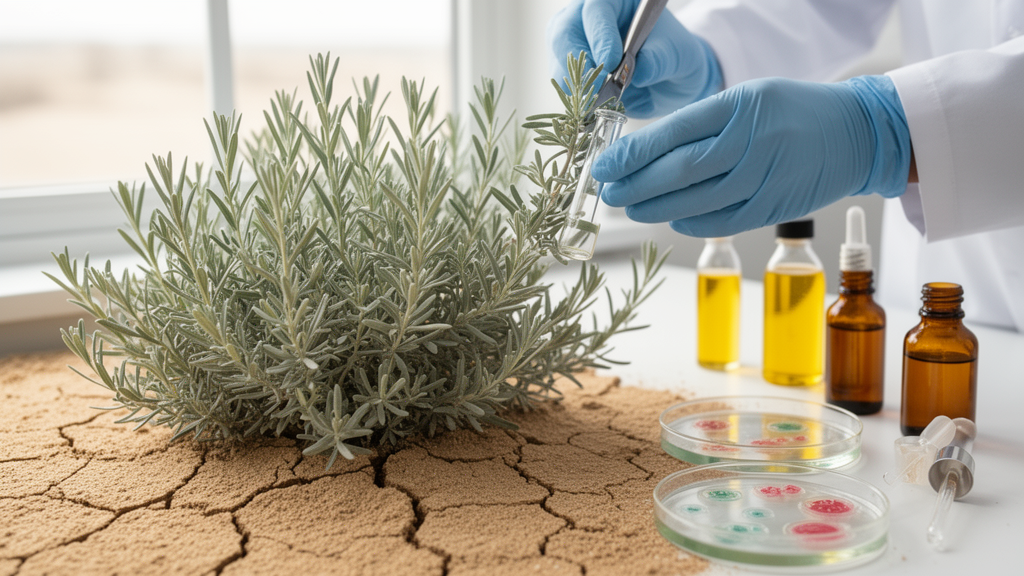
A laboratory study of Arabian boxthorn, Lycium shawii , collected in Iran found that leaf and stem essential oils and ethanol extracts inhibited four standard bacterial strains. These findings were obtained in vitro and do not establish efficacy in people. Researchers collected L. shawii plants in Minab County, Hormozgan province, in autumn 2019 and dried the leaves and stems.
The ethanol extract was prepared by mixing 10 g of powdered plant material with 100 mL of 70% ethanol and shaking the mixture for 24 hours at 21 ± 2 °C in darkness. After filtration and solvent evaporation, the extract was sterilized with ultraviolet light for 20 minutes and stored at 4 °C. Essential oil was obtained by water-distilling 100 g of dried powder for two hours with a Clevenger apparatus.
Gas chromatography-mass spectrometry identified nine compounds in the leaf essential oil and eight in the stem essential oil. The most abundant leaf-oil constituents were hexadecanoic acid at 8.08%, neophytadiene at 7.54% and phytol at 6.11%. In the stem oil, 2-methoxyphenol accounted for 7.01% and 3-(2-naphthyl)-1-butene for 5.15%.
The leaf extract contained nine identified compounds, led by 9,12,15-octadecatrien-1 at 12.29%, phytol at 10.39% and 9,12,15-octadecatrienoic acid at 9.84%. The stem extract also contained nine compounds, including toluene at 17.41%, hexadecanoic acid at 12.06% and cyclotrisiloxane at 10.50%. Antimicrobial assays used the standard strains Escherichia coli PTCC 1789, Pseudomonas aeruginosa PTCC 1791, Staphylococcus aureus PTCC 1826 and A. baumannii PTCC 1919.
In disk-diffusion tests, the preparations produced inhibition zones ranging from 14 to 44 mm. The leaf extract produced the largest zones against E. coli , P. aeruginosa and A. baumannii , at 44, 44 and 41.5 mm, respectively. S. aureus was the least susceptible in this assay: the largest zone against it was 18.5 mm, produced by the leaf extract.
In broth macro-dilution testing, minimum inhibitory concentrations ranged from 3.12 to 25 mg/mL across the preparations and bacteria. All four preparations had an MIC of 6.25 mg/mL against E. coli . The stem extract had an MIC of 6.25 mg/mL against P. aeruginosa , compared with 25 mg/mL for the other preparations.
Leaf essential oil was the most inhibitory against A. baumannii , with an MIC of 3.12 mg/mL, compared with 25 mg/mL for both extracts and stem essential oil. Against S. aureus , leaf essential oil, leaf extract and stem extract each had an MIC of 3.12 mg/mL, while stem essential oil had an MIC of 6.25 mg/mL. Minimum bactericidal concentrations were 12.5 mg/mL for all preparations against E. coli .
Against P. aeruginosa , leaf essential oil and stem essential oil required 50 mg/mL, while leaf extract and stem extract required 12.5 mg/mL. For A. baumannii , leaf essential oil had a minimum bactericidal concentration of 6.25 mg/mL, whereas leaf extract, stem extract and stem essential oil required 50 mg/mL. Against S. aureus , leaf essential oil, leaf extract and stem extract had values of 6.25 mg/mL, compared with 12.5 mg/mL for stem essential oil.
Additional experiments focused on leaf essential oil and A. baumannii . In a 96-well biofilm assay, the oil inhibited biofilm formation at higher tested concentrations. An ethidium-bromide efflux assay indicated that sub-MIC concentrations reduced the rate of dye pumping.
Real-time quantitative PCR was then used to assess expression of bap , abeM and adeB . Following treatment with 1.56 mg/mL leaf essential oil, expression relative to untreated controls was reduced by 25% for bap , 70% for abeM and 65% for adeB . The analyses were repeated three times, and statistical comparisons used one-way analysis of variance followed by Tukey’s test at P ≤ 0.05.
In the cell-culture experiment, researchers exposed MCF-7 cells to leaf essential oil at concentrations from 1.56 to 50 mg/mL for 24 to 72 hours. In the MTT procedure, purple formazan crystals were dissolved in dimethyl sulfoxide, and the measured optical density was directly proportional to the number of living cells. Viability decreased as the essential-oil dose increased.
The reported half-maximal inhibitory concentration was 4.66 µg/mL after 48 hours. This was an assay of one cell line and did not test anticancer effects in animals or people. The study provides chemical and laboratory activity data for plant material collected from one location, and the antimicrobial experiments used standard strains rather than a broader clinical-isolate collection.
The tested preparations also differed in composition, so the results do not identify which individual compound produced each effect. The authors stated that the essential oils and extracts show antimicrobial activity and that leaf essential oil affected the MCF-7 cell line, while further studies are warranted. Their suggestion that the preparations might be used alone or with antibiotics remains a prospect requiring additional research rather than a demonstrated clinical outcome.
Subject of Research: In vitro chemical and biological activity of Lycium shawii extracts and essential oils
Article Title: Detection of compounds in the essential oil and extract of Lycium shawii : Investigation on their anticancer, antimicrobial, antibiofilm and anti-efflux activities
Article References: Torabi, F., Hashemabadi, D., Kaviani, B., & Asadpour, L. (2025). Detection of compounds in the essential oil and extract of Lycium shawii: Investigation on their anticancer, antimicrobial, antibiofilm and anti-efflux activities. Italian Botanist, 20, 23-40. https://doi.org/10.3897/italianbotanist.20.138138
Image Credits: AI Generated
DOI: 10.3897/italianbotanist.20.138138
Keywords: Lycium shawii, essential oils, plant extracts, antibacterial activity, Acinetobacter baumannii, biofilm inhibition, efflux pumps, MCF-7 cells, in vitro study, Detection, compounds, essential
News Source: Drew Townsend. (October 20, 2026). Iranian Lycium shawii lab study reports antibacterial, anti-biofilm and MCF-7 cell-line effects. Scienmag.