It is a sponge. Cenotes are the hydrogeological heritage of the Yucatan Peninsula. They form when rainwater percolates through calcareous soil and dissolves the limestone below, eventually collapsing the roofs of underground cavities to create circular depressions connected to vast aquifers.
Where fresh and marine waters meet, chemical and biological stratification generates reservoirs of biodiversity with high endemism, housing specialized communities such as stygobiont crustaceans and fish adapted to low light and low oxygen. Yet while copepods, remipedes, ostracods, amphipods, and cave fish have been documented in detail, the sponges of Phylum Porifera have remained almost entirely unexplored for over five decades. The historical record is thin.
In 1936, Old documented Spongilla lacustris and Ephydatia crateriformis — now recognized as Radiospongilla crateriformis — in Yucatan cenotes. In 1968, Penney and Racek described a new species, Spongilla cenota, from a different cenote. Poirrier later confirmed that the material identified as S. lacustris was actually S. cenota, so all specimens of S. lacustris in Yucatan cenotes were reassigned.
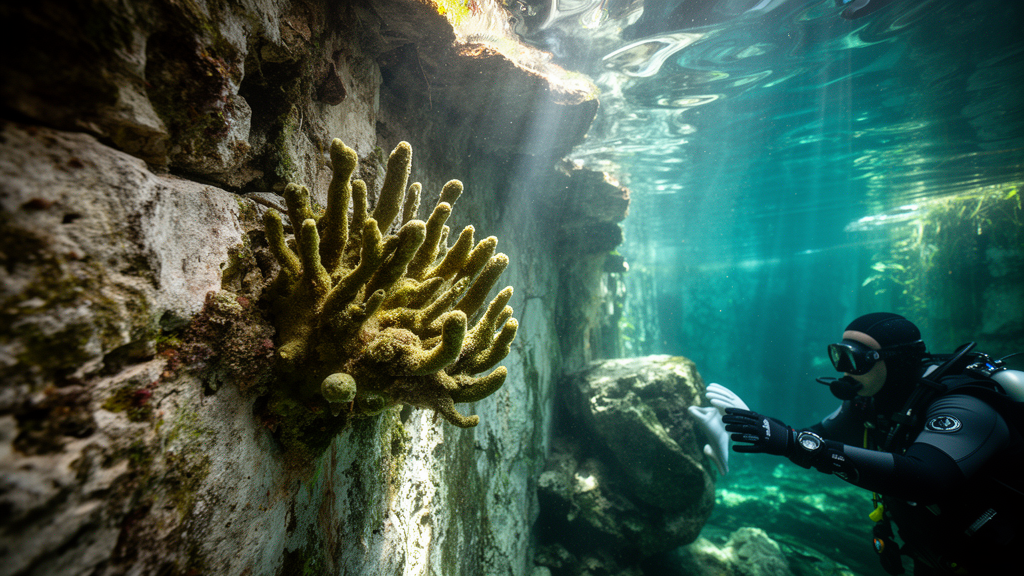
Since then, the biodiversity of freshwater sponges in these ecosystems has remained largely unexplored, with only two species ever reported. To close this gap, researchers led SCUBA surveys in two open-type cenotes. Sabak-Ha, in the municipality of Sacalum, is 60 meters long and 30 meters wide with a recorded depth of 120 meters — though its true depth is unknown.
From the surface to about 15 meters, a layer of organic matter creates extremely low visibility, and it is here, attached to the walls, that the sponges were found. No sponges were detected in the crystal-clear waters below. Suhem, in the municipality of Pixya, ranges from 4 to around 35 meters deep and is a popular tourist site.
Specimens were deposited in the Colección Nacional del Phylum Porifera – Gerardo Green at UNAM's Instituto de Ciencias del Mar y Limnología. The sponges displayed remarkable plasticity. In Sabak-Ha, they formed massive encrusting structures with prominent mounded and discoidal growth forms, appearing greenish-yellow in illuminated areas and dull pinkish in shaded zones — a color shift likely linked to photosynthetic symbionts.
In Suhem, they were diminutive, attenuated, and irregularly encrusting. The skeleton consists of paucispicular tracts of 2 to 5 intersecting oxea spicules forming an alveolate structure with rounded meshes, with generally scarce but present spongin. Under light and scanning electron microscopy, the spicule architecture told a precise story.
Smooth oxeas occurred in two size categories: the dominant type I measured 327.13 micrometers on average (243.28–373.53 micrometers), while the shorter, thinner type II averaged 172.55 micrometers. Spiny oxeas, found exclusively in one Sabak-Ha specimen, averaged 110.71 micrometers. Gemmuloscleres consisted of birotules with spined shafts and rotules of nearly identical morphology at both extremities, averaging 46.76 micrometers in length with rotule diameters of 23.41 micrometers.
Gemmules, observed only in Suhem specimens, were hemispherical and measured about 200.56 micrometers in diameter. Molecular analysis sealed the identification. DNA was extracted from ethanol-preserved samples and amplified with primers targeting the ITS1, 5.8S, and ITS2 regions plus partial 18S and 28S sequences.
BLAST searches against GenBank revealed that sequences from both cenotes were identical in nucleotide composition and differed by less than 3 percent from reference sequences of E. fluviatilis. Phylogenetic reconstruction using Maximum Likelihood and Bayesian Inference yielded congruent topologies, placing the cenote sponges in a well-supported monophyletic clade with E. fluviatilis, sister to clades of Heterorotula and Racekiela. Sequences are deposited in GenBank under accession numbers PX492551, PX492552, and PX492553.
Notably, the birotules from Sabak-Ha were longer (44.65–72.96 micrometers) than the typical range for E. fluviatilis (26–30 micrometers), while those from Suhem fell closer to the expected range (32.66–43.15 micrometers). This interpopulation variation suggests that site-specific environmental conditions within each cenote influence spicule formation and growth. Spine development on birotule shafts has been linked to elevated chloride concentrations and high alkalinity — conditions characteristic of cenote ecosystems — indicating that the spination reflects environmentally induced variation rather than species-level diagnostic characters.
With this discovery, the number of known cenote sponge species has risen to three, each from a different genus, and two new cenotes have been added to existing records, bringing the total to six cenote ecosystems with freshwater sponge populations. Given the high number of cenotes across the Yucatan Peninsula, further undiscovered species are likely. Notably, most of the cenotes where sponges have been reported lie outside the Reserva Estatal Geohidrológica Anillo de Cenotes, a Natural Protected Area established in 2013.
The study underscores the importance of integrating molecular and morphological data for accurate species identification, particularly in a genus where species delimitation has historically relied on the presence or absence of spines. Freshwater sponge research can illuminate water chemistry, illustrate the evolutionary history of ecosystems, and offer resources for biotechnological applications. As sponges have been overlooked in cenote biodiversity inventories for over 40 years, fundamental aspects of their ecology and biology in these unique karst environments remain unknown — creating valuable opportunities for future research into the environmental conditions that determine sponge presence, their spatiotemporal distribution across the cenote network, and their associated microbiomes.
Subject of Research: Discovery of the freshwater sponge Ephydatia fluviatilis in Yucatan cenote ecosystems using morphological and molecular analyses
Article Title: New discovery of the freshwater sponge Ephydatia fluviatilis (Linnaeus, 1759) in cenote ecosystems of Yucatan, Mexico: Morphological and molecular insights
Article References: Hernández-Solis, P. A., Gómez-Bretón, V. E., de la Cruz-Fernández, D. A., & Simões, N. (2026). New discovery of the freshwater sponge Ephydatia fluviatilis (Linnaeus, 1759) in cenote ecosystems of Yucatan, Mexico: Morphological and molecular insights. Subterranean Biology, 55, 109-136. https://doi.org/10.3897/subtbiol.55.177524
Image Credits: AI Generated
DOI: 10.3897/subtbiol.55.177524
Keywords: freshwater sponges, cenotes, Yucatan, Ephydatia fluviatilis, karst ecosystems, Porifera, taxonomy, DNA barcoding, Subterranean Biology, Mexico biodiversity, discovery, freshwater
News Source: Margaret Porter. (October 20, 2026). Freshwater Sponge Rediscovered in Yucatan Cenotes After Nearly 90 Years. Scienmag.