A three-year infrared camera-trap survey documented 12 mammal species in Xianxialing Nature Reserve in Zhejiang Province, China, and characterized the daily and seasonal activity rhythms of nine threatened species. The study was conducted from January 2021 to November 2023 and provides a baseline for understanding the reserve’s mammalian community and the temporal and elevational patterns associated with its threatened wildlife.
Xianxialing Nature Reserve extends between 28°15’47″N and 28°27’40″N latitude and 118°20’14″E and 118°40’50″E longitude. The area has an average temperature of 15.0°C, annual precipitation of 1650–2200 mm and an average altitude of 1,000 m. Its complex topography contributes to four distinct seasons and pronounced local variation in microclimatic conditions.
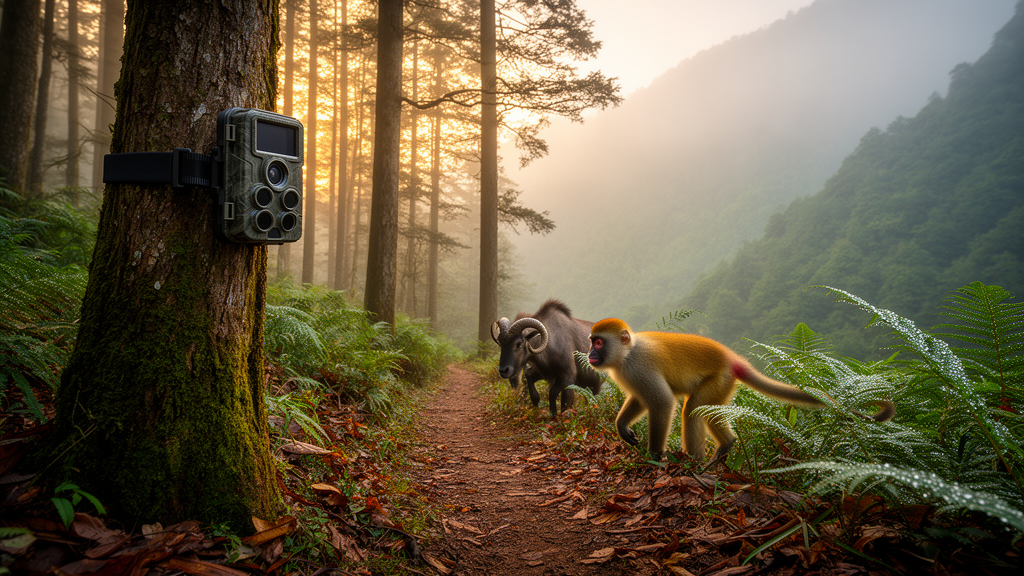
For the observational study, researchers deployed 97 infrared-triggered cameras across the reserve between January 2021 and November 2023. Camera stations were preferentially positioned in open understorey near water sources and at locations selected using visible signs of animals, including trails, faeces, nests, foraging marks, scratches and feathers. The cameras were accompanied by metadata recording coordinates, station identification, timestamps, elevation and habitat type.
The survey constituted the reserve’s first systematic camera-trap assessment of threatened mammal activity rhythms since its establishment, according to the study. The results recorded 12 mammal species, including the nationally protected Tibetan Macaque, Rhesus Macaque, Black Muntjac and Chinese Serow. A rarefaction curve indicated sufficient sampling effort, while Reeves’ Muntjac dominated the detected small- to medium-sized ground-dwelling mammals, a pattern consistent with findings from other subtropical reserves in China.
Activity rhythms varied among species and seasons. Chinese Ferret-badger, Chinese Hare and Masked Palm Civet showed predominantly nocturnal activity, consistent with the nocturnal foraging niches described for those species. Reeves’ Muntjac and Black Muntjac displayed bimodal, crepuscular patterns, with activity concentrated around dawn and dusk. These patterns were interpreted as possible forms of temporal niche optimisation that allow animals to use favourable light and temperature conditions while reducing exposure to potential daytime risks.
Hog Badger showed a pronounced midday activity peak during winter. The authors associated this pattern with an adaptive response to limited winter food availability, suggesting that increased daytime activity may help meet energy demands. This interpretation remains a proposed explanation rather than a result directly tested by the camera-trap observations, and the supplied account does not report numerical estimates of activity intensity or statistical uncertainty.
Seasonal variation in elevation was also observed for Masked Palm Civet, which preferred higher-altitude habitats in spring and summer and shifted toward lower areas in autumn and winter. The authors described this “upward in summer, downward in winter” pattern as potentially associated with seasonal temperature variation. By contrast, Hog Badger, Black Muntjac, Chinese Hare and Chinese Serow were reported at high elevations throughout the year, indicating differing altitudinal strategies among species sharing the landscape.
These divergent strategies may contribute to resource partitioning across altitudinal zones and thereby reduce interspecific competition, although the camera-trap study did not establish that mechanism causally. Its findings are observational and are based on detections from 97 camera stations rather than a census of every mammal in the reserve. The available account also does not provide species-level detection totals, Relative Abundance Index values or the complete statistical results, so the dataset is best interpreted as a baseline characterization rather than evidence of population trends.
Overall, the monitoring identified substantial mammalian diversity in Xianxialing Nature Reserve and showed clear interspecific and seasonal differences in daily activity, together with contrasting elevational patterns. The authors describe the dataset as a baseline for ecological research, monitoring and conservation management. They also call for later studies to integrate high-resolution vegetation maps, quantified anthropogenic-disturbance data and climate data to examine the ecological mechanisms behind the observed patterns.
Subject of Research: Camera-trap monitoring of mammalian diversity, daily activity rhythms and seasonal elevational patterns in Xianxialing Nature Reserve.
Article Title: Long-term camera trap monitoring of mammalian diversity and activity rhythms of threatened species in Xianxialing Nature Reserve, Zhejiang Province, China
Article References: Yu, Z.-C., Wang, X.-Y., Gao, C., Wang, K., Wang, M.-F., Gao, B.-W., Zhao, W., Wu, S.-H., Xu, Z.-P., Zhou, X., Xu, L.-L., Yu, J., Nneji, L., Chen, J.-M., Jin, W., & Lee, P. S. (2026). Long-term camera trap monitoring of mammalian diversity and activity rhythms of threatened species in Xianxialing Nature Reserve, Zhejiang Province, China. Biodiversity Data Journal, 14, Article e208779. https://doi.org/10.3897/bdj.14.e208779
Image Credits: AI Generated
Keywords: camera trapping, mammal diversity, threatened species, activity rhythms, Xianxialing Nature Reserve, Zhejiang Province, wildlife monitoring, altitudinal migration, seasonal behaviour, Long-term, camera, trap
News Source: Margaret Porter. (October 20, 2026). Long-term camera trap monitoring of mammalian diversity and activity rhythms of threatened species in Xianxialing Nature Reserve, Zhejiang Province, China. Scienmag.