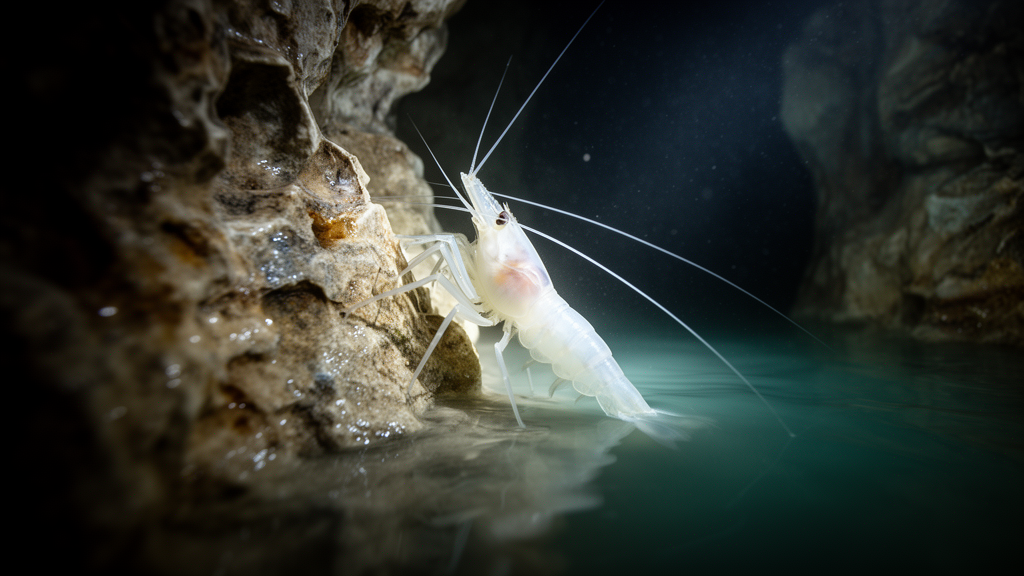
A morphological and molecular taxonomic study describes Caridina tashanica sp. nov., a depigmented shrimp with strongly reduced, unpigmented eyes collected from a hydrogen-sulphide-rich cave pool in the Zagros Mountains of southwestern Iran. The researchers identify the species as the first exclusively subterranean atyid shrimp reported from Iran and the first Caridina recorded from sulphidic groundwater.
The type locality is Tashan Cave, part of the Tashan-Chah Kabootari cave system in Khuzestan Province. The natural limestone cave is at 30°52′10″N, 50°10′01″E and 539 m above sea level. It contains several cave pools supplied with groundwater enriched in hydrogen sulphide, while nearby wells and springs are fed by the same sulphidic aquifer. The new species is currently known only from Tashan Cave, where it was found exclusively in one sulphidic pool, possibly in close association with bacterial mats.
Specimens were collected with a hand net during three field trips, on 27 August 2016, 16 October 2017 and 17 March 2018. The material included a male holotype with a carapace length of 3.19 mm, three paratypes and additional males and females, including two ovigerous females. The researchers examined 73 metric and 17 meristic characters using stereomicroscopy and prepared vector drawings from microphotographs. Diagnostic features included an extremely long, upward-curving rostrum with numerous teeth, short eyestalks without pigmentation, a smooth and depigmented carapace, and characteristic setation on the telson, uropods, pereiopods and male pleopods.
The diagnosis records rostral dentition of 13–19+3–5/9–22, seven to 10 spiniform setae on the uropodal diaeresis, four to six pairs of dorsomarginal spiniform setae on the telson and a comb-like row of 17–27 spiniform setae on the dactylus of the fifth pereiopod. The complete absence of body and eye pigmentation was interpreted as troglomorphy, a set of changes associated with subterranean life. The animals also differed from Middle Eastern surface-dwelling congeners in elongated walking legs, sparse setation on the first male pleopod endopodite and reduced retinacular hooks.
The molecular analysis used two mitochondrial regions, cytochrome c oxidase subunit I and 16S rDNA, together with the nuclear histone H3 gene. The concatenated dataset was 1,533 base pairs long. Phylogenetic analyses included 18 Caridina specimens from putatively related regional lineages in Africa, the Middle East, India and Sri Lanka, with Xiphocaris elongata as the outgroup. Bayesian inference and maximum-likelihood analysis produced the same topology and placed C. tashanica in a well-supported clade with the epigean C. shahrazadae, C. fossarum, C. enkii and C. chauhani, although the positions of some members of this broader group were not well supported.
C. tashanica was recovered as the sister of C. shahrazadae. The Kimura two-parameter distance was 15.1% for COI between C. tashanica and C. fossarum, and 3.7% for 16S rDNA between C. tashanica and C. shahrazadae. The researchers did not recover Iranian Caridina as monophyletic. They cautioned that the analysis was designed to assess relationships among selected Middle Eastern taxa rather than revise the highly diverse genus, whose broader relationships would require a wider taxonomic and molecular framework. They also did not assess whether the new species should be related to Puteonator iraqiensis, a morphologically similar monotypic genus from nearby Iraq.
Two ovigerous females carried 12–17 oval white eggs each, measuring 0.97–1.36 × 0.73–0.97 mm and having calculated volumes of 2.68–5.13 mm³. No eyes were visible in either batch of eggs. The authors noted that Caridina species with relatively large eggs generally lack a planktonic larval stage and are associated with landlocked freshwater habitats. They also observed that the smallest specimens in their sample might have been subadults, although a larger sample would be needed to verify that possibility.
The authors suggested that the unusually long rostrum could be associated with ecological or behavioural pressures and noted that the cave fish Garra tashanensis occurs in the same habitat, but the study did not establish predation or another causal mechanism for the trait. Sulphidic cave systems can depend primarily on microbial primary production, and some other subterranean atyid shrimps have been associated with sulphide-oxidising bacteria. The authors proposed that Tashan Cave may support a similar chemoautotrophic ecosystem, but this study did not analyse its food web or demonstrate what the shrimp consumes.
The study was bounded by its restricted geographic sampling and its use of selected regional taxa rather than a genus-wide molecular analysis. Only two ovigerous females were examined, and the available specimens were insufficient to verify whether the smallest individuals were subadults. The researchers stated that the incompletely studied cave system may contain additional undescribed taxa and that pollutants and human visits threaten its sulphidic ecosystem.
Subject of Research: Taxonomic description and molecular phylogeny of a sulphidic cave shrimp from southwestern Iran
Article Title: Caridina tashanica sp. nov., a new cave shrimp species ( Decapoda , Atyidae ) from sulphidic water in southwestern Iran
Article References: Jugovic, J., Malek Hosseini, M.-J., Fatemi, Y., Flot, J.-F., Kuntner, M., & Zakšek, V. (2026). Caridina tashanica sp. nov., a new cave shrimp species (Decapoda, Atyidae) from sulphidic water in southwestern Iran. Subterranean Biology, 55, 137-160. https://doi.org/10.3897/subtbiol.55.184889
Image Credits: AI Generated
DOI: 10.3897/subtbiol.55.184889
Keywords: Caridina tashanica, cave shrimp, Atyidae, Iran, karst, sulphidic groundwater, taxonomy, phylogenetics, troglomorphy, Zagros Mountains, Caridina, tashanica
News Source: Gavin Prescott. (October 20, 2026). Morphological and molecular study describes sulphidic cave shrimp from southwestern Iran. Scienmag.