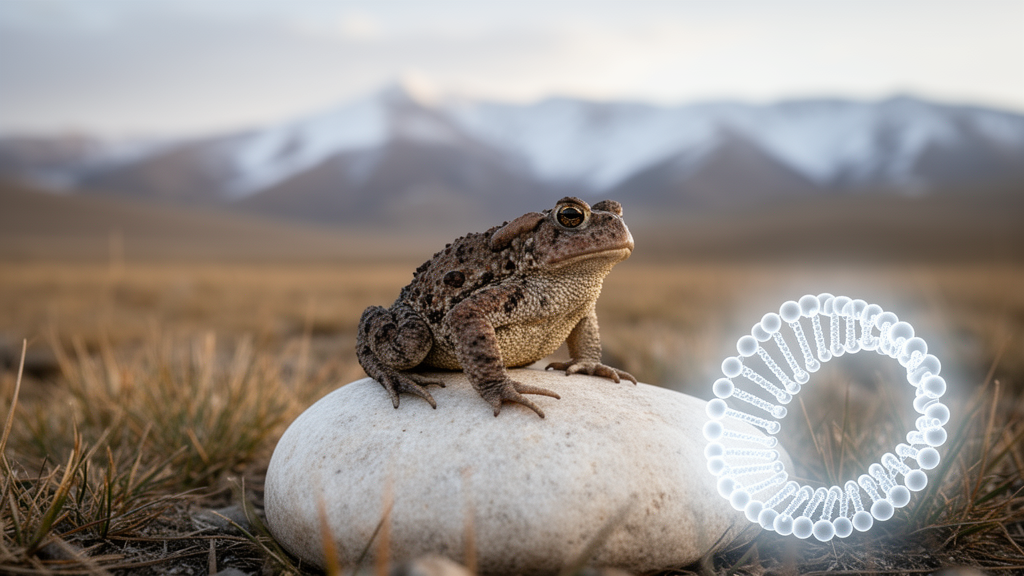
The complete mitochondrial genome of the frog Scutiger boulengeri is 49,991 base pairs long and contains an exceptionally expanded non-coding region, according to a genome-sequencing study of a single adult female specimen collected in Qinghai Province, China. The research combined Illumina short reads with Oxford Nanopore long reads to assemble the genome and used mitochondrial sequences to examine its structure, selection patterns, phylogenetic position and estimated divergence times.
The assembled mitochondrial DNA is a circular, double-stranded molecule containing 37 genes: 13 protein-coding genes, 22 transfer RNA genes and two ribosomal RNA genes. Most protein-coding regions and ribosomal RNA genes are conserved in position, but S. boulengeri has a 22,418-base-pair non-coding region encompassing the putative mitochondrial control region. That segment is far larger than the corresponding regions reported for two close relatives, S. liupanensis at 1,588 base pairs and S. ningshanensis at 1,480 base pairs.
The specimen was collected in August 2024 from Yaertang Township in Guoluo Tibetan Autonomous Prefecture at approximately 3,335 metres above sea level and was deposited as voucher SB250820. Illumina sequencing produced 24,255,804 clean paired-end reads totaling 7.33 gigabases, while Oxford Nanopore sequencing produced 858,550 reads with a mean length of 9,255 base pairs and a read N50 of 13,009 base pairs. Following assembly, error correction and polishing, 57,059 mitochondrial reads mapped to the final sequence at an average depth of 368.03-fold.
Most of the genome’s unusual length is attributable to non-coding sequence rather than expansion of protein-coding, transfer RNA or ribosomal RNA genes. In addition to the 22,418-base-pair putative control-region segment, the genome has 16 intergenic spacers totaling 11,239 base pairs. The largest spacer, between trnW and trnF, is 7,120 base pairs long. The study also identified translocations involving trnF and trnQ, while the protein-coding and ribosomal RNA genes remained highly conserved among the three compared Scutiger species.
The expanded region has an A+T content of 74.70%, compared with 69.77% for the complete genome. It contains multiple tandem-repeat units, which the authors identify as a likely contributor to its expansion. The genome as a whole has an A+T content of 69.77%, with nucleotide frequencies of T at 38.07%, A at 31.69%, C at 18.75% and G at 11.49%. The observed structural pattern is consistent with a concentration of variation in the control region and nearby tRNA-associated regions, although the study did not directly test the processes that produced the expansion.
Selection analysis estimated nonsynonymous-to-synonymous substitution ratios under the Yang–Nielsen model for all 13 protein-coding genes. Every Ka/Ks ratio was below 1, with atp8 having the highest value and the other genes showing lower values. The authors interpreted this pattern as evidence that the coding regions as a whole are under purifying selection, although the intensity of constraint differs among genes. Codon-usage analysis also found that frequently used codons generally end in A or T, a pattern associated with the genome’s AT-rich composition.
Phylogenetic analyses produced broadly congruent maximum-likelihood and Bayesian trees, but the cytochrome b dataset did not recover all sampled S. boulengeri sequences as a mutually monophyletic group. Instead, several sequences clustered close to species including S. liupanensis and S. jiulongensis. The broader analysis of concatenated sequences from 13 mitochondrial protein-coding genes, covering 30 taxa and 11,295 sites, recovered the major Megophryidae genera as distinct, well-supported clades. Within that dataset, S. boulengeri and S. liupanensis were sister groups, supported by a Bayesian posterior probability of 1.00 and a maximum-likelihood bootstrap value of 99, and the pair clustered with S. ningshanensis.
Bayesian divergence-time estimates based on the 13-protein-coding-gene matrix placed the divergence between S. ningshanensis and the clade containing S. boulengeri and S. liupanensis at approximately 5.96 million years ago, with a 95% highest posterior density interval of 3.29–8.87 million years. The estimated divergence between S. boulengeri and S. liupanensis was approximately 2.10 million years ago, with a 95% highest posterior density interval of 1.11–3.32 million years. Deeper estimated divergences were approximately 29.97 million years ago between Leptobrachella and the clade containing Leptobrachium, Oreolalax and Scutiger, and 18.73 million years ago between Leptobrachium and the Oreolalax–Scutiger clade.
These dates are model-based estimates rather than direct observations of evolutionary events, and the authors note several limitations. The analysis used a single mitochondrial genome from one sampled individual, which cannot represent the full geographic or genetic diversity of S. boulengeri; previous work has identified multiple lineages within the species. Mitochondrial introgression, incomplete lineage sorting and maternal inheritance can also make mitochondrial trees differ from species histories. The authors therefore present the timing estimates as preliminary references and identify broader population sampling, nuclear genomic evidence and additional fossil calibrations as necessary for resolving the genus’s complex evolutionary relationships.
Subject of Research: Comparative mitochondrial genomics and phylogeny of Scutiger boulengeri
Article Title: Mitochondrial genome of Scutiger boulengeri ( Anura , Megophryidae ) reveals an exceptionally expanded non-coding region and its phylogenetic position within Megophryidae
Article References: Wang, W.-T., Zhang, F.-H., Wang, R., & Zhang, X.-Z. (2026). Mitochondrial genome of Scutiger boulengeri (Anura, Megophryidae) reveals an exceptionally expanded non-coding region and its phylogenetic position within Megophryidae. ZooKeys, 1293, 17-44. https://doi.org/10.3897/zookeys.1293.203467
Image Credits: AI Generated
DOI: 10.3897/zookeys.1293.203467
Keywords: Scutiger boulengeri, mitochondrial genome, non-coding region, Megophryidae, phylogenetics, divergence timing, hybrid sequencing, purifying selection, Mitochondrial, genome, Scutiger, boulengeri
News Source: Juliet Wilcox. (October 20, 2026). Scutiger boulengeri mitochondrial genome expands to 49,991 bp and supports a close relationship with S. liupanensis. Scienmag.