In a new study published in Subterranean Biology, researchers report four live populations discovered in four different caves of the Département Pyrénées-Atlantiques in southwestern France, and subject them to an integrative taxonomic analysis combining fresh DNA sequence data with cutting-edge 3D X-ray microscopic imagery. The work confirms, for the first time in France, that live populations of this strictly Pyrenean species persist in several caves, while revealing a surprisingly wide variability in the shells of what is genetically a single species. Their known range encompasses the Cantabrian-Pyrenean region of northern Spain and the Pyrénées-Atlantiques in southwestern France, and finding live individuals is described as a serendipitous and challenging endeavor.
Most of the genus's diversity has been described from caves explored on the Spanish, Cantabrian-Pyrenean side of its range, but only rarely from the French side of the western Pyrenees. The species I. bellesi, first described in 1973, is considered uniquely Pyrenean and differentiates morphologically from its eight known Basque-Cantabrian congeners, including I. schaufussi, I. biscaiense, I. vasconicum, I. zaldivarae, I. percostulatum, I. gittenbergeri, I. praetermissum and I. costulatum, as well as the considered fossil I. goliath. In contrast to its eastern Alpine-Dinaric sister genus Zospeum, multiple species sympatry is not unusual for Iberozospeum.
Although empty shells of I. bellesi have frequently been found in southwestern French caves, only two live populations had been recorded so far before this study. Enhanced exploration in April 2025 contributed four more to the tally, of which only one, Lezea cave, was previously known for which DNA sequence data existed from the French side of the Franco-Spanish border region. In the most current phylogenetic study of the genus, only two populations from two proximate non-contiguous cave systems, one from Lexotoa cave in Spain, roughly 100 meters eastwards from the Franco-Spanish border, and Lezea cave in Pyrénées-Atlantiques, less than 1 kilometer from Lexotoa, were assigned to the I. bellesi clade.
That clade differentiated genetically from the biscaiense-zaldivarae clade but did not differentiate from other species using the selected genetic markers, COI, 16S, H3 and 5.8 S rRNA plus ITS2, leading researchers to suggest that I. bellesi likely constitutes a young radiation. Owing to the scarcity of data from caves on the French side of the Pyrenean chain and the paucity of DNA sequence data for I. bellesi, new biospeleological expeditions were conducted in March 2024 and April 2025 in karst caves of the Sare-Aïnhoa sector of the Franco-Spanish border region and its foothills. The Sare-Aïnhoa karst region lies about fifteen kilometers from the Atlantic Ocean and spans only a few square kilometers into both France and Spain.
In this work, three new populations sampled in March 2024 were assessed using DNA sequence data in sync with the earlier phylogenetic reconstruction, and the new sequences were added to the existing dataset. A total of seven individuals were imaged, measured and molecularly processed, with images and DNA extracts housed in the Natural History Museum Bern in Switzerland. Live specimens were preserved initially in 96 percent ethanol and later transferred to an 85 percent ethanol solution.
Before DNA extraction, every specimen was imaged under sterile conditions from frontal, lateral and apical view. Total DNA extraction used a commercial tissue kit in combination with a QIAcube extraction robot, with each specimen incubated for roughly four hours at 56 degrees Celsius. Interestingly, though successfully sequenced, the DNA content of the individuals from Burgosa cave was somehow too low, so sequences of these specimens could not be included in the phylogenetic study.
The maximum likelihood analysis revealed that the French populations cluster in the I. bellesi lineage. The only animal delivering the complete dataset, specimen NMBE_0585639 from Estérençuby cave ES102 in the Vallée d'Estérenguibel, integrated into the cladogram shown by the earlier study. Remarkably, the other six specimens with an incomplete marker set always clustered in a polytomy including the Spanish I. bellesi populations, for which reason the species identification is considered reliable.
Addition of the new dataset resulted in a new arrangement of the lineages: the I. bellesi and the I. zaldivarae plus I. biscaiense subclades are united, although only weakly supported, taking over the sister position with a support value above 92. This shows that the current state of knowledge is still rather incomplete and that more precise phylogenetic relationships can be expected when applying other methods and markers. Most specimens were scanned with an XRadia MicroXCT-200 imaging system generating 1600 projection images over 360 degrees of rotation for roughly 90 minutes at a voxel size of about 2 micrometers, while the paratype shell of I. bellesi was scanned separately using a NeoScan N80 system at a voxel size of 1.8 micrometers.
The 16-bit image datasets were cropped, histogram adjusted and converted to 8-bit, and further 3D graphical procedures were conducted with specialized volume rendering software. An initial segmentation step involving the watershed function was used to digitally remove impurities from the shells, followed by manual segmentation to discriminate external and internal shell structures. Shell measurements were made on the Micro-CT images, capturing shell height, shell width, aperture height, aperture width, height of last whorl and spire angle for each specimen.
The measurement data reveal that these shells, while minute, demonstrate considerable variation in shape and proportions. Shell height ranges narrowly from 1.17 to 1.60 millimeters and shell width from 0.85 to 1.02 millimeters, yet the ratio of shell height to shell width varies from 1.28 to 1.63, indicating the presence of both relatively squat and markedly elongate shell forms. The shell from cave ES102 demonstrates the stoutest form of the study, most comparable to the paratype material from Cueva de Aso in Huesca, Spain, while an individual from Urio gaina presents a much slenderer shell.
Aperture dimensions are consistent, with the aperture height to width ratio frequently close to 1, indicating that the aperture scales proportionally with shell size and is roughly oval to rounded in shape. The height of the last whorl consistently makes up more than half the total shell height, reflecting a compact spire dominated by the body whorl. Of all measurements, the spire angle presents the greatest variation, ranging from 51.84 to 70.93 degrees, with a low angle reflecting a tall, narrow and pointed spire and a high angle defining a short, wide and blunt spire, and an apparent negative correlation between shell slenderness and spire angle.
The Micro-CT image data reveal minimal variation in morphological characters such as teleoconch sculpture, peristome thickness, columellar configuration, protoconch and whorl configuration, and peristome rim alignment, but noticeable differentiation in aperture shape from ovate to roundish-ovate to round, with the aperture alignment either oblique to the shell axis or vertically aligned to it. The configuration of the parietal callus is quite variable in thickness and extent, and the shells vary in the configuration of the last quarter coiling of the body whorl in relationship to the umbilical zone. In the paratype shell, the end of the final whorl is very short and compactly formed, aligning straight next to a narrow umbilical depression, while one shell from Turziloa cave shows this part extending to the right side of the body whorl, forming a large umbilical depression.
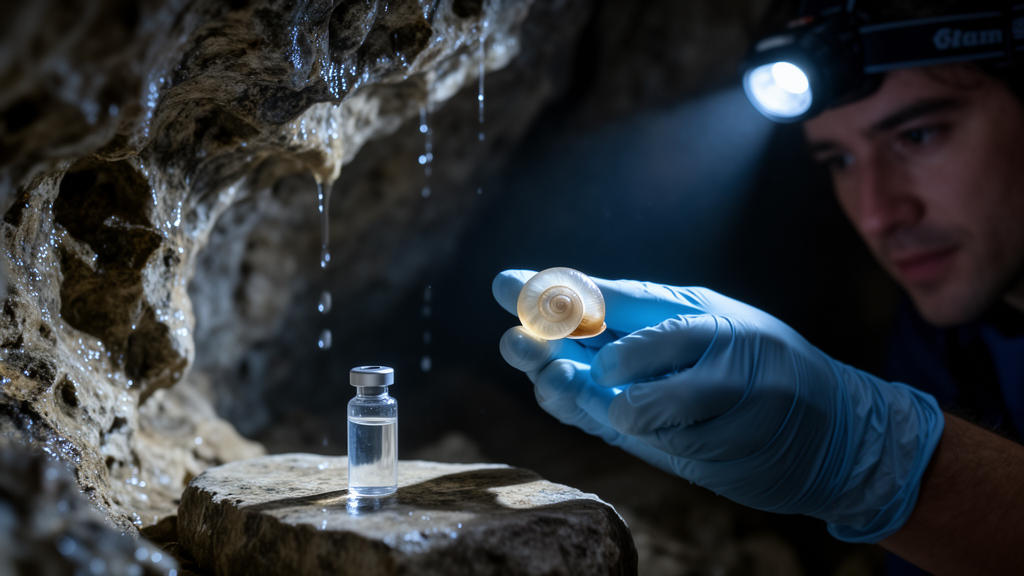
Contrasting conditions are observable even between shells collected in the same cavities of the same caves, which may well reflect different generations of I. bellesi impacted by different environmental influences at different times. Ecologically, living Iberozospeum were found in areas typically characterized by moist to moderately humid walls, which occasionally exhibit signs of carbonated efflorescence. The runoff from these walls fosters the regular accumulation of organic mud where the snails were found on cave walls, in rock crevices and at the base of walls above the interface to the ground.
These sites are characterized by their relative protection from air currents, serving as microhabitats that remain unexposed and prone to continuous, consistent environmental conditions over time. The sampled caves themselves are geologically diverse, developed in Lower Cretaceous limestone, Cretaceous sedimentary layers resting on a Paleozoic base, and Carboniferous limestone, with entrances charted at altitudes ranging from 300 to 650 meters and topography ranging from simple cavities to complex networks. Turziloa cave, for example, is distinguished by an active subterranean river, with the snails found toward the end of the system at the junction of active flow and a fossil gallery, in areas exposed to spray from water flows.
The study concludes that I. bellesi demonstrates a genetically reliable but ecophenotypically variable species in multiple caves of the Pyrénées-Atlantiques, and that neither the size, the altitude nor the structure of the karst network appear to be determining factors for the presence of living Iberozospeum in the western Pyrenees, while studies are in progress to better characterize the ecological parameters that determine the distribution and habitat requirements of this troglobiont species.
Subject of Research: Integrative taxonomic study of the cave snail Iberozospeum bellesi in French Pyrenean caves
Article Title: New exploration, DNA sequence data and 3D X-ray microscopy reveal prevalence of live populations and wide variability in shells of Iberozospeum bellesi in caves of the Pyrénées-Atlantiques, France ( Gastropoda , Ellobioidea , Ellobiidae )
Article References: Jochum, A., Kneubühler, J., Neubert, E., Chauvin, J., Gansoinat, S., Wackenheim, Q., Michalik, P., & Ruthensteiner, B. (2026). New exploration, DNA sequence data and 3D X-ray microscopy reveal prevalence of live populations and wide variability in shells of Iberozospeum bellesi in caves of the Pyrénées-Atlantiques, France (Gastropoda, Ellobioidea, Ellobiidae). Subterranean Biology, 55, 161-186. https://doi.org/10.3897/subtbiol.55.188007
Image Credits: AI Generated
DOI: 10.3897/subtbiol.55.188007
Keywords: Iberozospeum bellesi, cave snails, troglobionts, Pyrénées-Atlantiques, DNA barcoding, Micro-CT, integrative taxonomy, subterranean biology, Pyrenees, shell morphology, karst caves, biodiversity
News Source: Margaret Porter. (October 20, 2026). DNA and 3D X-ray scans reveal thriving cave snail populations in the French Pyrenees. Scienmag.