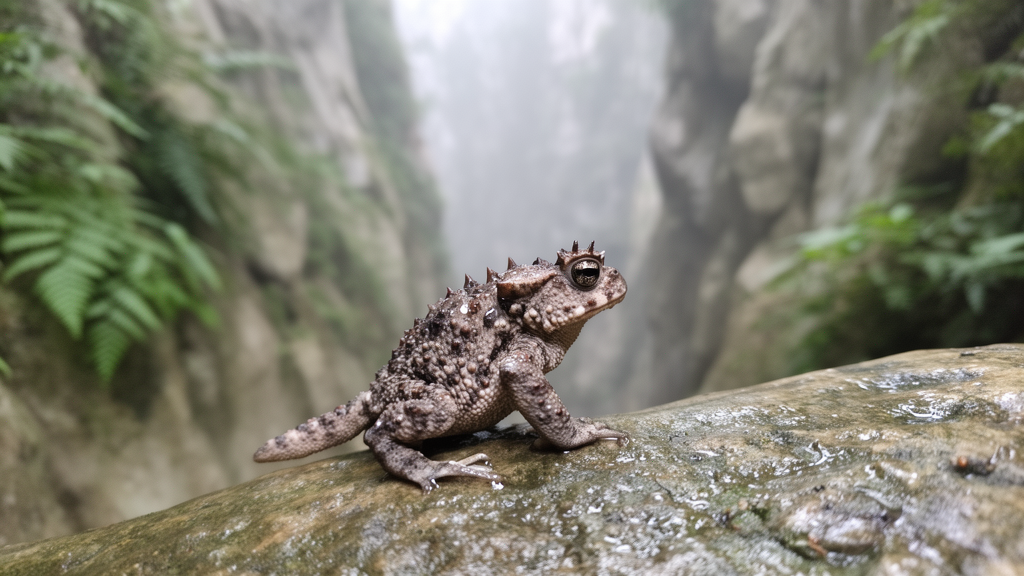
Deep in the montane forests of Tianlin County, in north-western Guangxi Zhuang Autonomous Region, China, a small brown frog with horn-like tubercles above its eyes has turned out to be a species entirely new to science. Researchers conducting an amphibian biodiversity survey in the region collected eight specimens of Asian horned toads from Langping Town at roughly 1,495 metres above sea level, and a combination of genetic sequencing and detailed morphological analysis has now confirmed that these animals belong to an undescribed species. The discovery adds to a genus that is expanding at a remarkable pace.
Boulenophrys , a group of frogs within the subfamily Megophryinae, currently comprises 81 recognised species distributed from eastern and central China across south-eastern Asia to the Sunda Shelf islands, the Philippines, and westwards to Nepal and north-eastern India. Fifty-seven of those species have been described in the last decade alone, and as many as ten new species were published in 2025 by various research groups. The path to the new species began in June 2023, when the survey team collected seven adult males and one adult female from a mountain stream surrounded by evergreen broadleaved forest.
The specimens were euthanised using isoflurane, fixed in 10 percent buffered formalin, and later transferred to 75 percent ethanol for long-term preservation. Muscle tissue for molecular work was stored in 95 percent ethanol at minus 20 degrees Celsius. All voucher specimens were deposited at the Moutai Institute in Guizhou Province, and the survey and handling procedures were approved by the Forestry Bureau of Tianlin County and the Laboratory Animal Ethics Committee of the Moutai Institute.
To determine where the mystery toads sat on the amphibian family tree, the researchers extracted DNA from muscle tissue and amplified two mitochondrial markers: a 525 base pair fragment of the 16S rRNA gene and a 558 base pair fragment of the cytochrome c oxidase subunit I gene, or COI. These were concatenated into a single 1,083 base pair sequence for phylogenetic analysis. The team assembled and aligned sequences using the ClustalW module in BioEdit, selected the best partition scheme and evolutionary model with PARTITIONFINDER, which settled on the GTR plus G plus I model for each partition, and then reconstructed evolutionary relationships using both Maximum Likelihood methods in PhyML and Bayesian Inference in MrBayes.
All Boulenophrys samples formed a well-supported monophyletic clade, and the Tianlin lineage emerged as the sister group to B. anlongensis , a species described from Anlong County in neighbouring Guizhou Province, with maximal Bayesian posterior probability of 1.00 and a bootstrap support of 98 percent. Genetic distances told the same story: within the undescribed taxon, 16S divergence was zero and COI divergence stayed below 0.2 percent, but between the Tianlin toads and B. anlongensis the distance reached 1.4 percent for 16S and 8.2 percent for COI. Those figures are comparable to divergence levels considered valid for species delimitation in congeneric anurans, and they stand in contrast to some closely related species pairs in the genus, such as B. binlingensis , B. yezhongensis and B. binchuanensis , which differ by only 0.3 percent at 16S.
Morphology provided the second line of evidence. The researchers measured seventeen morphometric characters on the eight Tianlin specimens and on five male B. anlongensis , using dial calipers accurate to 0.1 millimetre. Mann-Whitney U tests on the raw measurements showed that B. anlongensis was significantly larger in snout-vent length and in most other traits, with p-values of 0.004 for many characters including head width, tympanum diameter, hind-limb length and tibia width.
Only interorbital space, eye diameter and thigh length failed to reach statistical significance, with thigh length approaching the threshold at p equals 0.051. Because much of this difference could simply reflect overall body size, the team corrected each character for allometry by dividing it by snout-vent length and log-transforming the result before running a principal component analysis. Even after removing the effect of body size, the two species remained clearly separated.
The first two principal components of the size-corrected male data accounted for 53.8 percent of total variance, with the first component, driven largely by interorbital space, hind-limb length and lower arm diameter, explaining 36.3 percent and the second, dominated by head width, explaining 17.5 percent. Specimens of the new species and B. anlongensis clustered apart along the first component axis, confirming that the two taxa differ not only in size but in body proportions as well. The diagnostic features of Boulenophrys tianlinensis are a distinctive combination.
It is a medium-sized frog, with males measuring 34.3 to 39.0 millimetres in snout-vent length and the single known female reaching 47.1 millimetres. Each upper eyelid margin bears one small horn-shaped tubercle. Vomerine ridges are present but vomerine teeth are absent, the tongue is not notched posteriorly, and the tympanum is rounded and clearly visible.
The toes carry only rudimentary webbing and lack lateral fringes, the heels overlap when the thighs are held perpendicular to the body axis, and the tibiotarsal articulation reaches the middle of the eye when the leg is stretched forwards. Males possess a single subgular vocal sac, and breeding males develop dark brown nuptial spines on the bases of the first and second fingers. Compared directly with B. anlongensis , the new species is significantly smaller in nearly every measured trait, lacks the narrow lateral fringes on its toes, and shows a different relative finger length order.
The holotype, an adult male with the catalogue number MT TL20230603004, was collected by Jing Liu on 3 June 2023 at the type locality. In life, the animal displays a dark brown dorsum with an inverted triangular brown speckle between the eyes, X-shaped ridges on the back, four transverse bands on the thighs and shanks, alternating dark and white bars along the lip margins, and a brown-and-white mottled belly. Individual variation among the paratypes is considerable, ranging from darker animals with indistinct striping to lighter ones with prominent brown patches, and the female carries dense black spines on the warty granules of her dorsum and flanks.
The species appears to favour stones in streams and gorges within evergreen broadleaved forest, where it lives alongside at least four other amphibian species, including Boulenophrys jingdongensis , Kurixalus odontotarsus , Amolops sinensis and Leptobrachella ventripunctata . The discovery also carries a broader message about how new species arise in this corner of Asia. Southwest China is a globally recognised biodiversity hotspot, and the authors argue that its karst canyon landscapes, with deep gorges and isolated peaks, act as robust geographic barriers that restrict gene flow, create microrefugia and drive allopatric speciation, a pattern particularly pronounced in groups like Boulenophrys that disperse poorly and occupy narrow ecological niches.
The straight-line distance between the type localities of the new species and B. anlongensis exceeds 100 kilometres, with the Nanpan River and intervening canyons forming effective dispersal barriers. Much remains unknown about the Tianlin Horned Toad: there are no data yet on its population size, breeding ecology or the threats it may face from climate change and human disturbance, and the authors stress that systematic surveys and long-term monitoring are needed to safeguard the species in these fragile karst ecosystems.
Subject of Research: Description of a new horned toad species, Boulenophrys tianlinensis, from western Guangxi, China
Article Title: A new species of the genus Boulenophrys ( Anura , Megophryidae ) from western Guangxi, China
Article References: Liu, J., Cheng, Y., Shen, T., Feng, C., Mu, L., Zhou, J., Wei, G., & Li, S. (2026). A new species of the genus Boulenophrys (Anura, Megophryidae) from western Guangxi, China. Zoosystematics and Evolution, 102(5), 1139-1157. https://doi.org/10.3897/zse.102.193995
Image Credits: AI Generated
Keywords: Boulenophrys tianlinensis, horned toad, new species, Guangxi, China, amphibian taxonomy, megophryid frogs, molecular phylogenetics, karst biodiversity, 16S rRNA, COI gene, cryptic species
News Source: Juliet Wilcox. (October 20, 2026). Research report: A new species of the genus Boulenophrys ( Anura , Megophryidae ) from western Guangxi, China. Scienmag.