Short-read genome skimming recovered DNA barcodes from all seven myxomycete herbarium specimens tested in a proof-of-concept study, including a 91-year-old collection. The investigators recovered at least one of four targeted markers—nuclear small-subunit ribosomal RNA, mitochondrial small-subunit ribosomal RNA, elongation factor 1-alpha and mitochondrial cytochrome c oxidase subunit I—from every specimen, and more than one marker from six.
Nomenclatural types anchor scientific names to physical specimens and can help resolve questions about diagnostic traits, taxonomic boundaries and relationships among species. For myxomycetes, a group of terrestrial protists that produce fungus-like fruiting bodies, conventional Sanger-based barcoding has a typical age limit estimated at 10–20 years because preserved DNA fragments over time. The study addresses the resulting mismatch between historical names associated with unbarcoded types and molecular data from contemporary collections.
Genome skimming involves low-coverage random sequencing rather than reconstruction of a complete nuclear genome. High-copy regions, including ribosomal and mitochondrial markers, can be represented disproportionately often in the sequence data, potentially allowing identification when very little intact DNA remains. The researchers considered this approach suitable for myxomycete collections because fragments of total DNA may persist even when they are too short for routine PCR and Sanger sequencing of conventional barcode loci.
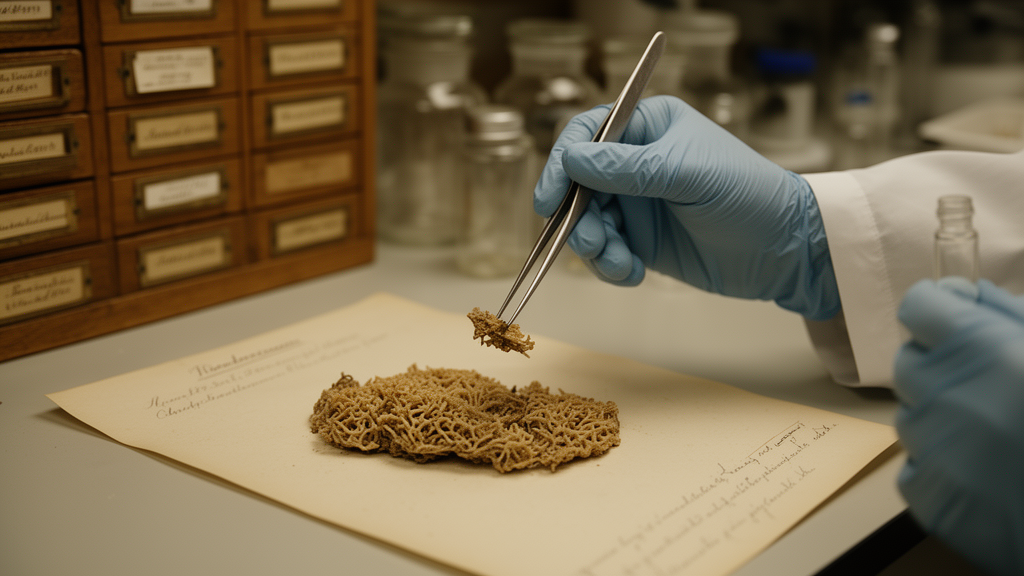
The experimental sample comprised seven specimens from the herbarium of the Institute of Botany and Landscape Ecology at the University of Greifswald, Germany. Collection dates ranged from 1935 to 1997, giving specimen ages of 29–91 years, and the set included Fuligo cinerea, Trichia scabra, Lindbladia tubulina, Cribraria mirabilis and Lycogala epidendrum. Approximately 1 mm³ of spores was taken from each specimen. Eight had initially been selected, but one contained no DNA and was excluded.
After filter-based DNA extraction, samples with 150 ng of DNA were prepared for sequencing directly, while those with lower yields underwent six hours of whole-genome amplification. Libraries containing 158–658 ng of DNA were sequenced on an Illumina NovaSeq at a depth of five million read pairs per sample. The reads were assembled with metaSPAdes, except for the specimen with the largest input and sequencing volume, for which the standard SPAdes mode was used after an out-of-memory error. Contigs were screened against nucleotide databases and assessed for taxonomic identity, GC content, length and read coverage.
Nuclear small-subunit ribosomal RNA sequences were recovered from all seven specimens. Their lengths ranged from 157 to 7,755 base pairs, with coverage from one to 127 copies. In six cases, the recovered fragments at least partly overlapped the approximately 600-base-pair region conventionally used for myxomycete barcoding. The recovered anchor contigs were consistent with the specimens’ preliminary morphological identifications, although identifying Eumycetozoa sequences remained difficult because genomic reference data for myxomycetes remain sparse.
The researchers recognized 28 genes in total. Elongation factor 1-alpha occurred in four specimens, mitochondrial cytochrome c oxidase subunit I in three and mitochondrial small-subunit ribosomal RNA in two. The 33-year-old L. tubulina specimen produced the most extensive target data, including a 7,755-base-pair nuclear small-subunit fragment, a 4,847-base-pair mitochondrial small-subunit fragment and an EF1a contig longer than 10 kbp. Its initial DNA concentration was 8.57 ng/μL, the highest among the seven, and its assemblies contained contigs as long as 114 kbp.
Specimen age was not significantly correlated with DNA yield, read length, the number of recovered Eumycetozoa contigs or assembly quality among the five specimens that underwent whole-genome amplification. The two specimens with the highest target-DNA yields were 33 and 64 years old and were not the youngest. These observations do not negate time-dependent DNA degradation; instead, they indicate that preservation and specimen-specific properties can outweigh chronological age across the several-decade range studied. The small sample and the uneven use of whole-genome amplification prevent firm conclusions about the amplification procedure’s effect.
Most assembled sequence belonged to a “no-hit” fraction without matches in the reference database. Its similarity in GC-content and coverage to confirmed myxomycete fragments suggests that some may be target DNA, but low coverage, short contigs and background noise prevent the entire fraction from being assigned to the specimens. Non-target DNA included human, skin-microflora, cattle, arthropod, bacterial, archaeal and viral signals. Whole-genome-amplified samples generally showed greater contamination and less target DNA, although the available data could not determine whether amplification preferentially amplified younger contaminant DNA. Overall, the study shows that genome skimming can link selected historical myxomycete collections to molecular barcodes, while broader taxonomic use remains constrained by contamination, fragmented assemblies and the shortage of reference genomes.
Subject of Research: Genome skimming for molecular barcoding of historical myxomycete herbarium specimens
Article Title: Short-read genome skimming enables molecular barcoding of old myxomycete collections
Article References: Leontyev, D. V., Schnittler, M., & Shchepin, O. N. (2026). Short-read genome skimming enables molecular barcoding of old myxomycete collections. IMA Fungus, 17, Article e201932. https://doi.org/10.3897/imafungus.17.201932
Image Credits: AI Generated
DOI: 10.3897/imafungus.17.201932
Keywords: myxomycetes, genome skimming, DNA barcoding, herbarium specimens, Illumina sequencing, museomics, nomenclatural types, archival DNA, Short-read, genome, skimming, enables
News Source: Juliet Wilcox. (October 20, 2026). Genome skimming barcodes myxomycete herbarium specimens aged 29 to 91 years. Scienmag.