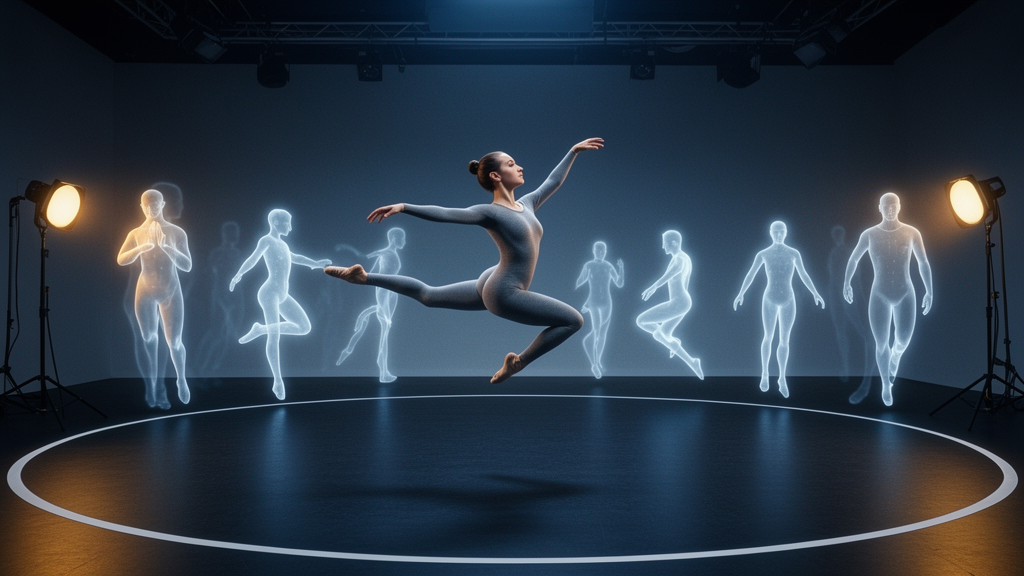
A research study of a music-conditioned system for generating and transferring three-dimensional dance movements reported strong results on the AIST++ dataset. The method combined a conditional denoising diffusion probabilistic model, a spatio-temporal graph convolutional network (ST-GCN), a Transformer-based music-motion encoder and adaptive instance normalization (AdaIN). In the main 250-step sampling configuration, the system reported a Fréchet Inception Distance (FID) of 5.23 for motion-generation quality, a Dynamic Time Warping (DTW) index of 5.11 for music synchronization and a subjective evaluation score of 4.33.
The framework starts with Gaussian noise and progressively denoises it into a sequence of three-dimensional human motions conditioned on input music and a target dance-style label. The music is represented using Mel-frequency cepstral coefficients, Mel spectrograms, attack intensity and beat information. A four-layer Transformer with eight attention heads and a hidden dimension of 512 processes the acoustic features. Its cross-modal attention aligns music beats and motion transitions, while a local attention window limits the current frame’s access to nearby musical context.
Human motion is represented with unit quaternions for joint rotations and three-dimensional vectors for root-joint displacement. During diffusion denoising, ST-GCN treats joints as graph nodes and bones as connections, allowing spatial convolutions to model skeletal topology and temporal convolutions to represent changes between frames. The denoising network is trained with a mean-squared error objective for predicted noise, together with losses for motion velocity, bone-length stability, beat alignment and style recognition.
Style is controlled through a dedicated encoder that converts a one-hot dance-style label into multi-scale scaling and shifting parameters. AdaIN applies these parameters to selected feature maps in the diffusion U-Net, while the music and style conditions guide the reconstruction process. The researchers compared five placement strategies, including label concatenation and insertion at the encoder, bottleneck, decoder or all layers. Combining bottleneck and decoder insertion produced the best reported combination of FID, DTW and interaction score; full-layer insertion had a higher FID of 5.47 and was associated with local motion perturbations.
Evaluated on AIST++, the model was compared with established systems such as Bailando and FACT and with Transformer-based methods including DanceTransformer, StyleWave and MotionGPT. The proposed method reported the strongest overall results across motion quality, music synchronization and style accuracy. Its FID of 5.23 was 0.74 below StyleWave, the best-performing Transformer baseline reported in the comparison; its DTW of 5.11 was 0.35 lower than StyleWave’s value, and its style accuracy of 0.91 was 0.03 higher. Paired t-tests using ten independent experiments for each method found p-values below 0.01 for the reported comparisons across FID, DTW and style accuracy.
The subjective assessment involved 40 raters, comprising 20 professional choreographers with at least five years of experience and 20 general-audience participants. In blind comparisons, the proposed system received mean scores of 4.25 ± 0.41 for naturalness, 4.30 ± 0.38 for rhythm synchronization, 4.45 ± 0.35 for style expression, 4.18 ± 0.40 for emotional consistency and 4.12 ± 0.43 for long-sequence coherence. Real dance recordings received the highest overall scores. The lower emotional-consistency score than style-expression score indicates that the model represented dance-style features more effectively than subtle changes in musical emotion.
Feature Transition Smoothness measurements showed values above 0.78 for all tested cross-style combinations. Hip-hop and street dance reached bidirectional values of 0.95 and 0.96, while the transition from street dance to ballet had the lowest reported value, 0.78. The framework can also linearly interpolate between the affine parameter sets of two styles, producing a continuous style condition. The study did not report a specific hip-hop-to-ballet interpolation experiment, and the measured transition results should not be interpreted as demonstrating that particular combination.
The diffusion training schedule contained 1,000 steps, whereas the main experiments used Denoising Diffusion Implicit Model sampling with 250 steps. At 50 steps, the reported FID was 5.36, DTW was 5.22 and inference time was 0.63 seconds; at 250 steps, FID was 5.23, DTW was 5.11 and style accuracy was 95.6%. Hardware tests reported generation times of 0.85 seconds on an RTX 3090 and 1.42 seconds on a Tesla T4, with 4.2 GB of video memory reported for the T4 configuration. The paper also notes inconsistent descriptions of sampling-step counts in different parts of the experimental setup.
Long-sequence tests identified the framework’s main limitations. For a 15-second sequence, FID was 5.23, DTW was 5.11 and the coherence score was 0.91. At 60 seconds, FID rose to 5.74, DTW to 5.69 and global drift reached 4.1; at 120 seconds, FID was 6.28, foot-slip rate was 8.9% and coherence fell to 0.76. The authors also note a relatively high training cost, blurred style boundaries for categories with few training samples, and emotion-style mapping that depends on expert annotations and a music-emotion classifier. All experiments were confined to AIST++, so the reported results do not establish performance for other datasets or real-world dance production.
Subject of Research: Evaluation of a diffusion and ST-GCN framework for music-conditioned 3D dance generation and style transfer
Article Title: Dance arrangement and style transfer methods driven by diffusion models and spatiotemporal graph convolutional networks
Article References: Chang, J., & Zhai, M. (2026). Dance arrangement and style transfer methods driven by diffusion models and spatiotemporal graph convolutional networks. Discover Artificial Intelligence, 6(1), Article 1270. https://doi.org/10.1007/s44163-026-02039-9
Image Credits: AI Generated
DOI: 10.1007/s44163-026-02039-9
Keywords: music-conditioned dance generation, conditional diffusion model, spatio-temporal graph convolution, dance style transfer, adaptive instance normalization, AIST++ dataset, 3D human motion, cross-modal attention, long-sequence coherence, Dance, arrangement, style
News Source: Blake Davidson. (October 20, 2026). Diffusion and graph networks improve music-conditioned dance generation and style control. Scienmag.