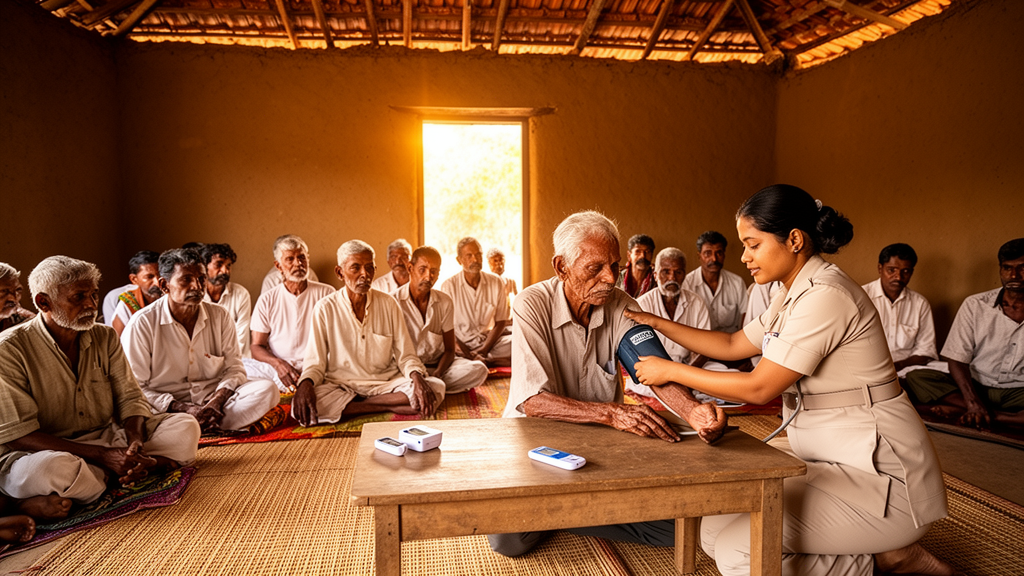
The abstract of a mixed-methods implementation study reports that a programme to strengthen village health committees in a tribal area of Maharashtra was associated with higher non-communicable disease screening and service use between 2020 and 2022. The study included 97 committees: 50 serving two intervention primary health centres and 47 serving two active-control primary health centres. Hypertension screening increased by 42%, while diabetes screening increased by 56.3%. Outpatient attendance for these conditions rose by more than tenfold at the intervention primary health centres.
Researchers used structured facility and committee assessment tools to examine changes in committee functioning, service coverage and service utilisation. They analysed non-communicable disease indicators with a difference-in-differences approach. The intervention consisted of structured capacity building, on-site supportive supervision, and facilitation of planning and implementation of health activities. Compared with control areas, intervention areas also showed improvements in referral linkages, outreach activities and health promotion efforts. Other measured improvements in committee functioning included meeting regularity, member participation, reconstitution, adherence to procedural norms and intersectoral convergence.
In-depth interviews with stakeholders were used to examine the mechanisms and enabling factors associated with the observed service changes. Interview findings identified effective planning, convergence across sectors, community empowerment and expanded committee roles as mechanisms supporting non-communicable disease service delivery. Stakeholders also described continued training and supportive supervision as important for sustaining the gains. These qualitative results were reported alongside the quantitative measures; the abstract does not provide interview participant numbers or detailed analytical results.
The findings are bounded by the study’s implementation-research scope. It covered committees under four primary health centres in one tribal block of Maharashtra, and the abstract does not report confidence intervals, statistical significance, or effects on clinical outcomes such as blood-pressure control or diabetes management. The available summary therefore indicates improved screening, attendance and service-delivery processes, rather than demonstrating reduced disease burden or long-term clinical benefit. The published version is an early-access article that the journal states may still undergo further editorial changes.
Subject of Research: Implementation research on village health committee strengthening and non-communicable disease services in tribal Maharashtra
Article Title: Revitalising village health committees to improve non-communicable disease care: evidence from a mixed-methods implementation research study in tribal area of Maharashtra
Article References: Selvaraj, K., Khan, M. F., Deshmukh, P. R., Sujiv, A., Solanki, R., Tripathy, J. P., Kushwaha, A., Banerjee, S., Selokar, D., Tamgire, L., Thanigachalam, S., Sabale, R. M., Inamdar, A. S., Bhardwaj, V., & Babu, B. V. (2026). Revitalising village health committees to improve non-communicable disease care: evidence from a mixed-methods implementation research study in tribal area of Maharashtra. BMC Health Services Research. https://doi.org/10.1186/s12913-026-15671-z
Image Credits: AI Generated
DOI: 10.1186/s12913-026-15671-z
Keywords: village health committees, non-communicable diseases, hypertension screening, diabetes screening, implementation research, mixed methods, tribal health, Maharashtra, primary health centres, community health, Revitalising, village
News Source: Ophelia Keating. (October 20, 2026). Mixed-methods study of 97 village health committees reports improved non-communicable disease screening in tribal Maharashtra. Scienmag.