• HOME
  • NEWS
  • EXPLORE
    • CAREER
      • Companies
      • Jobs
    • EVENTS
    • iGEM
      • News
      • Team
    • PHOTOS
    • VIDEO
    • WIKI
  • BLOG
  • COMMUNITY
    • FACEBOOK
    • INSTAGRAM
    • TWITTER
Tuesday, October 20, 2026
BIOENGINEER.ORG
No Result
View All Result
  • Login
  • HOME
  • NEWS
  • EXPLORE
    • CAREER
      • Companies
      • Jobs
        • Lecturer
        • PhD Studentship
        • Postdoc
        • Research Assistant
    • EVENTS
    • iGEM
      • News
      • Team
    • PHOTOS
    • VIDEO
    • WIKI
  • BLOG
  • COMMUNITY
    • FACEBOOK
    • INSTAGRAM
    • TWITTER
No Result
View All Result
Bioengineer.org
No Result
View All Result
Home NEWS Science News Technology

Experimental coconut-derived C/CoNi aerogel shows measured electromagnetic absorption and shielding performance

by
October 20, 2026
in Technology
Reading Time: 2 mins read
0
Experimental coconut-derived C/CoNi aerogel shows measured electromagnetic absorption and shielding performance

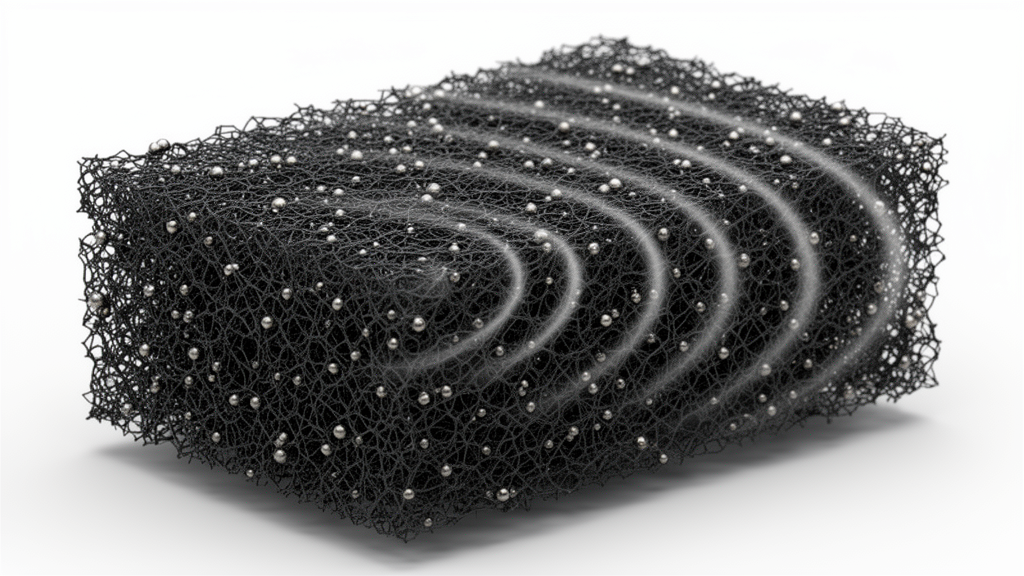
Coconut-derived carbon nanofiber aerogel with CoNi alloy nanoparticles delivers strong electromagnetic wave absorption

Share on FacebookShare on TwitterShare on LinkedinShare on RedditShare on Telegram

A laboratory study reported that a composite aerogel made from coconut-derived carbon nanofibers and cobalt-nickel alloy nanoparticles achieved a minimum reflection loss of −39.41 dB at 1.5 mm and an effective absorption bandwidth of 4.58 GHz at 2.0 mm. The article abstract also reports electromagnetic shielding effectiveness of 24.5 dB and radar-cross-section reduction across a wide range of incident angles.

The researchers prepared the material by freeze-drying and high-temperature carbonizing natural coconut to form a carbon nanofiber aerogel. They then grew CoNi alloy nanoparticles directly on the fiber surfaces through a hydrothermal process, producing what they designated C/CoNi-NA. According to the abstract, microscopy and related characterization showed that the nanoparticles were uniformly anchored to the fibers and that the aerogel’s three-dimensional porous structure remained intact. The authors associated this structure with the material’s compressive resilience and fatigue resistance, although the abstract does not provide quantitative mechanical-test results.

Electromagnetic characterization indicated that adding CoNi increased dielectric polarization and magnetic loss. The authors described the resulting combination as synergistic dielectric and magnetic losses. In the shielding analysis, total shielding effectiveness reached 24.5 dB, while absorption shielding effectiveness was substantially greater than reflection shielding effectiveness. The abstract therefore characterizes the measured shielding behavior as predominantly absorption-based. It also reports outstanding radar-cross-section reduction over a wide range of incident angles but does not state the tested angular range or numerical reduction values in the available text.

The findings support the authors’ conclusion that coconut-derived C/CoNi-NA is a promising lightweight, elastic material for broadband electromagnetic-wave absorption and electromagnetic-interference shielding. That conclusion remains bounded by the accessible evidence: this report is based on the journal article’s abstract rather than an assessment of the complete study. The preview does not disclose detailed testing conditions, uncertainty estimates, specimen counts, comparative material results, durability-cycle measurements or application-scale performance, so those aspects cannot be evaluated from the supplied abstract.

Subject of Research: Experimental evaluation of a coconut-derived C/CoNi nanofiber aerogel for electromagnetic absorption and shielding

Article Title: Biomass-derived elastic C/CoNi nanofiber aerogel with electromagnetic wave absorption and shielding properties

Article References: Zhou, G., Dong, H., Deng, H., Ma, C., Zhang, B., & Wang, Y. (2026). Biomass-derived elastic C/CoNi nanofiber aerogel with electromagnetic wave absorption and shielding properties. Journal of Materials Science, 61(42), 33084-33096. https://doi.org/10.1007/s10853-026-13761-1

Image Credits: AI Generated

DOI: 10.1007/s10853-026-13761-1

Keywords: C/CoNi aerogel, coconut carbon, nanofibers, electromagnetic absorption, electromagnetic shielding, reflection loss, radar cross section, CoNi nanoparticles, porous materials, Biomass-derived, elastic, CoNi

News Source: Denise Maddox. (October 20, 2026). Experimental coconut-derived C/CoNi aerogel shows measured electromagnetic absorption and shielding performance. Scienmag.


Tags: Biomass-derivedC/CoNi aerogelcoconut carbonCoNiCoNi nanoparticleselasticelectromagnetic absorptionelectromagnetic shieldingnanofibersporous materialsradar cross sectionreflection loss
Share12Tweet7Share2ShareShareShare1

Related Posts

Antimicrobial cyclic peptide shows multi-target effects in laboratory acne models

Antimicrobial cyclic peptide shows multi-target effects in laboratory acne models

October 20, 2026
Research report: An integrative theoretical model of AI-supported cybersecurity governance and organizational resilience

Research report: An integrative theoretical model of AI-supported cybersecurity governance and organizational resilience

October 20, 2026

Cross-scale regulation mechanisms of alloying elements on the mechanical properties of β-Ti alloys: a synergistic strategy to integrate machine learning and first-principles calculations

October 20, 2026

Synthetic benchmark test finds sensitivity-aware graph model improves privacy-leak path ranking

October 20, 2026

POPULAR NEWS

  • Antimicrobial cyclic peptide shows multi-target effects in laboratory acne models

    Antimicrobial cyclic peptide shows multi-target effects in laboratory acne models

    29 shares
    Share 12 Tweet 7
  • Persistent tinnitus preceded diagnosis of multifocal tuberculosis in a 32-year-old patient: case report

    29 shares
    Share 12 Tweet 7
  • Mixed-methods study of 97 village health committees reports improved non-communicable disease screening in tribal Maharashtra

    29 shares
    Share 12 Tweet 7
  • Quercetin improves bone measures in rats with collagen-induced arthritis alongside reduced Wnt3A and β-catenin expression

    29 shares
    Share 12 Tweet 7

About

We bring you the latest biotechnology news from best research centers and universities around the world. Check our website.

Follow us

Recent News

Antimicrobial cyclic peptide shows multi-target effects in laboratory acne models

Persistent tinnitus preceded diagnosis of multifocal tuberculosis in a 32-year-old patient: case report

Mixed-methods study of 97 village health committees reports improved non-communicable disease screening in tribal Maharashtra

Subscribe to Blog via Email

Enter your email address to subscribe to this blog and receive notifications of new posts by email.

Join 85 other subscribers
  • Contact Us

Bioengineer.org © Copyright 2023 All Rights Reserved.

Welcome Back!

Login to your account below

Forgotten Password?

Retrieve your password

Please enter your username or email address to reset your password.

Log In
No Result
View All Result
  • Homepages
    • Home Page 1
    • Home Page 2
  • News
  • National
  • Business
  • Health
  • Lifestyle
  • Science

Bioengineer.org © Copyright 2023 All Rights Reserved.