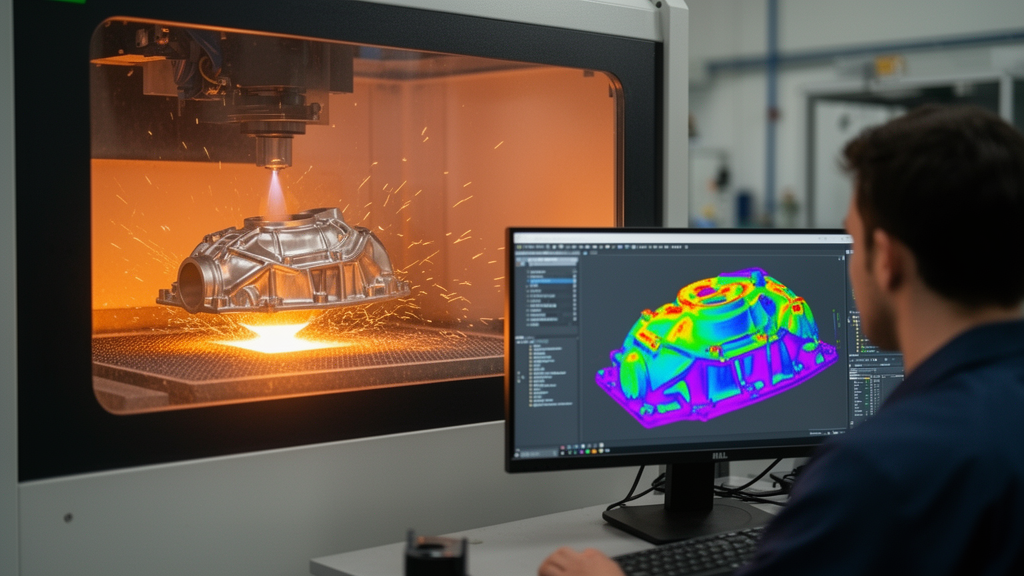
A review in the Journal of Materials Science examines how finite element modeling and artificial intelligence can support additive manufacturing of refractory alloys, according to the article abstract. The review covers refractory alloy systems based on tungsten, molybdenum, tantalum and niobium, as well as emerging refractory high-entropy alloys. It focuses on their potential for extreme-environment applications, where the abstract highlights high-temperature strength, thermal stability, creep resistance and radiation tolerance as notable properties, while also emphasizing that fabrication remains difficult because of high melting temperatures, oxidation sensitivity, ductile-to-brittle transition behavior and susceptibility to cracking and residual stress formation.
Additive manufacturing is presented in the abstract as a promising approach for producing complex refractory alloy components with improved material utilization and design flexibility. The review considers four major technologies: laser powder bed fusion, laser directed energy deposition, electron beam powder bed fusion and wire arc additive manufacturing. It also discusses the thermal gradients, rapid solidification rates and complex thermo-metallurgical phenomena associated with additive manufacturing. According to the abstract, these process conditions often contribute to microstructural heterogeneity, porosity, distortion and performance variability, although the review does not establish that a particular technology eliminates those issues.
The review’s modeling section addresses recent advances in thermal, mechanical, microstructural and multiscale finite element approaches, with emphasis on process–structure–property relationships. Its artificial-intelligence section provides a systematic review of machine learning, deep learning, physics-informed neural networks and digital twins in process optimization, defect prediction and quality assurance. The abstract highlights the integration of artificial intelligence and finite element modeling as a potential pathway toward predictive and autonomous manufacturing, but this is a forward-looking direction identified by the review rather than a demonstrated manufacturing outcome. Because the supplied evidence is limited to the abstract, the article does not permit assessment of the studies, simulations, datasets, performance measures or conclusions discussed in the full review.
The final section of the review identifies current challenges, knowledge gaps and future research opportunities connected to intelligent manufacturing frameworks for next-generation refractory alloy components. These unresolved issues are part of the review’s stated scope rather than results from a new experiment or production trial. The available abstract does not report a systematic search strategy, number of included studies, quantitative synthesis, validation results, process-specific comparisons or a completed digital-twin implementation. Accordingly, the review synthesizes an active research area spanning computational modeling, data-driven methods and additive manufacturing, while the supplied evidence does not support claims that artificial intelligence or digital twins have already made refractory-alloy manufacturing fully predictable, autonomous or reliable.
Subject of Research: A review of computational modeling and artificial intelligence for additive manufacturing of refractory alloys
Article Title: Review: finite element modeling, artificial intelligence, digital twins and applications for additive manufacturing of refractory alloys
Article References: Das, B., Patel, P., Madan, R., Aseef Khan, M. D., Yadav, A., & Bandyopadhyay, T. K. (2026). Review: finite element modeling, artificial intelligence, digital twins and applications for additive manufacturing of refractory alloys. Journal of Materials Science, 61(42), 32538-32605. https://doi.org/10.1007/s10853-026-13762-0
Image Credits: AI Generated
DOI: 10.1007/s10853-026-13762-0
Keywords: refractory alloys, additive manufacturing, finite element modeling, artificial intelligence, digital twins, machine learning, defect prediction, process optimization, refractory high-entropy alloys, Review, finite, element
News Source: Denise Maddox. (October 20, 2026). Review: finite element modeling, artificial intelligence, digital twins and applications for additive manufacturing of refractory alloys. Scienmag.