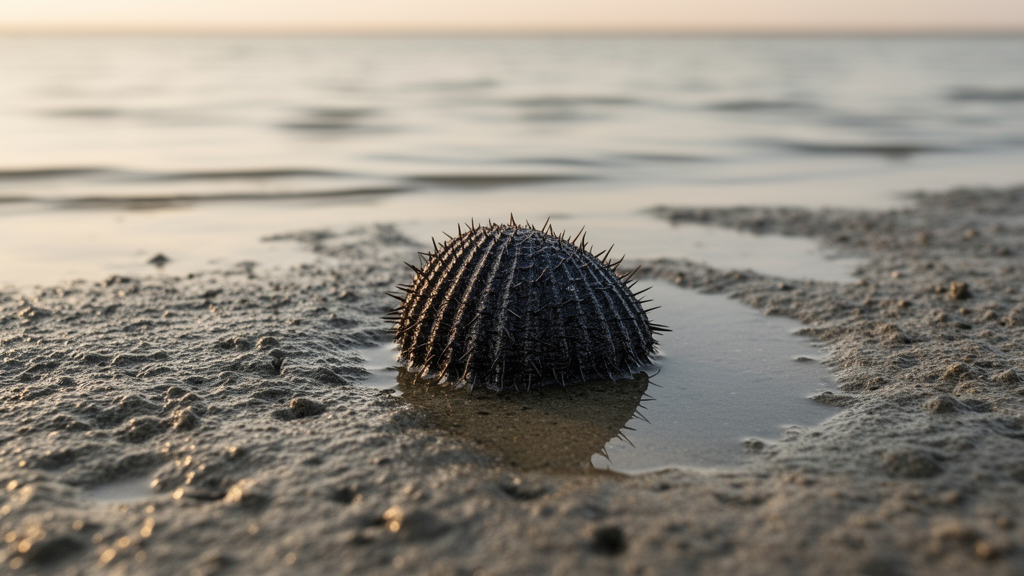
An integrative taxonomic study has formally described Anadara adiastola sp. nov. as a distinct ark clam species from Kuwait’s intertidal and shallow sublittoral habitats in the northern Arabian/Persian Gulf. The study combined shell morphology, internal anatomy and mitochondrial cytochrome oxidase subunit I (COI) sequence data to distinguish the Kuwaiti animals from named species represented in public sequence databases.
The research addressed an unresolved identification recorded in earlier Kuwait molluscan surveys. Most material then available consisted of disarticulated shells, while the few living specimens collected were unsuitable for molecular analysis. Targeted collecting from 2024 to 2026 yielded live animals from Al-Judailiat, Shuwaikh and Miscan Island. Earlier intertidal material had been collected by hand digging during surveys from 2015 to 2018, supplemented in late 2019.
For the analysis, researchers extracted genomic DNA from alcohol-preserved tissues and amplified a COI fragment with primers targeting the standard Folmer barcode region. Five Kuwait specimens were sequenced. These sequences were compared with suitable Anadarinae COI records available in GenBank on 1 April 2026 and with three specimens from Oman provided by the Florida Museum of Natural History. The final dataset comprised 588 COI sequences representing Anadara, Diluvarca, Larkinia, Lunarca, Scapharca and Tegillarca. A neighbour-joining analysis used the Kimura two-parameter model and 1,000 bootstrap replications.
The Kuwaiti specimens formed a distinct mitochondrial lineage but could not be assigned to a named species through sequence matching. The closest BLASTn result was Anadara globosa, with 84.1% pairwise identity. In the neighbour-joining tree, the nearest sampled clade comprised sequences labelled A. crebricostata, although the Kuwaiti specimens differed from that clade by 18.7% under the Kimura two-parameter model and the relationship had bootstrap support below 70%. The authors cautioned that the tree was not a robust phylogeny of Anadarinae because some GenBank identifications were inconsistent, including records assigned to A. crebricostata from China even though the species has an accepted Australian range.
Shell characters also separated the new species from regional congeners. Anadara adiastola has an oblong, subtrapezoidal shell that is distinctly longer than high, reaches approximately 70 mm in length and is slightly inequivalve, with the left valve larger than the right. Its diagnostic shell features include 31–35 radial ribs, with a mode of 34, and weak cross-bars concentrated mainly on the anterior median area of the left valve. The thick olive- to chestnut-brown periostracum forms bristles between the ribs, with especially long bristles projecting ventrally on the posterior slope.
Anatomical observations were based on dissected specimens. The mantle edge was entirely unfused, the posterior inhalant aperture was strongly folded and bore short tentacles, and the anterior and posterior adductor muscles were large. The foot had a well-developed heel and toe, while a narrow byssus attached the animal to sediment particles. Large labial palps carried up to 82 sorting ridges on the outer palp and 70 on the inner palp. The authors discussed this feature in relation to the species’ muddy habitat and high suspended-particle load, without directly measuring depth distributions across the region.
Living animals were recorded from Kuwait Bay, Khor Sabiyah and Boubyan Island in muddy or sandy-mud sediment. They were found at the low-water mark, suggesting a primarily shallow sublittoral occurrence. Worm tubes and calcareous concretions attached to the umbonal area, together with observations of animals moving through sediment with their umbos exposed, indicated a shallow, semi-infaunal habit. The holotype was collected at Al-Judailiat on 15 December 2025. The type series, including GenBank vouchers, was deposited in the National Museum of Wales in Cardiff under accession numbers NMW.Z.2021.009.031 through NMW.Z.2021.009.038. The species name refers to its previously confused and indistinct taxonomic status.
The description places the taxon in Anadara in the broad sense because the available molecular evidence does not provide a stable generic or subgeneric framework for Anadarinae. Several limitations remain. Some large, heavily umbonate shells collected at Miscan and Umm Al-Namil islands did not match the typical form of A. adiastola, although allometric growth could explain the difference. Too few such shells were available to resolve their identity, and additional live-collected material suitable for sequencing is needed to confirm whether they represent the new species or another taxon.
The authors also could not rule out a non-native origin because of high shipping volume into the Gulf, although material attributable to A. adiastola was already present in Kuwait collections reported in 1984. Unidentified shells resembling the new species from Pakistan’s Balochistan coast were not examined in detail or sequenced, so the occurrence of related or conspecific populations elsewhere along the northern Arabian Sea remains unresolved. The available evidence supports recognition of A. adiastola as a distinct species represented in Kuwait, but its wider regional distribution and biogeographic origin require further investigation.
Subject of Research: Integrative description of the new ark clam species Anadara adiastola from Kuwait
Article Title: Integrative taxonomy reveals a new species, Anadara adiastola sp. nov. ( Bivalvia , Arcidae ) from the northern Arabian/Persian Gulf, north-western Indian Ocean
Article References: Al-Kandari, M., Garzia, M., Salvi, D., & Oliver, P. G. (2026). Integrative taxonomy reveals a new species, Anadara adiastola sp. nov. (Bivalvia, Arcidae) from the northern Arabian/Persian Gulf, north-western Indian Ocean. ZooKeys, 1294, 333-353. https://doi.org/10.3897/zookeys.1294.203117
Image Credits: AI Generated
DOI: 10.3897/zookeys.1294.203117
Keywords: Anadara adiastola, integrative taxonomy, ark clam, Kuwait, COI sequencing, shell morphology, molluscan anatomy, Arabian/Persian Gulf, new species, Integrative, taxonomy, reveals
News Source: Juliet Wilcox. (October 20, 2026). Morphology, anatomy and COI data identify distinct Anadara species in Kuwait. Scienmag.