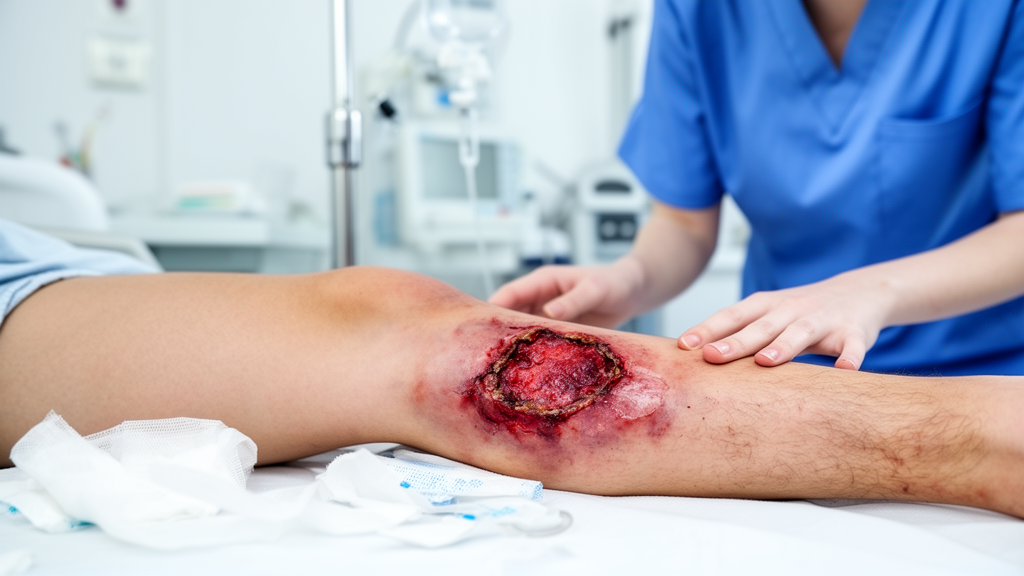
A case report summarized in the abstract describes a 20-year-old man with a history of polysubstance use who was admitted with rapidly progressive hemorrhagic and necrotic lesions affecting both lower extremities after recent physical trauma. The presentation included severe necrotizing soft tissue injury, suspected sepsis with acute organ dysfunction and acute kidney injury. The initial cause of the extensive injury remained uncertain, and analytical confirmation of desomorphine exposure was not obtained.
Toxicological screening detected opiates and tetrahydrocannabinol. The authors note that illicitly manufactured opioid preparations may contain toxic contaminants capable of causing severe local tissue injury, but a causal relationship between a specific illicit preparation and extensive necrotizing lesions is often difficult to establish because analytical confirmation is rarely available. Admission blood cultures and early wound cultures were negative. Local microbiological samples obtained after broad-spectrum antimicrobial therapy had begun later yielded multiple healthcare-associated organisms, including VIM-producing Pseudomonas aeruginosa and vancomycin-resistant Enterococcus faecium.
The investigators interpreted the later isolates as secondary wound colonization and/or infection rather than evidence that a resistant organism caused the original necrosis. The timing of sample collection and the initial antimicrobial exposure limit the conclusions that can be drawn from these cultures about when or how the resistant organisms were acquired. Despite empirical antimicrobial therapy, tissue necrosis progressed and required repeated surgical debridement. Histopathological examination showed necrosis of the skin and subcutaneous tissue with a suppurative inflammatory infiltrate.
The reported course included prolonged wound care, culture-directed antimicrobial therapy and reconstructive treatment. As a single-patient case report summarized from the article abstract, the study cannot establish comparative outcomes, population-level incidence or a causal link between any particular exposure, toxic adulterant or later multidrug-resistant organism and the lesions. It documents an unresolved initial etiology followed by resistant organisms interpreted by the authors as secondary healthcare-associated colonization and/or infection, while also illustrating the diagnostic difficulty of extensive necrotizing soft tissue injury in a patient with polysubstance use and recent trauma.
Subject of Research: A single-patient case report of necrotizing soft tissue injury followed by multidrug-resistant wound colonization and/or infection
Article Title: Severe necrotizing soft tissue injury with secondary multidrug-resistant wound colonization and infection in a patient with polysubstance use and suspected toxic adulterant exposure: a case report
Article References: Azzaddin, L., Giedzicz, K., Stawarz, W., Dytkowski, M., Jabłoński, R., & Hady, H. R. (2026). Severe necrotizing soft tissue injury with secondary multidrug-resistant wound colonization and infection in a patient with polysubstance use and suspected toxic adulterant exposure: a case report. BMC Infectious Diseases. https://doi.org/10.1186/s12879-026-14506-w
Image Credits: AI Generated
DOI: 10.1186/s12879-026-14506-w
Keywords: case report, necrotizing soft tissue injury, multidrug-resistant organisms, wound colonization, polysubstance use, healthcare-associated infection, surgical debridement, acute kidney injury, toxicological screening, Severe, necrotizing, soft
News Source: Ophelia Keating. (October 20, 2026). Case report links uncertain initial injury with later multidrug-resistant wound colonization in a 20-year-old man. Scienmag.