Credit: Ms. Laura Woods
Deciding to start a family later in life could be about more than just the age of your eggs. A new study in mice suggests the age of a mother's womb may also have a part to play. This work, led by Dr Myriam Hemberger at the Babraham Institute and the Centre for Trophoblast Research in Cambridge, UK, is one of the first to look at the effects of age on womb health and it is expected to lead to new research into human pregnancies.
The risks of complications during pregnancy all increase with age. A woman in her late 30s is twice as likely as a younger woman to have a stillbirth, she is also 20% more prone to giving birth prematurely and more likely to experience conditions such as pre-eclampsia. Many of these effects have been linked to the deteriorating quality of ageing egg cells. Yet, this new research, published in Nature Communications, reveals that older wombs also have more trouble adapting to pregnancy.
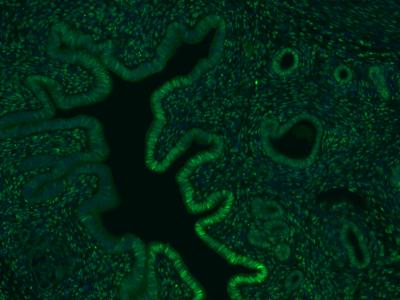
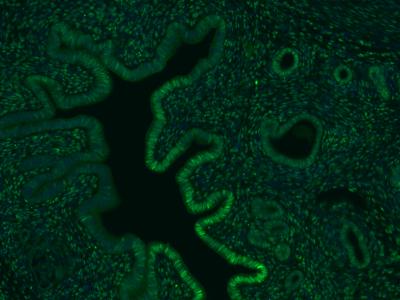
By examining first pregnancies in aged mice, the team showed that, for mice as for humans, the risk of complications increases with age. Closer examination revealed that the wombs of older mothers are less able to support the growth of a placenta, meaning the developing young have poor blood supply, which slows their growth and can cause birth defects.
The co-first authors were Ms Laura Woods and Dr Vicente Perez-Garcia. Speaking about the findings, Ms Woods said: "We wanted to enhance our understanding of the increased risks of pregnancy in older mothers. When we compared mice who have their first litter in middle age to their younger counterparts, we found that the lining of the uterus does not respond as well to pregnancy hormones and this delays placenta formation. By identifying the key pathways affected by age in mice we have a better idea of what to look for in humans."
Understanding the potential risks of pregnancy with age is an increasingly important issue. In the UK, more and more women are starting families later and in 2015, 53% of UK births were to women aged 30 or over. A 2016 report by the Human Fertilisation and Embryology Authority showed that freezing eggs for later use is also growing in popularity. In 2001, just 29 women opted for the treatment, rising to 816 by 2014.
Lead author, Dr Hemberger, Group Leader in Epigenetics at the Babraham Institute, said: "Overall, our study highlights the importance of the ageing uterine environment as a cause of reproductive decline in female mice. This is one of the first times that the considerable impact of age on pregnancy has been studied in detail beyond the effects of egg fitness. More research will be needed to establish if and how our results translate to humans."
The shorter lifespan of mice means that they are useful for studying the effects of age on pregnancy but these results cannot always be directly applied to human pregnancies. These new results will help to guide long-term studies in humans but it is not yet clear what the implications of these findings will mean for family planning and human healthcare. It is clear that other factors besides egg quality may need to be considered when planning a family.
As a member of the Royal College of Obstetricians and Gynaecologists, Ashley Moffett, Professor of Reproductive Immunology at the University of Cambridge and expert on placenta formation, said: "We know that the so-called Great Obstetrical Syndromes, in particular pre-eclampsia are more common in older women but it's still not clear why. Although more work is needed to demonstrate this effect in humans, this study could help advance research into these important questions".
###
Media Contact
Jonathan Lawson
[email protected]
01-223-496-230
@babrahaminst
http://www.babraham.ac.uk/
Related Journal Article
http://dx.doi.org/10.1038/s41467-017-00308-x