The meeting was held under exceptional circumstances at the beginning of the coronavirus pandemic, which resulted in the cancellation of several presentations, including the planned Friday lecture by Eva Knop of Agroscope Reckenholz. The published meeting protocol records the scope and institutional business of the event, but it does not provide full methods, numerical results or statistical analyses for most individual talks. Its findings therefore describe the subjects presented and the decisions taken by the society rather than a single experimental study.
Much of the Friday afternoon programme was devoted to applied entomology, especially the recognition and management of potentially invasive insects in Switzerland. Stève Breitenmoser of Agroscope Changins presented a study of companion plants, or associated cultivation, and damage caused by the cabbage flea beetle, Psylliodes chrysocephala, in winter oilseed rape. Tanja Sostizzo of Agroscope Reckenholz addressed the Japanese beetle as an invasive pest in Switzerland, while Lukas Seehausen of CABI Delémont discussed biological control of non-native insects in the country.
The protocol lists these contributions as presentations and gives no numerical outcomes, so the report cannot establish how effective any particular management method was or whether the approaches performed differently from one another. Other Friday talks addressed invasive species in urban settings and questions concerning establishment. Marcus Schmidt of the City of Zurich’s Department of Environment and Health presented work on controlling the invasive ant Tapinoma magnum in Zurich.
Ann-Christin Honnen of the Tropical Health Institute Basel discussed invasive mosquitoes in Switzerland and the routes to successful establishment. The programme also included Lisa Fisler of the Swiss Centre for the Faunal Mapping, who reported on hoverflies, or Syrphidae, in Switzerland, including current knowledge, applications and projects, and Sarah Rohr of the University of Bern and the Natural History Museum Bern, who presented work on glacier flies in the Selhofen Zopfen wetland. Gabi Müller of the City of Zurich described the first recorded occurrence of the subterranean termite Reticulitermes grassei in northeastern Switzerland, covering a survey of the infestation and control work.
Daniel Burckhardt of the Natural History Museum Basel examined the taxonomy of pear psyllids within the Hemiptera family Psyllidae, describing the history of continuing misidentifications. Emmanuel Toussaint of the Natural History Museum of the City of Geneva delivered Saturday’s principal lecture on insect phylogenomics, the use of molecular sequence data to reconstruct evolutionary relationships and build phylogenetic trees. He described how sequencing and tree-building methods had become more accurate, faster and less expensive over time.
He also noted that older DNA can increasingly be prepared and used, adding to the research value of museum collections. Projects on skipper butterflies, the family Hesperiidae, illustrated the method’s application to a group that had received comparatively little study. According to the protocol, phylogenomic work in recent years substantially improved knowledge of the systematics of these butterflies and allowed researchers to investigate possible historical spread across Arabia, Africa and Asia.
These routes represent interpretations of evolutionary history, not direct observations of living insects moving between regions. Toussaint also presented recent work on the evolution of large ground beetles using hyRAD-X methods. His lecture placed this work within a broader account of the historical development of molecular phylogenetics, including the increasing use of archived DNA from natural-history specimens.
The protocol does not provide the number of genes, taxa or specimens analysed, nor does it report confidence intervals or other measures of uncertainty. Accordingly, the account establishes the methods and taxonomic scope discussed at the meeting but does not permit independent evaluation of the strength or precision of the inferred relationships and dispersal pathways. Armin Coray of the Natural History Museum Basel asked why insects are still drawn, while Kay Lucek of the University of Basel presented work on intraspecific differentiation during secondary contact between subspecies of the Eurebia euryale species complex.
Rudolf Bryner discussed his revision of the Nematopogon adansoniella species group within Lepidoptera and the family Adelidae. José D. Gilgado of the University of Basel reported a shift in the elevational distribution of several millipede species in the Swiss National Park over the previous 100 years.
Because the protocol does not reproduce the underlying distribution data or define the species-level scope of the comparison, the reported shift cannot be extended to all millipedes or to the Swiss Alps as a whole. Several talks focused on inventories and the organisation of entomological data. Vivien Cosandey of the University of Lausanne presented an inventory and analysis of beetles in Eurasian eagle-owl nest boxes in the canton of Vaud.
Christian Monnerat of the Swiss Centre for the Faunal Mapping discussed the dragonfly genus Omans, and Anne Freitag of the Cantonal Zoology Museum in Lausanne introduced Opération Fourmis, a participatory inventory of ants in the canton of Vaud. The protocol lists the subjects and institutional affiliations of these presentations. It does not provide complete species lists, sampling denominators, detection probabilities or comparative abundance estimates, and it therefore does not establish how representative the resulting records were for the wider regional fauna.
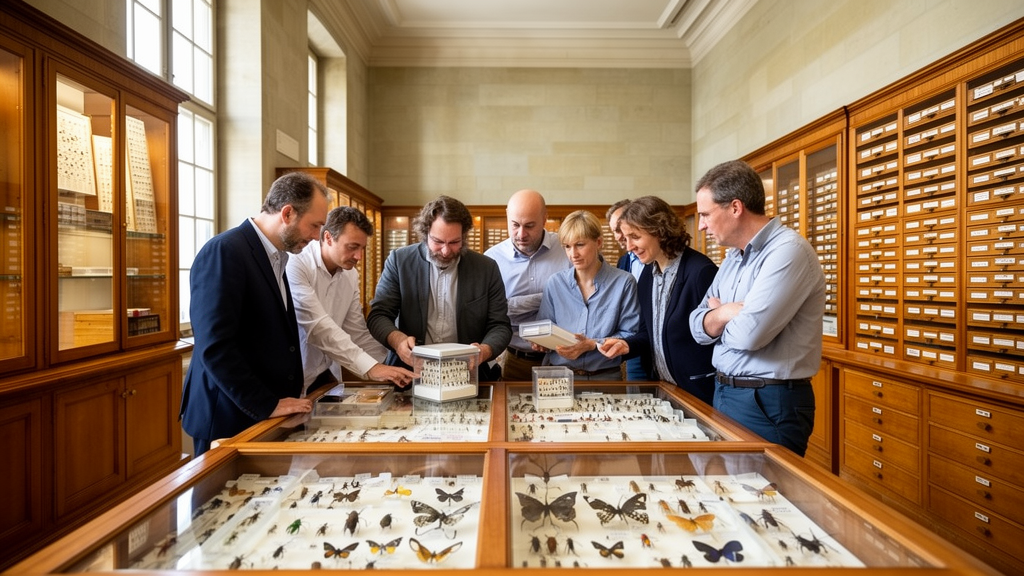
Digitization and scientific communication were also prominent. Hannes Baur of the Natural History Museum Bern presented “Ans Licht geholt,” a project making the museum’s insect holdings accessible through the internet. In the society’s institutional report, the president noted that the Swiss Academy of Sciences had launched an initiative to digitize all natural-history collections in Switzerland, with members of the Swiss Entomological Society involved in that work.
The annual report also described continuing public and professional engagement with insect decline, including media inquiries, panel discussions and contributions to a Hotspot issue devoted to insects. Those activities were reported as society business rather than as new measurements of insect abundance, and the protocol did not present a new trend analysis or causal assessment. At the general meeting, Hannes Baur opened proceedings at 10:10, and the members present approved the 2019 minutes without amendment.
The report said that requests for financial support had been granted in full by the Swiss Academy of Sciences, the Biedermann-Mantel Foundation and Syngenta, which contributed CHF 7,500, CHF 6,000 and CHF 6,000 respectively. The 2019 accounts showed an annual profit of CHF 6,581.53 and assets of CHF 109,416.19. Auditors Michel Sartori and Yannick Chittaro found that the opening balance, annual accounts and receipts corresponded with the accounts submitted, and the members granted discharge to the treasurer.
The 2020 budget anticipated a profit of CHF 0, while membership fees remained CHF 60 for members in Switzerland and CHF 30 for students or others in training for three years. Members elected Oliver Martin of ETH Zurich as president for the 2020–2023 term. Baur moved to the position of vice-president, and Stefan Ungricht became an assessor, while the other board changes were also approved unanimously.
The society’s publishing activities included the third issue of Alpine Entomology in 2019, which comprised 15 articles on 217 pages: 13 research articles, one short note and a meeting report. Ten of the 13 research articles were in English, and the journal had entered the Emerging Sources Citation Index in March 2019. Fauna Helvetica published volumes on vespid wasps and amphipods, and Meloe proscarabaeus, the black-and-blue oil beetle, was chosen as the insect of the year for 2020.
The protocol concluded with the announcement that the next annual meeting would take place on 5 and 6 March 2021 at the Museo cantonale di storia naturale in Lugano.
Subject of Research: Meeting report on Swiss insect research, invasive species, phylogenomics, taxonomy and digital natural-history collections
Article Title: Protokoll der Jahresversammlung der Schweizerischen Entomologischen Gesellschaft vom 6. und 7. März am Naturhistorischen Museum Basel
Article References: Neumann, M. (2020). Protokoll der Jahresversammlung der Schweizerischen Entomologischen Gesellschaft vom 6. und 7. März am Naturhistorischen Museum Basel. Alpine Entomology, 4, 189-193. https://doi.org/10.3897/alpento.4.59809
Image Credits: AI Generated
Keywords: Swiss entomology, annual meeting, invasive insects, insect phylogenomics, taxonomy, biodiversity inventories, museum collections, citizen science, digital collections, agricultural pests, Protokoll, Jahresversammlung
News Source: Gavin Prescott. (October 20, 2026). Research report: Protokoll der Jahresversammlung der Schweizerischen Entomologischen Gesellschaft vom 6. und 7. März am Naturhistorischen Museum Basel. Scienmag.