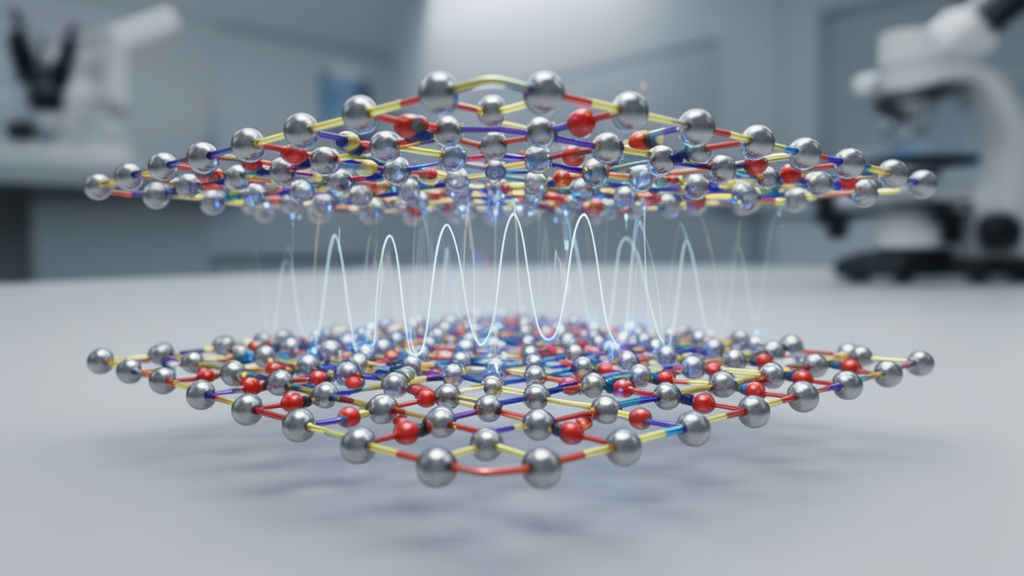
Changing the stacking order of two-dimensional indium selenide can switch or eliminate ferroelectric polarization, according to a study that grew large-area films of two polymorphs with controlled 2H and 3R configurations. The researchers used chemical vapour deposition to regulate selenium kinetics and strain relaxation, producing β′-In2Se3 and α-In2Se3 in specific stacking arrangements. Their analysis found that the structural differences strongly correlated with ferroelectric behaviour: β′-In2Se3 changed from antiferroelectric to paraelectric when switched from 2H to 3R stacking, whereas α-In2Se3 lost its in-plane ferroelectric polarization during a 3R-to-2H transition. The results demonstrate that stacking order is a structural parameter for tailoring polarization in the same two-dimensional material.
This materials study combined atomic-resolution microscopy, non-linear optical characterization and first-principles calculations to connect atomic arrangement with polarization. The microscopy and optical measurements were used alongside calculations rather than relying on a single type of observation, allowing the investigators to examine how the 2H and 3R configurations differ in their structural and ferroelectric properties. The reported transitions also show that the effect is polymorph-dependent. For β′-In2Se3, the stacking change altered the material from antiferroelectric to paraelectric; for α-In2Se3, the relevant structural change removed in-plane ferroelectric polarization. The work therefore addresses the largely unexplored role of stacking order in intrinsic two-dimensional ferroelectric systems.
The team subsequently combined the stacking configurations to create controlled 2H/3R ferroelectric homojunctions made from In2Se3. Differential phase-contrast scanning transmission electron microscopy directly visualized polarization-dependent potential barriers at the interfaces. These junctions also exhibited switchable band alignment and tunable carrier transport, linking the local polarization arrangement to the behavior of charge carriers across the engineered boundary. The results do not establish that such interfacial properties are inherently difficult to control in single-stacking material; rather, they show that the homojunctions possess switchable band alignment and tunable transport as directly observed and measured in the study.
Stacking-engineered homojunctions translated those structural effects into improved laboratory memristor behavior. Devices incorporating the junctions had significantly reduced switching voltages compared with devices based on single-stacking α-In2Se3. Their on/off ratio reached approximately 2.6 × 10^4, about one order of magnitude higher than that of the single-stacking α-In2Se3 devices used for comparison. These are measured device results rather than predictions: the report identifies lower switching voltage and a larger separation between resistance states in the homojunction devices. It does not establish performance beyond the tested laboratory configurations or demonstrate a commercial memory application.
Taken together, the experiments identify stacking order as a way to alter ferroelectricity without changing the chemical identity of the material and as a basis for constructing polymorphic homojunctions. The synthesis strategy provided large-area β′- and α-In2Se3 films with selectable 2H or 3R structures, while microscopy, optical measurements and calculations established how those structures govern polarization. The junctions then provided a route to switchable band alignment, tunable carrier transport and memristors with reduced switching voltages and an on/off ratio of approximately 2.6 × 10^4. The authors describe the resulting stacking-engineered polymorphic heterogeneity as a platform for two-dimensional ferroelectronics and memory technologies, although the reported evidence remains at the material-and-device research stage.
Subject of Research: Stacking-controlled ferroelectricity and memristor behavior in two-dimensional In2Se3
Article Title: Stacking-specific two-dimensional In2Se3 for ferroelectric homojunctions
Article References: Zheng, X., Yang, T., He, X., Zhang, W., Tsang, C. S., Li, Y., Wong, L. W., Yan, Z., Zhang, J., Chen, T., Chen, H., Jia, R., Lee, C.-S., Lau, S. P., Zheng, S., Zhao, J., Yang, M., & Ly, T. H. (2026). Stacking-specific two-dimensional In2Se3 for ferroelectric homojunctions. Nature Nanotechnology. https://doi.org/10.1038/s41565-026-02309-8
Image Credits: AI Generated
DOI: 10.1038/s41565-026-02309-8
Keywords: two-dimensional materials, indium selenide, ferroelectricity, stacking order, homojunctions, memristors, chemical vapour deposition, band alignment, polarization, atomic-resolution microscopy, Stacking-specific, two-dimensional
News Source: Denise Maddox. (October 20, 2026). Stacking Order Reshapes Ferroelectricity in Two-Dimensional Indium Selenide. Scienmag.