• HOME
  • NEWS
  • EXPLORE
    • CAREER
      • Companies
      • Jobs
    • EVENTS
    • iGEM
      • News
      • Team
    • PHOTOS
    • VIDEO
    • WIKI
  • BLOG
  • COMMUNITY
    • FACEBOOK
    • INSTAGRAM
    • TWITTER
Tuesday, October 20, 2026
BIOENGINEER.ORG
No Result
View All Result
  • Login
  • HOME
  • NEWS
  • EXPLORE
    • CAREER
      • Companies
      • Jobs
        • Lecturer
        • PhD Studentship
        • Postdoc
        • Research Assistant
    • EVENTS
    • iGEM
      • News
      • Team
    • PHOTOS
    • VIDEO
    • WIKI
  • BLOG
  • COMMUNITY
    • FACEBOOK
    • INSTAGRAM
    • TWITTER
No Result
View All Result
Bioengineer.org
No Result
View All Result
Home NEWS Science News Technology

Laboratory tests map compressive-strength trends in EICP-treated loess

by
October 20, 2026
in Technology
Reading Time: 2 mins read
0
Laboratory tests map compressive-strength trends in EICP-treated loess

Enzyme-Driven Mineralization Turns Collapsing Loess Into Stronger Ground

Share on FacebookShare on TwitterShare on LinkedinShare on RedditShare on Telegram

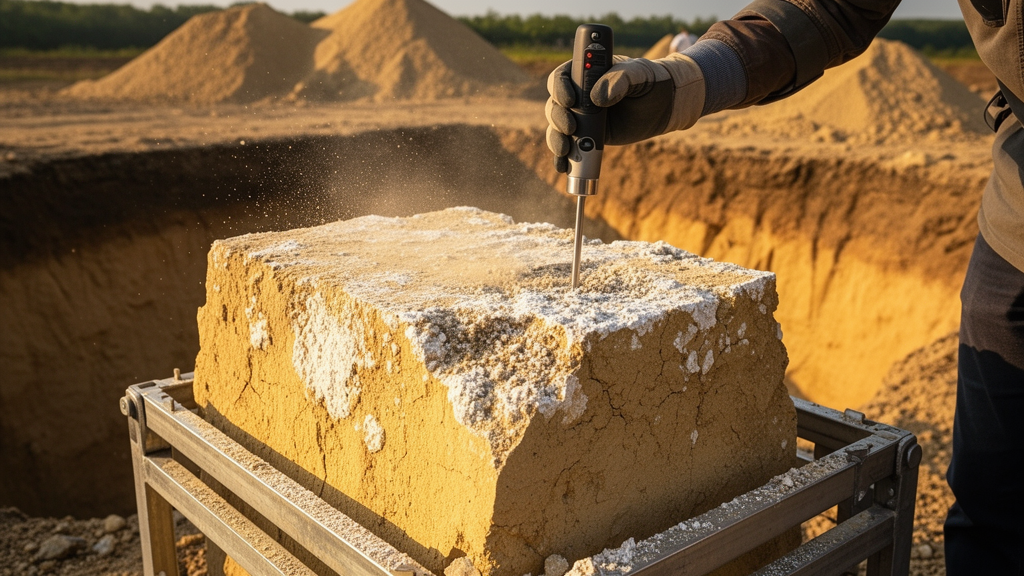
Laboratory experiments described in a Scientific Reports abstract mapped how preparation conditions and soil properties influenced the unconfined compressive strength of loess treated with enzyme-induced calcium carbonate precipitation (EICP). The reported maximum occurred among specimens prepared at a dry density of 1.55 g/cm³ with 4% sodium montmorillonite content. The abstract does not provide an untreated-loess comparison, so it does not establish the magnitude of any treatment-versus-control difference.

The researchers used an orthogonal test design to assess enzyme concentration during the mineralization process. Experiments controlled cementing-solution concentration, soybean powder concentration, skimmed milk powder concentration, pH and standing time, with the results used to determine an optimal mineralization condition. The abstract identifies that condition as 200 g/L soybean powder, 1.50 mol/L cementing solution, 2 g/L skimmed milk powder, pH 7 and a standing time of 120 hours. It does not report the resulting calcium carbonate content in the supplied text.

Unconfined compressive strength tests examined the effects of dry density, cementing-solution content, the enzyme-to-cementation-solution ratio and sodium montmorillonite content. Within the tested ranges, measured strength increased as initial dry density and sodium montmorillonite concentration increased. Strength followed a non-linear response to cementing-solution content: it first increased and then decreased as that content rose, reaching the reported maximum at 14%. Likewise, strength first increased and then decreased as the enzyme-to-cementation-solution ratio decreased, with the maximum reported at a ratio of 2:3. The stress–strain curve for EICP-treated loess was divided into four observed stages: a slowly ascending stage, a fast-growing stage, a slow-growth stage and an attenuation-decrease stage.

The available evidence is limited to the abstract of an experimental laboratory study. It does not state specimen counts, numerical UCS values, statistical uncertainty, an untreated comparison, long-term durability results or performance under field conditions. Although the authors said the findings could support practical implementation of EICP for foundation treatment, the abstract describes no field trial or broader validation. The reported trends and maxima therefore apply to the preparation conditions and test scope described in the abstract.

Subject of Research: Laboratory evaluation of preparation conditions and compressive strength in EICP-treated loess

Article Title: Research on the mechanical properties of loess solidified via enzyme induced calcium carbonate precipitation (EICP)

Article References: Chen, S., Liu, J., Li, G., & Chen, C. (2026). Research on the mechanical properties of loess solidified via enzyme induced calcium carbonate precipitation (EICP). Scientific Reports. https://doi.org/10.1038/s41598-026-75677-9

Image Credits: AI Generated

DOI: 10.1038/s41598-026-75677-9

Keywords: loess, enzyme-induced calcium carbonate precipitation, EICP, unconfined compressive strength, soil stabilization, sodium montmorillonite, cementing solution, laboratory testing, Research, mechanical, properties, solidified

News Source: Denise Maddox. (October 20, 2026). Laboratory tests map compressive-strength trends in EICP-treated loess. Scienmag.


Tags: cementing solutionEICPenzyme-induced calcium carbonate precipitationlaboratory testingloessmechanicalpropertiesresearchsodium montmorillonitesoil stabilizationsolidifiedunconfined compressive strength
Share12Tweet7Share2ShareShareShare1

Related Posts

StrokeTime maps cellular responses across the mouse brain’s stroke timeline

StrokeTime maps cellular responses across the mouse brain’s stroke timeline

October 20, 2026
Laboratory Fe2O3/Co3O4 particle electrode achieves 93.4% tetracycline removal under optimized conditions

Laboratory Fe2O3/Co3O4 particle electrode achieves 93.4% tetracycline removal under optimized conditions

October 20, 2026

Scopus bibliometric review maps 2015–2025 growth in AI research for sustainable water management

October 20, 2026

Rank fusion improves malware detection in three longitudinal benchmarks, with threshold drift limiting gains

October 20, 2026

POPULAR NEWS

  • Health literacy moderates the link between health perception and surgical fear in cataract patients

    Health literacy moderates the link between health perception and surgical fear in cataract patients

    29 shares
    Share 12 Tweet 7
  • StrokeTime maps cellular responses across the mouse brain’s stroke timeline

    29 shares
    Share 12 Tweet 7
  • Review examines amino acid transporters as metabolic vulnerabilities in liver cancer

    29 shares
    Share 12 Tweet 7
  • Retrospective cohort reports frequent subsequent CRE infection after rectal colonization in adult ICU patients

    29 shares
    Share 12 Tweet 7

About

We bring you the latest biotechnology news from best research centers and universities around the world. Check our website.

Follow us

Recent News

Health literacy moderates the link between health perception and surgical fear in cataract patients

StrokeTime maps cellular responses across the mouse brain’s stroke timeline

Review examines amino acid transporters as metabolic vulnerabilities in liver cancer

Subscribe to Blog via Email

Enter your email address to subscribe to this blog and receive notifications of new posts by email.

Join 85 other subscribers
  • Contact Us

Bioengineer.org © Copyright 2023 All Rights Reserved.

Welcome Back!

Login to your account below

Forgotten Password?

Retrieve your password

Please enter your username or email address to reset your password.

Log In
No Result
View All Result
  • Homepages
    • Home Page 1
    • Home Page 2
  • News
  • National
  • Business
  • Health
  • Lifestyle
  • Science

Bioengineer.org © Copyright 2023 All Rights Reserved.