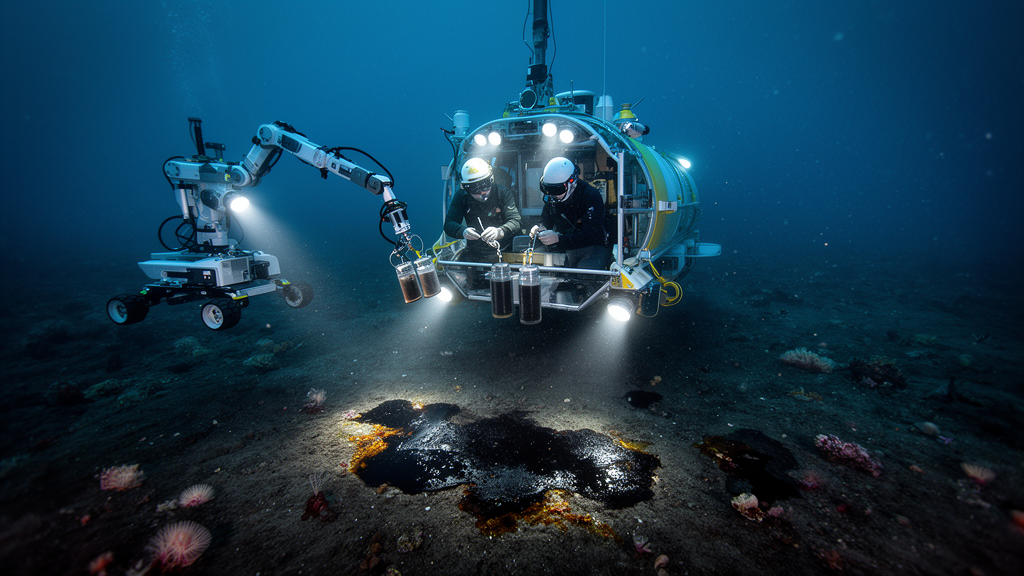
A long-term assessment of the open Gulf of America found that deep-water fish, large crustaceans and small squid declined sharply after the 2010 Deepwater Horizon spill and had not returned to their earlier abundance by the end of the study period. Researchers combining more than 2,000 net samples with acoustic surveys and genetic analyses reported declines of 64% in fishes, 62% in large crustaceans and 60% in small squid and other cephalopods. The findings, published in Proceedings of the National Academy of Sciences, describe a sustained disruption across the deep-pelagic ecosystem rather than a brief post-spill change.
The study examined the dark midwater region extending from the surface to depths of about 600–5,000 feet. This vast habitat includes the deep scattering layer, where fish, squid, krill and other small animals rise toward the surface at night to feed and descend again during the day. It represents more than 90% of the Gulf’s volume and supports a diverse community of animals that forms an important link between surface production and larger predators. The authors said their use of independent sampling methods helped establish that the pattern extended across the ecosystem.
The net samples were collected from 2011 through 2023 and paired with acoustic surveys that measured the distribution of organisms in the water column. Researchers also examined changes in genetic diversity in three lanternfish species. Some components of the community were affected more severely than the broad group estimates: krill declined by nearly 73%, bristlemouth fishes by 69% and lanternfishes by 63%. The consistency of these patterns across multiple approaches indicates that the changes were not limited to one sampling technique or a narrow group of organisms.
Concentrations of prey that had been common in 2011 also virtually disappeared by 2023. Those dense patches are important because they can improve the energetic payoff for whales, dolphins, tuna, sharks, seabirds and other predators searching for food in deep or open water. The study therefore connects the measured decline in midwater organisms with a potential loss of food resources for higher consumers. The authors did not directly demonstrate predator outcomes, but the disappearance of prey aggregations provides a mechanism through which the disruption could propagate through Gulf food webs.
The researchers investigated several alternative explanations for the declines. They used consistent sampling equipment and methods, accounted for differences among Gulf water masses and found no comparable changes in deep-water temperature, oxygen or food availability. Those checks weakened the possibility that the observed pattern was simply an artifact of inconsistent sampling or major environmental shifts in the physical and chemical conditions of the deep Gulf. Even abundant, widely distributed species can undergo substantial changes without obvious signs at the surface, making sustained monitoring especially important for organisms that are otherwise difficult to observe.
Although the study does not establish direct causation, the authors identified the Deepwater Horizon spill and the response activities associated with it as the most plausible explanation for the timing and scale of the decline. The disaster released an estimated 4 million to 4.9 million barrels of oil, and approximately 770,000 gallons of chemical dispersant were injected near the wellhead. Oil-related compounds have subsequently been detected in deep-water fish eggs and cephalopod tissue. The source material notes that such contamination can cause mortality, developmental damage and reduced fitness and may interfere with the ability of widely dispersed deep-sea fishes to locate mates in darkness.
Genetic diversity emerged as another concern. Analyses of three lanternfish species tracked changes that may indicate consequences for the capacity of populations to adapt. One of the researchers described genetic diversity as a form of insurance because it supports the evolutionary potential species need to respond to environmental change. The study’s combination of abundance, acoustic and genetic data suggests that the disruption affected not only the number of animals but also potentially important dimensions of the biological community beneath the surface. The authors warned that declines among species historically viewed as abundant or widespread could otherwise remain unnoticed without dedicated monitoring.
Taken together, the results suggest that the Gulf may have entered a persistently depleted ecological state with no clear timetable for recovery. The losses extend beyond the immediate location of the wellhead because the affected deep-pelagic community spans a vast area of the open Gulf. These animals are prey for some of the ocean’s largest predators and participate in the movement of carbon from surface waters into the deep ocean. Their decline may therefore weaken marine food webs and reduce the ecosystem’s capacity to store carbon. The study offers no basis for a specific recovery forecast, but its 2011–2023 observations show that the major declines persisted for at least much of the 16 years following the spill, with prey aggregations continuing to be scarce at the end of the record.
Subject of Research: Long-term assessment of deep-pelagic population decline following the Deepwater Horizon oil spill in the Gulf of America.
Article Title: Life in the deep Gulf plummeted after Deepwater Horizon
Article References: Life in the deep Gulf plummeted after Deepwater Horizon. Original publication (Bibliographic details unavailable.)
Image Credits: AI Generated
DOI: Not provided
Keywords: Deepwater Horizon, Gulf of America, deep-pelagic ecosystem, marine populations, oil spill, lanternfish, cephalopods, acoustic surveys, genetic diversity, food webs, Life, deep
News Source: Drew Townsend. (October 20, 2026). Deep-Gulf life remains depleted 16 years after oil spill. Scienmag.