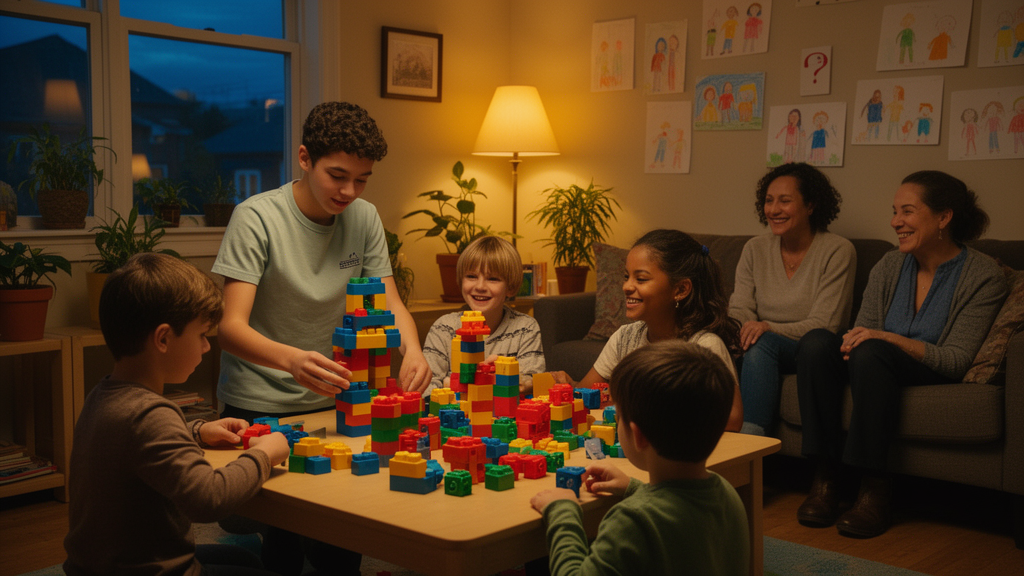
Parents of children participating in Malmö’s All-Activity Houses reported that the programme strengthened social relationships among children, created a stronger sense of community for families and helped children become more active, confident and joyful. The findings come from a qualitative focus-group study, rather than a trial or other design capable of establishing that the activities caused changes in well-being.
The study was conducted within a community-based participatory research programme involving families, peer leaders, programme directors and academic researchers in three disadvantaged areas of Malmö, Sweden. The All-Activity Houses provide free after-school activities at schools for children aged 6 to 16. Depending on the site, activities include sports, dance, music, cooking, creative pursuits and social gatherings involving families. The three included houses opened in 2011, 2018 and 2022, and their activities are developed in close collaboration with participating children.
Researchers used a series of multi-stage focus groups conducted between June 2023 and September 2024. Approximately 50 parents were invited through meetings associated with their children’s participation, and 18 subsequently joined the study. They included three fathers and 15 mothers representing nine national backgrounds: Kosovo, Syria, Albania, Iraq, Somalia, Palestine, Afghanistan, Morocco and Kurdistan. Seven parents attended two sessions and 11 attended one session. Across the three houses, researchers held seven dialogues lasting about 45 minutes each, conducted in Swedish with Arabic and Somali interpretation where needed.
Following the final dialogue, the researchers reported that no new information had emerged, indicating that saturation had been reached. The recordings were transcribed, and the first author conducted inductive content analysis through open coding, grouping similar codes into subcategories and developing two main categories. Other researchers reviewed the coded material and the final analysis. The authors described the analysis as a form of field validity, while noting that member checking with participants was not possible for logistical reasons.
Parents said the activities helped children build friendships and meet peers in person rather than primarily communicating through phones. Some described children visiting one another’s homes after activities. Parents also reported that their children developed language skills, confidence in expressing themselves and greater willingness to engage in activities independently. For families, participation opened opportunities to meet other parents, exchange contact details and organize later gatherings.
Family excursions and group activities were also valued because financial constraints limited some families’ ability to travel beyond their immediate area. Some parents said that being among other mothers at activities such as dance classes provided relief from the workload at home, while others associated social interaction with opportunities to learn Swedish. Parents also valued receiving direct feedback from peer leaders about their children’s participation and progress, describing the leaders as trusted adults who listened to and affirmed children.
The programme was also associated by parents with changes in children’s everyday routines. Children reportedly spent more time playing football, dancing or taking part in other physical activities and less time using phones, computers or television. Parents observed increased self-esteem, independence and the development of practical skills such as baking, as well as greater willingness to ask questions and express themselves. Activity days were described as producing visible joy, with children looking forward to participating and returning home eager to discuss what they had done.
Despite the positive perceptions, parents also expressed a need for more support in parenting. They asked for parent support groups in their own communities, particularly for parents who speak little Swedish, and wanted clearer information about parenting resources and how Swedish social services and police procedures work. The findings indicate that some parents were reluctant to seek help because they regarded authorities as threatening. This request for information concerned parents’ own contact with public agencies; the study did not establish that peer leaders acted as links between families and public services.
The study has important limitations. The sample was self-selected from parents who attended information meetings, potentially favouring those who were more integrated or socially advantaged. No sociodemographic information was collected about parents who did not attend those meetings. Most participants attended only one session, and interpretation may have affected power relations within groups, although the researchers used the same Arabic interpreter throughout and a well-regarded Somali interpreter. The interview guide had not been pilot-tested, and the findings cannot be generalised as causal effects because there was no comparison group or quantitative assessment of well-being. The authors called for further quantitative research to examine the programme’s possible effects and measure social capital. Few parents perceived gender-related differences in how the activities affected their children’s well-being, so the study produced no substantive findings on that question.
Subject of Research: Parents’ perceptions of children’s well-being and family social relationships in Malmö’s All-Activity Houses
Article Title: Parents’ views on their own and their children’s well-being in the context of organised after-school activities in disadvantaged areas
Article References: Mangrio, E., Zarzour, N., & Rämgård, M. (2026). Parents’ views on their own and their children’s well-being in the context of organised after-school activities in disadvantaged areas. BMC Public Health, 26(1), Article 2967. https://doi.org/10.1186/s12889-026-29898-2
Image Credits: AI Generated
DOI: 10.1186/s12889-026-29898-2
Keywords: All-Activity Houses, Malmö, child well-being, after-school activities, focus groups, community-based participatory research, social capital, peer leaders, parental support, Sweden, Parents, views
News Source: Ophelia Keating. (October 20, 2026). Qualitative Malmö focus-group study links after-school activities with stronger family social ties and perceived child well-being. Scienmag.