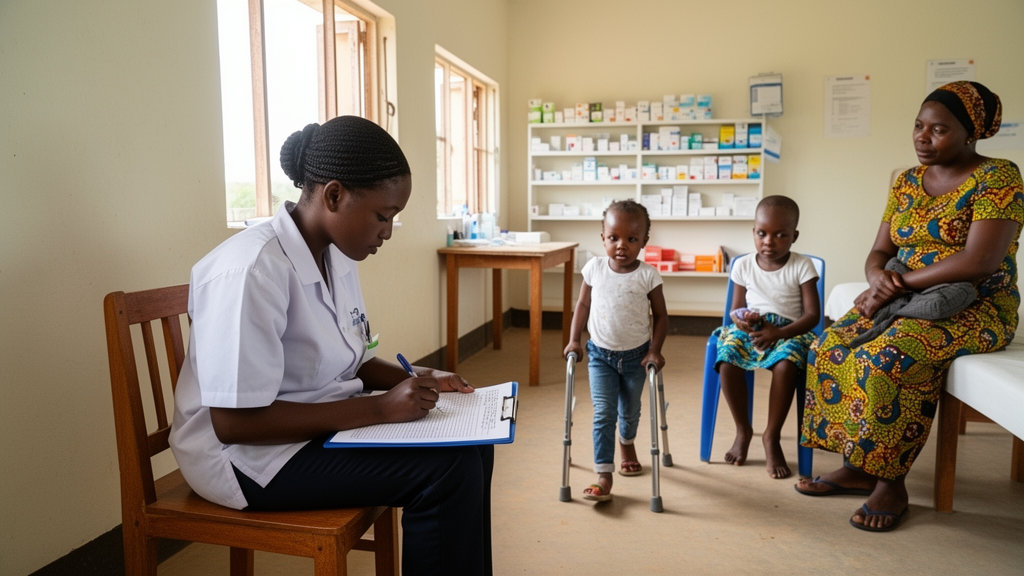
Community health workers in Rwanda commonly reported encountering children with physical or mental disabilities in the communities they served, according to a quantitative study of 358 workers. Overall, 63.6% said they had observed at least one child with a disability. The study captures community health workers’ reports rather than a population prevalence estimate, because it neither clinically assessed children nor surveyed every child in a defined population.
Researchers analyzed secondary data from the 358 participating community health workers, or CHWs. Each worker reported whether they had observed at least one child with a physical or mental disability in their community. The sample’s median age was 45 years, and 57.7% of participants were female. Descriptive statistics summarized workers’ characteristics and their reported observations, while bivariate and multivariable logistic regression analyses examined factors associated with reporting childhood disabilities.
The most frequently reported physical conditions were genu valgum, mentioned by 38.3% of participating workers; clubfoot, reported by 36.1%; and hearing impairment, reported by 34.0%. For mental or developmental conditions, 40.1% of workers reported observing developmental delay and 21.7% reported epilepsy. These figures represent the percentages of health workers who mentioned each condition, not the percentages of children who had it. The design therefore describes the range and frequency of workers’ observations but cannot establish how many children in Rwanda live with each disability.
Referral was a prominent part of workers’ reported activity: 94.6% said they had referred cases to health facilities. The regression analysis identified two factors associated with whether workers reported observing children with disabilities. Female workers had higher odds of reporting a case than male workers, with an adjusted odds ratio of 2.03, a 95% confidence interval of 1.27–3.23 and a p-value of 0.003. Workers with 11–15 years of experience also had higher odds of reporting childhood disabilities than those with fewer than five years of experience, with an adjusted odds ratio of 2.22, a 95% confidence interval of 1.08–4.56 and a p-value of 0.030. These statistical associations do not establish that gender or experience caused differences in reporting.
The findings position community health workers as potential identifiers and referral points for childhood disabilities in rural, low-resource settings, where access to early diagnosis, care and support systems may be limited. The researchers concluded that strengthening workers’ capacity through targeted training, screening tools and improved referral systems may enhance early identification and equitable access to care. The study itself did not test those interventions or measure whether stronger screening and referral systems improve child outcomes. It instead provides descriptive evidence about the conditions workers reported observing, their referral activity and the worker characteristics associated with reporting a case. Direct child-level assessment would be required to estimate population prevalence, while evaluation of training, screening and referral approaches would be needed to determine whether they improve diagnosis and care.
Subject of Research: Community health worker reports of childhood physical and mental disabilities in rural Rwanda
Article Title: Community health worker–reported observations of physical and mental disabilities among children in rural setting in Rwanda
Article References: Umurerwa, M., uwimpuhwe, D., Dukuzimana, M. J., Franke, M. A., Mukundwa, P. N., & Ngwakongnwi, E. (2026). Community health worker–reported observations of physical and mental disabilities among children in rural setting in Rwanda. BMC Health Services Research. https://doi.org/10.1186/s12913-026-15875-3
Image Credits: AI Generated
DOI: 10.1186/s12913-026-15875-3
Keywords: Rwanda, childhood disability, community health workers, rural health, physical disability, mental disability, developmental delay, clubfoot, hearing impairment, health referrals, Community, health
News Source: Ophelia Keating. (October 20, 2026). Rwanda health worker survey reports childhood disability observations. Scienmag.