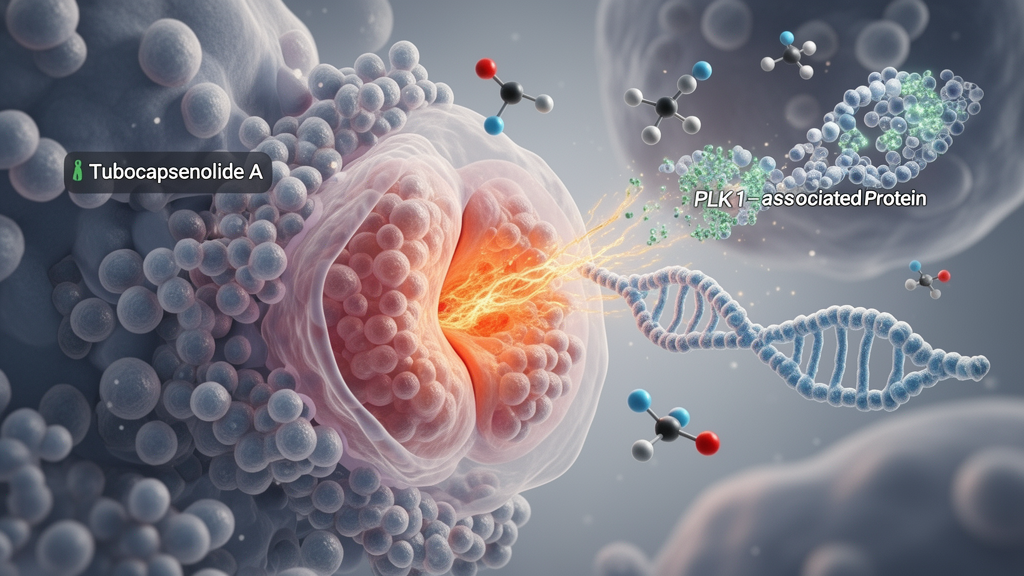
A preclinical study reports that tubocapsenolide A (TA), a natural withanolide isolated from Tubocapsicum anomalum , can weaken oxaliplatin resistance in colorectal cancer cells by inhibiting polo-like kinase 1 (PLK1) and disrupting a PLK1–CEP55–ESCRT pathway associated with vesicular handling of chemotherapy-induced damage. The research combined patient-derived organoids, resistant colorectal cancer cell lines, mouse xenografts, biochemical assays and imaging. In the experimental systems studied, TA reduced the extrusion of damaged nuclear and mitochondrial material, allowing damage to accumulate inside oxaliplatin-resistant cells and increasing their sensitivity to the drug.
The findings identify a potential lead compound and a previously unrecognized resistance mechanism, but they do not establish a clinical treatment or human safety. The authors first identified a distinctive phenotype in oxaliplatin-resistant colorectal cancer cells. HCT116-OR cells, selected to resist oxaliplatin, and parental HCT116 cells engineered to overexpress PLK1 developed more nuclear buds containing DNA labeled by the DNA-damage marker γ-H2A.X after exposure to oxaliplatin.
The resistant cells also produced more mitochondrial-derived vesicles, characterized by the presence of the mitochondrial matrix protein PDH and the absence of the outer-membrane protein TOM20. Vesicular fractions isolated from resistant cells contained more mitochondrial DNA, including mtCo3, mtND1 and mtD-loop sequences. PLK1 knockdown or TA treatment reduced nuclear budding, mitochondrial-derived-vesicle formation and the export of damaged DNA, while increasing the retention of damaged chromatin within the nucleus.
The mechanism connects PLK1 with the endosomal sorting complexes required for transport, or ESCRT. ESCRT proteins participate in membrane constriction and scission, and the ESCRT-III subunit CHMP4B accumulated at the necks of nuclear buds and on mitochondria in oxaliplatin-resistant HCT116 and HCT-8 cells. TA treatment and PLK1 knockdown suppressed this recruitment.
PLK1 appeared to regulate the process through phosphorylation of the adaptor protein CEP55 at serine 436. That phosphorylation reduced CEP55 association with KIF23, while increasing its association with the ESCRT-associated proteins ALIX and TSG101. Rescue experiments supported a functional role for this modification: the phospho-deficient CEP55S436A mutant failed to restore nuclear budding, mitochondrial-derived vesicles, vesicular mitochondrial DNA and CHMP4B recruitment efficiently, whereas the phosphomimetic CEP55S436D variant partially restored these phenotypes after CEP55 depletion.
The results suggest that resistant colorectal cancer cells may repurpose machinery normally involved in cytokinetic abscission to support a damage-clearance program under platinum stress. Several biochemical and biophysical experiments identified PLK1 as a direct target of TA. A TA-derived proteolysis-targeting chimera promoted PLK1 degradation, and quantitative proteomics identified PLK1 as the most strongly depleted protein in the relevant proteomic comparison.
Affinity pull-down with a biotinylated TA probe enriched recombinant PLK1, and competition with free TA reduced that enrichment. A fluorescent TA probe colocalized with PLK1 in HCT116 cells, while cellular thermal-shift and protease-protection assays supported intracellular engagement. Surface plasmon resonance measured a dissociation constant of 7.59 micromolar for full-length PLK1, and microscale thermophoresis gave 12.85 micromolar.
Photoaffinity labeling and mass spectrometry mapped the interaction to two candidate regions, including a pocket at the junction between the kinase and polo-box domains. Mutation experiments showed that replacing R135 or W410 markedly weakened TA binding, supporting those residues as important components of the interaction. TA also directly inhibited PLK1 catalytic activity in an in vitro kinase assay using a CEP55-derived peptide.
Its half-maximal inhibitory concentration was approximately 2.24 micromolar at 50 micromolar ATP and 2.34 micromolar at 200 micromolar ATP. The investigators interpreted this relative insensitivity to ATP concentration as consistent with binding at the kinase-domain–polo-box-domain interface rather than simple competition at the canonical ATP-binding site. In cellular experiments, TA reduced CEP55 serine-436 phosphorylation, diminished the association of phosphorylated CEP55 with ALIX and TSG101, and prevented CHMP4B recruitment at membrane-budding sites.
The study therefore proposes that TA interrupts a molecular relay linking PLK1 activity to ESCRT-mediated scission, rather than producing its effects only through generalized mitotic arrest. At cytotoxic concentrations, TA generated a broad cellular stress response in colorectal cancer models. Proteomic pathway analysis placed cell-cycle disruption upstream of reactive oxygen species accumulation, altered glutathione metabolism, DNA damage, mitochondrial impairment and cell-death programs.
In HCT116 cells, TA reduced viability and clonogenicity, increased reactive oxygen species, depleted reduced glutathione and reduced ATP production. Mitochondria became fragmented and lost membrane potential, while oxidative DNA damage measured as 8-hydroxy-2′-deoxyguanosine and nuclear foci marked by 53BP1 increased. Indicators of lipid peroxidation, including malondialdehyde, 4-hydroxynonenal and Liperfluo signal, rose along with intracellular ferrous iron.
The ferroptosis-associated protein GPX4 was downregulated. PLK1 knockdown attenuated these responses, while the ferroptosis inhibitor ferrostatin-1 reduced iron accumulation and lipid peroxidation. These findings link PLK1 to the cellular consequences of TA treatment, but they were obtained in cultured cells and preclinical models rather than in patients.
Antitumor activity was also observed across several experimental systems. TA inhibited a panel of colorectal cancer cell lines, with half-maximal inhibitory concentrations ranging from 0.47 to 4.02 micromolar. In HCT116 and DLD-1 mouse xenografts, intragastric administration of 10 to 40 milligrams per kilogram suppressed tumor progression in a dose-dependent manner without significant body-weight loss.
Under the tested regimen, oxaliplatin produced comparable tumor inhibition in the HCT116 model but caused substantial weight loss. TA also disrupted patient-derived colorectal organoids established from primary tumors, and most of the organoids were more sensitive to TA than to oxaliplatin or 5-fluorouracil. In acute mouse testing, oral doses as high as 1,000 milligrams per kilogram produced no mortality or apparent behavioral abnormalities, and serum markers and histology of major organs did not show significant treatment-associated abnormalities.
The acute-toxicity groups were small, however, and favorable tolerability in these models does not establish safety in people. Pharmacokinetic measurements identified a substantial limitation to TA’s development potential. After intravenous administration in rats, the compound had an approximate elimination half-life of 1.6 hours and extensive tissue distribution, with an apparent volume of distribution of 14.7 liters per kilogram.
Oral administration produced a longer apparent half-life of about four hours, consistent with delayed gastrointestinal absorption, but absolute oral bioavailability was only about 17%, compared with approximately 85% after intraperitoneal administration. The authors considered limited absorption and presystemic metabolism as possible explanations. TA consequently remains a preclinical compound with an exposure profile that would require further development.
Clinical transcriptomic data supported the relevance of PLK1 to resistance without establishing its value as a clinical biomarker. Across seven colorectal cancer cohorts containing 408 patient samples, PLK1 expression was higher in nonresponders than in responders and yielded an area under the receiver operating characteristic curve of 0.701. Higher PLK1 expression was also associated with poorer overall survival in a TCGA colorectal cancer analysis, and CRISPR-Cas9 dependency data classified PLK1 as pan-essential across diverse colorectal adenocarcinoma lineages.
In cell experiments, PLK1 overexpression conferred oxaliplatin resistance, whereas PLK1 depletion resensitized resistant cells. TA and oxaliplatin were synergistic in resistant HCT116 and HCT-8 models: in one assay, 0.2 micromolar TA lowered the oxaliplatin half-maximal inhibitory concentration from 31.88 ± 4.11 micromolar to 7.52 ± 1.48 micromolar. In HCT116-OR xenografts, low-dose TA combined with oxaliplatin produced greater tumor-growth inhibition than the FOLFOX comparator regimen, without significant body-weight loss.
Low-dose TA appeared to act primarily as a chemosensitizer rather than as an independently lethal agent. At 0.2 micromolar, TA alone did not appreciably alter cell-cycle distribution, apoptosis, lipid peroxidation or intracellular ferrous iron after 24 hours. When combined with oxaliplatin, it increased G2/M accumulation and apoptosis.
Early measurements of LC3B and p62 with lysosomal inhibition showed no substantial alteration in autophagic flux during this treatment window, suggesting that autophagy was not prominently involved then, although the study did not exclude a later role. Taken together, the results support an adaptive model in which elevated PLK1 activity helps colorectal cancer cells remove locally damaged nuclear and mitochondrial components through a CEP55-dependent ESCRT pathway. By lowering CEP55 serine-436 phosphorylation and reducing ESCRT recruitment, TA leaves more genomic and mitochondrial damage inside resistant cells, intensifying oxidative stress, mitochondrial dysfunction and ferroptotic signaling.
The work provides a detailed preclinical mechanism for a possible chemosensitizing strategy, while the compound’s pharmacology and the pathway’s human therapeutic relevance remain to be established.
Subject of Research: Preclinical disruption of PLK1–CEP55–ESCRT damage clearance to sensitize colorectal cancer to oxaliplatin.
Article Title: Tubocapsenolide A Overcomes Oxaliplatin Resistance in Colorectal Cancer by Targeting PLK1 to Impair CEP55–ESCRT‐Associated Vesicular Damage Clearance
Article References: Yang, Y., Liang, J., Wang, L., Zhang, H., Zhang, Z., Liu, Y., Zhu, R., Xu, W., Xu, S., Sun, D., Xiang, K., Wang, Y., Fan, Z., Wang, Z., Li, H., & Chen, L. (2026). Tubocapsenolide A Overcomes Oxaliplatin Resistance in Colorectal Cancer by Targeting PLK1 to Impair CEP55–ESCRT‐Associated Vesicular Damage Clearance. Advanced Science, Article e78310. https://doi.org/10.1002/advs.78310
Image Credits: AI Generated
DOI: 10.1002/advs.78310
Keywords: colorectal cancer, oxaliplatin resistance, tubocapsenolide A, PLK1, CEP55, ESCRT, mitochondrial-derived vesicles, ferroptosis, patient-derived organoids, drug discovery, Tubocapsenolide, Overcomes
News Source: Nathaniel Bowman. (October 20, 2026). Tubocapsenolide A Disrupts PLK1-Linked Damage Clearance in Oxaliplatin-Resistant Colorectal Cancer. Scienmag.