• HOME
  • NEWS
  • EXPLORE
    • CAREER
      • Companies
      • Jobs
    • EVENTS
    • iGEM
      • News
      • Team
    • PHOTOS
    • VIDEO
    • WIKI
  • BLOG
  • COMMUNITY
    • FACEBOOK
    • INSTAGRAM
    • TWITTER
Tuesday, October 20, 2026
BIOENGINEER.ORG
No Result
View All Result
  • Login
  • HOME
  • NEWS
  • EXPLORE
    • CAREER
      • Companies
      • Jobs
        • Lecturer
        • PhD Studentship
        • Postdoc
        • Research Assistant
    • EVENTS
    • iGEM
      • News
      • Team
    • PHOTOS
    • VIDEO
    • WIKI
  • BLOG
  • COMMUNITY
    • FACEBOOK
    • INSTAGRAM
    • TWITTER
No Result
View All Result
Bioengineer.org
No Result
View All Result
Home NEWS Science News Technology

Lanthanum-tuned PtCo intermetallic catalyst improves oxygen-reduction activity in fuel-cell study

by
October 20, 2026
in Technology
Reading Time: 2 mins read
0
Lanthanum-tuned PtCo intermetallic catalyst improves oxygen-reduction activity in fuel-cell study

Lanthanum-tuned PtCo intermetallic catalyst improves oxygen-reduction activity in fuel-cell study

Share on FacebookShare on TwitterShare on LinkedinShare on RedditShare on Telegram

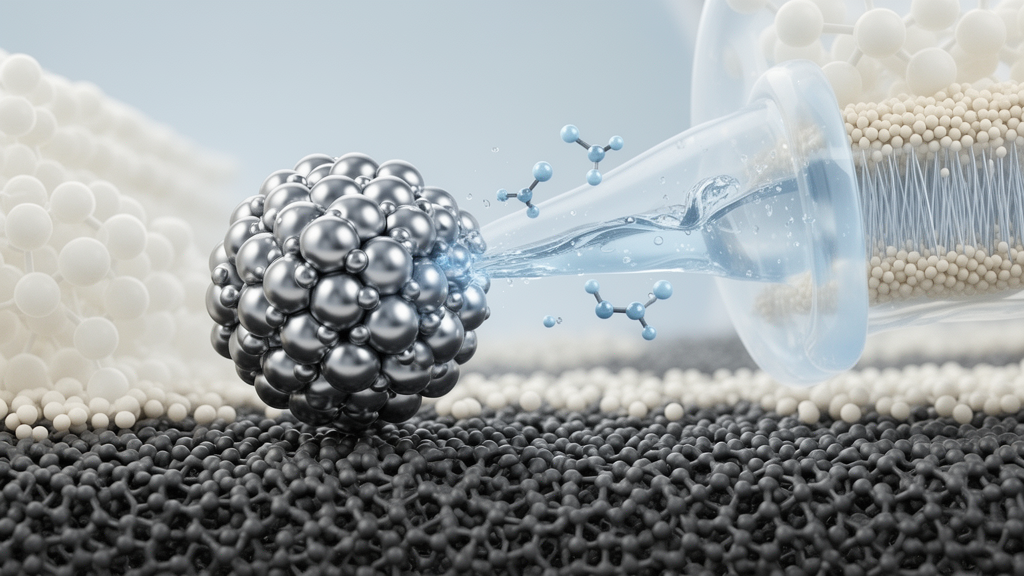
Ternary platinum–cobalt–lanthanum nanoparticles achieved higher intrinsic activity than commercial Pt/C for the oxygen reduction reaction at an optimal lanthanum content, according to a materials study in the Journal of Materials Science. The researchers varied the lanthanum content of PtCoLa intermetallic electrocatalysts and observed a volcano-shaped relationship between composition and performance. Their findings also showed that the optimized catalyst resisted nanoparticle agglomeration and active-site dissolution under harsh conditions.

The study addresses the sluggish oxygen-reduction kinetics that the authors identify as a primary bottleneck in commercializing polymer electrolyte membrane fuel cells. In their catalyst series, highly electropositive lanthanum tuned the electronic structure of platinum active sites and optimized the binding energy of oxygen intermediates. The optimized PtCoLa composition displayed higher intrinsic ORR activity than commercial Pt/C, indicating an improvement in activity at the level of the catalyst’s active sites rather than a result established solely by surface area.

Lanthanum content did not have a uniformly beneficial effect. Performance rose to an optimum and then declined as more lanthanum was incorporated. The researchers associated excessive loading with segregation of amorphous phases, which blocked active sites. This behavior accounts for the reported volcano-shaped trend: a suitable lanthanum fraction enabled the strongest performance, whereas further addition impaired the catalyst. The accessible report does not specify the optimal composition, so the chemical proportions associated with the maximum cannot be determined from the supplied evidence.

Post-mortem analyses of the optimized material indicated that structural integration of lanthanum stabilized the nanoparticles during harsh operation. Suppressed agglomeration reduced the clustering of catalyst particles, while limited active-site dissolution helped preserve the catalyst’s reactive structure. These observations provide a mechanistic explanation for the reported durability and distinguish the optimized composition’s structural stability from the loss of performance caused by excessive lanthanum and amorphous-phase segregation.

The accessible source provides the study abstract and figure placeholders but not the full numerical results. It does not report mass activity, half-wave potential, durability-test duration, degradation rate, electrode loading, comparative Pt/C values, or the composition of the optimized catalyst. Performance in a complete polymer electrolyte membrane fuel cell was also not established in the available material. Accordingly, the study supports a promising catalyst-design strategy at the electrocatalyst level, but its full performance envelope and device-level implications cannot be assessed from the supplied evidence.

Subject of Research: Lanthanum-doped PtCo intermetallic electrocatalysts for oxygen reduction in polymer electrolyte membrane fuel cells

Article Title: Investigation of lanthanum doping effects on the activity and durability of PtCo intermetallic electrocatalysts for the oxygen reduction reaction

Article References: Jung, J. Y. (2026). Investigation of lanthanum doping effects on the activity and durability of PtCo intermetallic electrocatalysts for the oxygen reduction reaction. Journal of Materials Science, 61(42), 33189-33201. https://doi.org/10.1007/s10853-026-13701-z

Image Credits: AI Generated

DOI: 10.1007/s10853-026-13701-z

Keywords: PtCoLa nanoparticles, oxygen reduction reaction, intermetallic electrocatalysts, lanthanum doping, platinum–cobalt catalyst, fuel cells, electrocatalyst durability, electronic structure, nanoparticle agglomeration, amorphous phase segregation, Investigation, lanthanum

News Source: Bethany Barker. (October 20, 2026). Lanthanum-tuned PtCo intermetallic catalyst improves oxygen-reduction activity in fuel-cell study. Scienmag.


Tags: amorphous phase segregationelectrocatalyst durabilityelectronic structurefuel cellsintermetallic electrocatalystsinvestigationlanthanumlanthanum dopingnanoparticle agglomerationoxygen reduction reactionplatinum–cobalt catalystPtCoLa nanoparticles
Share12Tweet7Share2ShareShareShare1

Related Posts

Ultrasound-activated channel improves glucose control in diabetic mice within dose window

Ultrasound-activated channel improves glucose control in diabetic mice within dose window

October 20, 2026
Multi-agent framework evaluates factual narratives in 100 legal consultations

Multi-agent framework evaluates factual narratives in 100 legal consultations

October 20, 2026

Physics-informed AI reduces errors in aneurysm flow reconstructions

October 20, 2026

Recycled rubber–steel dampers improve cyclic resistance in laboratory tests

October 20, 2026

POPULAR NEWS

  • Piper betle leaf oil shows cell cytotoxicity and antioxidant activity in vitro

    Piper betle leaf oil shows cell cytotoxicity and antioxidant activity in vitro

    29 shares
    Share 12 Tweet 7
  • Rare Alpine hoverflies use mountaintops for mating above 3,000 metres

    29 shares
    Share 12 Tweet 7
  • Research report: A systematic literature review to identify delivery strategies of digital health for low SEP populations

    29 shares
    Share 12 Tweet 7
  • Lanthanum-tuned PtCo intermetallic catalyst improves oxygen-reduction activity in fuel-cell study

    29 shares
    Share 12 Tweet 7

About

We bring you the latest biotechnology news from best research centers and universities around the world. Check our website.

Follow us

Recent News

Piper betle leaf oil shows cell cytotoxicity and antioxidant activity in vitro

Rare Alpine hoverflies use mountaintops for mating above 3,000 metres

Research report: A systematic literature review to identify delivery strategies of digital health for low SEP populations

Subscribe to Blog via Email

Enter your email address to subscribe to this blog and receive notifications of new posts by email.

Join 85 other subscribers
  • Contact Us

Bioengineer.org © Copyright 2023 All Rights Reserved.

Welcome Back!

Login to your account below

Forgotten Password?

Retrieve your password

Please enter your username or email address to reset your password.

Log In
No Result
View All Result
  • Homepages
    • Home Page 1
    • Home Page 2
  • News
  • National
  • Business
  • Health
  • Lifestyle
  • Science

Bioengineer.org © Copyright 2023 All Rights Reserved.