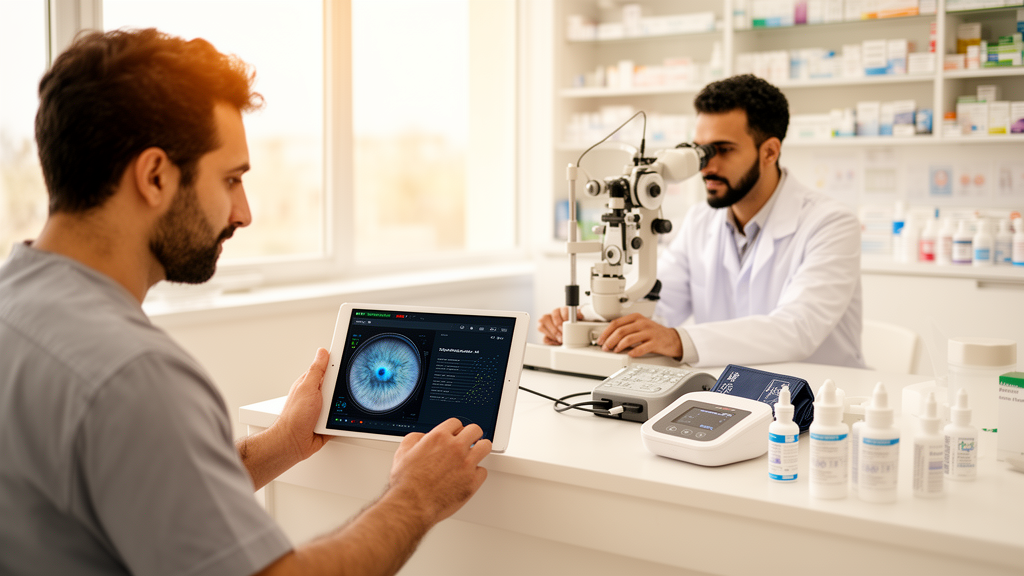
A prospective, open-label study in Jordan found that pharmacist-operated artificial intelligence could support diabetic retinopathy screening in community pharmacies, while a pharmacist-supervised conversational agent was associated with better glaucoma medication adherence than standard text-message reminders. The two-phase project involved 518 adults with diabetes who were eligible for retinal screening and 94 adults with primary open-angle glaucoma who were randomly assigned to a WhatsApp chatbot or SMS reminder group. Of the 518 eligible people with diabetes, 402 completed artificial-intelligence screening, or 77.6%.
Among patients whose results required referral, 81.0% saw a specialist within eight weeks. In the glaucoma comparison, all 94 participants completed six-month follow-up: medication possession ratio averaged 0.91 in the chatbot group versus 0.79 in the SMS group, while self-reported missed doses and intraocular pressure were also lower in the chatbot group. These findings demonstrate feasibility in the studied pharmacy setting, but the two phases examined different processes and do not establish that combining the tools produces long-term clinical benefits in all populations.
The research targeted two distinct obstacles in ocular care. Diabetic retinopathy and glaucoma are major preventable causes of irreversible blindness, yet annual diabetic retinopathy screening is often underused. The American Diabetes Association advises annual screening, although adherence to that recommendation is generally below 60% and may fall below 15% in underserved areas.
Contributing barriers include workforce shortages, fragmented referral pathways, prolonged waits for specialist care and loss to follow-up, especially in low- and middle-income countries. Jordan has no structured population-based diabetic retinopathy screening program, making screening largely opportunistic through physician referral or patient initiative. Glaucoma presents a different challenge: patients receiving treatment must take medication consistently over long periods, but 30% to 50% may miss at least 20% of prescribed doses.
Conventional phone calls and text messages have produced only modest adherence improvements of about 6% to 10%, which are difficult to sustain. The investigators therefore evaluated an autonomous screening workflow and a separate adherence-support intervention rather than following one group of patients through a continuous care pathway. For the screening phase, the team used version 1.3 of the AEYE-DS autonomous diagnostic system together with an Optomed Aurora non-mydriatic handheld fundus camera.
The system analyzed one macula-centered retinal image from each eye using three deep-learning algorithms. Four pharmacists received approximately 10 hours of formal on-the-job training, including two supervised hands-on sessions covering image acquisition, patient positioning, equipment use and operation of the artificial-intelligence system. Eligible participants were 18 to 79 years old and had type 1 or type 2 diabetes, with eligibility determined from pharmacy prescription records.
The researchers excluded people with significant media opacities, active ocular infections, other retinopathy that could interfere with image acquisition or interpretation, or uncertain eye problems identified through medical histories, participant reports and brief pharmacist-facilitated vision screening. Such exclusions limit the findings to people whose eyes could produce sufficiently clear images for the system. After obtaining written informed consent, a pharmacist captured retinal photographs of both eyes, ran the AEYE-DS analysis, printed the generated report and referred cases that were positive or ungradable.
Referrals were handled through a project-specific tele-ophthalmology portal embedded in the dispensing workflow. The primary endpoint was screening coverage, defined as the proportion of eligible adults receiving artificial-intelligence retinal screening. Secondary endpoints included pharmacist processing time, time to ophthalmology review, the number of ungradable images and the number of positive referral results.
This was a screening and early-case-finding service, not a diagnostic or treatment program: pharmacists facilitated image capture, consent, education, reporting and referral but did not confirm a clinical diagnosis or initiate therapy. Time-and-motion observations found an average screening time of 3.3 ± 1.1 minutes, and patients rated their experience at 4.7 ± 0.3 out of 5. Among the 518 eligible people with diabetes, 402 completed screening, producing an uptake of 77.6% with a 95% confidence interval of 73.7% to 81.1%.
The autonomous system independently classified 16.9% of those screened as having referable diabetic retinopathy, with a 95% confidence interval of 13.4% to 20.9%. A small proportion, 3.0%, had ungradable images, with a 95% confidence interval of 1.6% to 5.2%. Of participants sent for an eye examination because of a referable or ungradable result, 81.0% completed specialist review within eight weeks, with a 95% confidence interval of 69.0% to 89.7%.
A historical six-month physician-referral pathway had a completion rate of 42.3%, with a 95% confidence interval of 34.1% to 50.9%. The contrast is encouraging for assessing a possible way to improve referral completion, but it was not a randomized comparison. The historical figure came from a different period and pathway, so the study alone cannot determine how much of the difference was caused by the pharmacy model.
The glaucoma phase enrolled adults with primary open-angle glaucoma who owned a smartphone capable of using WhatsApp, had received a once-daily prostaglandin analogue for approximately three months and had a baseline medication possession ratio between 50% and 90%. An independent researcher used computer-generated block randomization with blocks of six to allocate participants 1:1 to the chatbot or control condition. Neither participants nor pharmacists were blinded.
The intervention was a retrieval-augmented GPT-4 Turbo conversational agent delivered through WhatsApp. It was designed to use motivational-interviewing-style prompts for behavioral and medication-adherence support, not to diagnose glaucoma, select medicines or adjust doses. A hand-curated ophthalmology knowledge base contained approximately 200 question-and-answer pairs drawn from sources including American Academy of Ophthalmology Preferred Practice Patterns and included common questions about medication management, side effects and dosing regimens.
A backend dashboard allowed pharmacists to monitor use, automatically flag people who had not interacted for 48 hours and review those cases weekly. All 94 randomized participants, 47 per group, completed follow-up. At six months, pharmacy-claim-based medication possession ratio averaged 0.91 ± 0.06 in the chatbot group and 0.79 ± 0.11 in the SMS group, a difference of 0.12 with p<0.001.
Participants reported missing medication on 3.2 ± 2.1 days per month with the chatbot versus 7.0 ± 3.4 days with SMS, a difference of 3.8 days and p=0.002. Mean intraocular pressure in the better eye decreased by 2.8 ± 3.6 mmHg in the chatbot group and by 0.9 ± 4.1 mmHg in the SMS group; the reported between-group difference was 1.9 mmHg with p=0.010. Chatbot users interacted with the system 6.1 ± 1.5 times per day.
They also reported higher satisfaction, averaging 4.6 ± 0.4 out of 5 compared with 3.7 ± 0.7 among SMS users, with p<0.001. The randomized allocation supports a comparative association between the supervised chatbot and better measured adherence, self-reported behavior and pressure in this 94-person sample, but the open-label design and short follow-up limit conclusions about durability. A decision-tree economic model compared pharmacy-based artificial-intelligence screening with the physician-referral pathway from the health-system perspective.
The combined purchase price of the Optomed Aurora camera and AEYE-DS system, as reported by the manufacturer, was US$9,800, and the model amortized this capital cost over five years. Variable costs included 1.50 Jordanian dinars for materials per screening and pharmacist labor based on the observed workflow and an average community-pharmacist wage of 21.6 dinars per hour. The model estimated a cost of US$21.60 per patient for the pharmacy program, compared with US$14.80 for physician referral.
After accounting for referral completion, it estimated the cost of a completed referral at US$26.67 in the pharmacy pathway and US$34.97 in the physician pathway, with an incremental cost-effectiveness ratio of US$19.10 for each additional completed referral. These are modeled estimates rather than randomized economic outcomes, and they depended on assumptions about screening volume, referral completion and physician-visit costs. The study has several notable strengths.
Adherence was measured from pharmacy dispensing data rather than self-report alone, intraocular pressure was assessed clinically, pharmacist time was quantified through time-and-motion observation, and the economic model was tailored to Jordan. Its limitations are equally consequential. The glaucoma trial included only 94 people, followed them for six months and could not blind participants or pharmacists.
Medication possession inferred from dispensing may not exactly match ingestion, while the study was confined to a single geographic area. The diabetic retinopathy phase was a feasibility evaluation rather than a randomized test of long-term clinical outcomes, and its referral comparison used a historical physician pathway. Larger multisite studies with longer follow-up would be needed to test the findings across broader populations, assess sustainability and determine whether the observed differences persist outside Jordan.
Within these limits, the results show that community pharmacies can host point-of-care retinal imaging and pharmacist-managed conversational support for glaucoma adherence, providing a decentralized approach to two different barriers in eye care.
Subject of Research: Evaluation of autonomous diabetic retinopathy screening and conversational AI support for glaucoma adherence in Jordanian community pharmacies
Article Title: Pharmacist-led integration of autonomous AI screening and conversational AI for ocular disease management
Article References: Kharshid, A., Alasasfeh, O., Saleh, M., Halasah, A., Alsulman, S. A., Alfaqeer, R., Tarawneh, R., Alhawarneh, D., Maaitah, F., & Alkfaween, M. (2026). Pharmacist-led integration of autonomous AI screening and conversational AI for ocular disease management. Pharmacia, 73, Article e186370. https://doi.org/10.3897/pharmacia.73.e186370
Image Credits: AI Generated
DOI: 10.3897/pharmacia.73.e186370
Keywords: artificial intelligence, community pharmacies, diabetic retinopathy, glaucoma, medication adherence, retinal screening, GPT-4 chatbot, WhatsApp, Jordan, eye care, prospective study, Pharmacist-led
News Source: Ophelia Keating. (October 20, 2026). Pharmacy AI linked to eye screening and glaucoma adherence in Jordan. Scienmag.