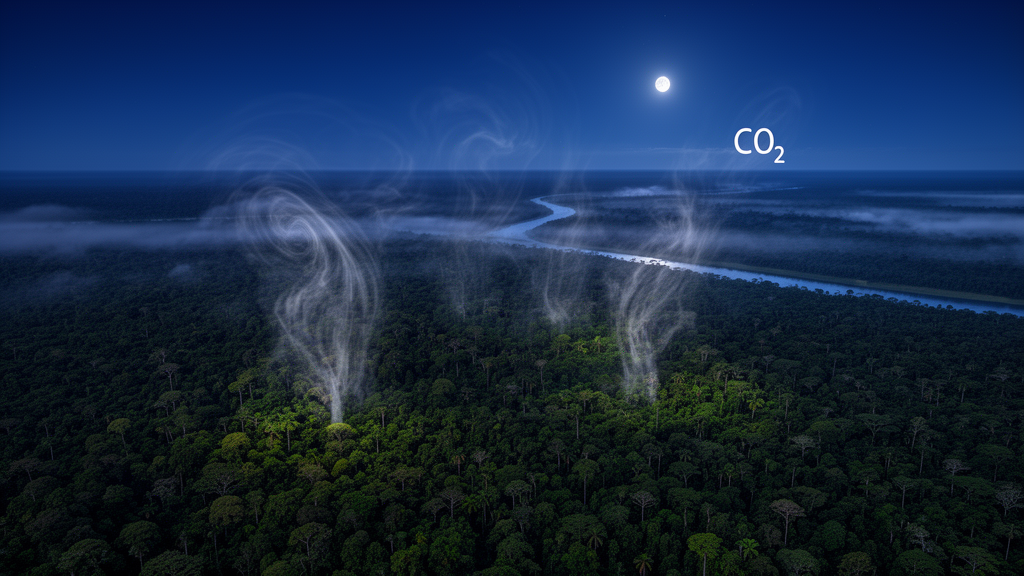
Only about 6% of the nocturnal profiles measured above and within the Amazon rainforest during the 2022 dry season matched the weakly or strongly stable boundary-layer regimes commonly represented in weather and climate models, according to an observation-driven study of the CloudRoots-Amazon22 field campaign. The analysis found that wind shear, longwave radiative cooling, intermittent turbulence and the forest’s internal structure jointly controlled exchanges of heat and carbon dioxide at the canopy-atmosphere interface. In strongly stable periods, turbulence was nearly absent and the canopy was decoupled from the stable layer above; in weakly stable periods, shear-generated turbulence promoted mixing between the two layers.
The study examined nocturnal observations from the Amazon Tall Tower Observatory, or ATTO, in the central Amazon. Measurements were collected from 8 to 19 August 2022, while the nights of 20 and 21 August were excluded because several required variables, including longwave radiation and carbon dioxide flux observations, were unavailable. The network combined the 325 m ATTO tall tower with an 81 m Instant tower positioned 670 m away. Sensors at 14 height levels measured atmospheric variables, trace gases and turbulent fluxes, which were calculated at 30-minute intervals and corrected for outliers, temporal trends, wind-field rotation, time lags, spectral losses, crosswind effects and density fluctuations. The within-canopy measurements represented dense forest, whereas the tall tower stood in a more disturbed, open-forest environment. The researchers defined the aerodynamic canopy top as 32 m and treated the period from 18:00 to 06:00 local time as nocturnal.
To estimate the height of the nocturnal boundary layer, the authors applied five criteria based on vertical profiles of potential temperature, carbon dioxide, horizontal wind speed, gradient Richardson number and turbulent kinetic energy. Because observations were available at discrete heights, second-order logarithmic functions were fitted to the temperature, carbon dioxide and wind profiles, while Richardson number and turbulent kinetic energy were linearly interpolated. Across all methods, estimated heights ranged from 74 to 298 m, and the mean across the five criteria generally remained between 142 and 164 m during the night. The temperature-based estimate averaged 150 ± 27.1 m, the carbon-dioxide estimate 145 ± 42.2 m, and the wind-based estimate 156 ± 46.5 m. The Richardson-number method averaged 134 ± 29.5 m, whereas the turbulent-kinetic-energy method averaged 193 ± 50.9 m; the latter could be applied in only about 20% of the analyzed hours.
Wind conditions contributed to the variation among the height estimates. Weak nocturnal low-level jets occurred during the nights of 12–13 and 17–18 August, with maximum wind speeds of 5.5 m s−1. These nights had low-level jet nose heights between 80 and 100 m, wind speeds no greater than 3.0 m s−1 at the top of the tower and shallow boundary layers no higher than 135 m. On nights with nearly linear vertical wind profiles, including 13–17 August, wind-based boundary-layer estimates were at least 167 m. The overall results were consistent with previous ATTO studies, which reported nocturnal boundary-layer heights from 81 to 247 m. Differences were expected because each criterion responds to a different physical process. The study suggests that gradient-based approaches may provide useful estimates where detailed vertical turbulence measurements are unavailable, while noting that elevated turbulent layers can complicate the Richardson-number and turbulent-kinetic-energy methods.
The vertical structure evolved in opposing directions within and above the canopy. At the canopy-atmosphere interface, between 25 and 81 m, the potential-temperature gradient increased from 0.040 to 0.046 K m−1 through the night, while the carbon-dioxide gradient strengthened from −0.09 to −0.51 ppm m−1. Below the canopy, between 5 and 25 m, the temperature gradient decreased from 0.067 to 0.015 K m−1 and the carbon-dioxide gradient increased from −1.77 to −0.69 ppm m−1. Air above the forest therefore became more strongly stratified as the night progressed, while air within the canopy became better mixed. The authors associated the canopy mixing with a locally cold layer in the dense crown, roughly between 15 and 30 m, which can promote sinking motions. Turbulence observations in selected periods were consistent with downward movement of cold air within the canopy.
To distinguish the idealized stability regimes, the researchers applied six criteria involving potential temperature, carbon dioxide, wind speed, Richardson number, turbulent kinetic energy and friction velocity. Only eight hours, distributed across four nights with two consecutive hours per night, satisfied all six criteria for either regime. The mean boundary-layer height in the selected strongly stable profiles was 133 m, compared with 165 m in the weakly stable profiles. Between 25 and 50 m, the strongly stable regime contained a 2.08 K temperature increase, compared with 1.29 K in the weakly stable regime. The carbon-dioxide gradient between 38 and 79 m was −21.8 ppm in strongly stable profiles and −5.5 ppm in weakly stable profiles. Above roughly 200 m, differences in turbulent kinetic energy, Richardson number and friction velocity largely disappeared, suggesting that the regimes’ turbulent differences did not substantially affect the residual layer.
Budget calculations showed how mechanical mixing and buoyancy produced the contrasting regimes. In the weakly stable case, shear production at the canopy top was 6.20 × 10⁻³ ± 2.05 × 10⁻³ m2 s−3, far larger than the strongly stable value of 0.16 × 10⁻³ ± 0.52 × 10⁻³ m2 s−3. Buoyant consumption was −1.70 × 10⁻³ ± 0.94 × 10⁻³ m2 s−3 in the weakly stable regime and −0.30 × 10⁻³ ± 0.31 × 10⁻³ m2 s−3 in the strongly stable regime. Dissipation was also greater in the weakly stable case, at −4.69 × 10⁻³ ± 0.25 × 10⁻³ m2 s−3, compared with −0.43 × 10⁻³ ± 0.44 × 10⁻³ m2 s−3 in the strongly stable case. The turbulent-kinetic-energy tendency itself was 10 to 100 times smaller than the individual budget terms. These observations support a decoupled canopy beneath the stable layer during strongly stable conditions and a coupled, shear-mixed canopy during weakly stable conditions.
The heat budget quantified differences in exchange across the interface. Turbulent heat-flux divergence at the canopy top was −3.62 ± 1.54 K h−1 in weakly stable periods and −1.23 ± 0.79 K h−1 in strongly stable periods, consistent with stronger mechanical mixing in the former. The atmospheric longwave cooling rate at the canopy top was −0.24 ± 0.35 K h−1 in weakly stable conditions and −0.35 ± 0.02 K h−1 in strongly stable conditions. Cloud cover may have reduced cooling during two weakly stable periods. Because longwave radiation was measured at only one height, the cooling rate was estimated with the RTE + RRTMGP radiative-transfer model driven by downscaled ERA5 temperature and moisture profiles. Comparisons at 75 m showed an absolute mean difference of 6.92 W m−2 and a standard error of 3.90 W m−2. The model-based estimate nevertheless introduced additional uncertainty, and the heat-budget residual remained substantial.
Carbon dioxide transport was similarly sensitive to canopy-atmosphere coupling. At the canopy top, turbulent carbon-dioxide transport averaged 33.94 ± 37.45 ppm h−1 in weakly stable periods and 23.39 ± 9.54 ppm h−1 in strongly stable periods, although the weakly stable estimate was much more variable. At 50 m, the mean nocturnal carbon-dioxide flux was 3.82 µmol m−2 s−1 during weakly stable conditions, with a maximum of 6.38 µmol m−2 s−1. In the decoupled strongly stable regime, the average was only 0.16 µmol m−2 s−1. Weakly stable mixing transported carbon-dioxide-rich air upward from the canopy, while strong stability inhibited that exchange and favored accumulation beneath the forest crown. The simplified carbon-dioxide budget omitted horizontal advection and other terms, and an estimated horizontal gradient could account for much of the remaining negative residual.
The findings are limited to one two-week measurement period in the 2022 dry season at a single central-Amazon site, where topography and heterogeneous forest structure limit direct extrapolation to the wider basin. Wet-season clouds, precipitation and turbulent activity differ from those observed here, while one year of measurements cannot characterize interannual variability. The budgets also assumed horizontal homogeneity and negligible subsidence, and their residuals included observational uncertainty, advection, pressure effects and other unmeasured processes. Nevertheless, the results provide an observational benchmark for testing nocturnal parameterizations. The authors call for schemes that explicitly represent tall, multilayer canopies, intermittent turbulent bursts and stability-dependent coupling, supported by measurements at intervals of five minutes or less and by high-resolution observations of the cooling layer between 20 and 30 m.
Subject of Research: Observation-driven analysis of Amazonian dry-season nocturnal boundary-layer dynamics and carbon dioxide transport
Article Title: From prototypical regimes to observed complex dynamics and CO2 transport in the Amazonian nocturnal boundary layer
Article References: Huitema, A. C., de Feiter, V. S., González-Armas, R., Hartogensis, O. K., van Asperen, H., Dias-Júnior, C. Q., & Vilà-Guerau de Arellano, J. (2026). From prototypical regimes to observed complex dynamics and CO 2 transport in the Amazonian nocturnal boundary layer. Atmospheric Chemistry and Physics, 26(20), 14725-14747. https://doi.org/10.5194/acp-26-14725-2026
Image Credits: AI Generated
DOI: 10.5194/acp-26-14725-2026
Keywords: Amazon rainforest, nocturnal boundary layer, carbon dioxide transport, canopy-atmosphere exchange, turbulent kinetic energy, atmospheric stability, Amazon Tall Tower Observatory, climate models, dry-season observations, intermittent turbulence, prototypical, regimes
News Source: Russell Cooper. (October 20, 2026). From prototypical regimes to observed complex dynamics and CO2 transport in the Amazonian nocturnal boundary layer. Scienmag.