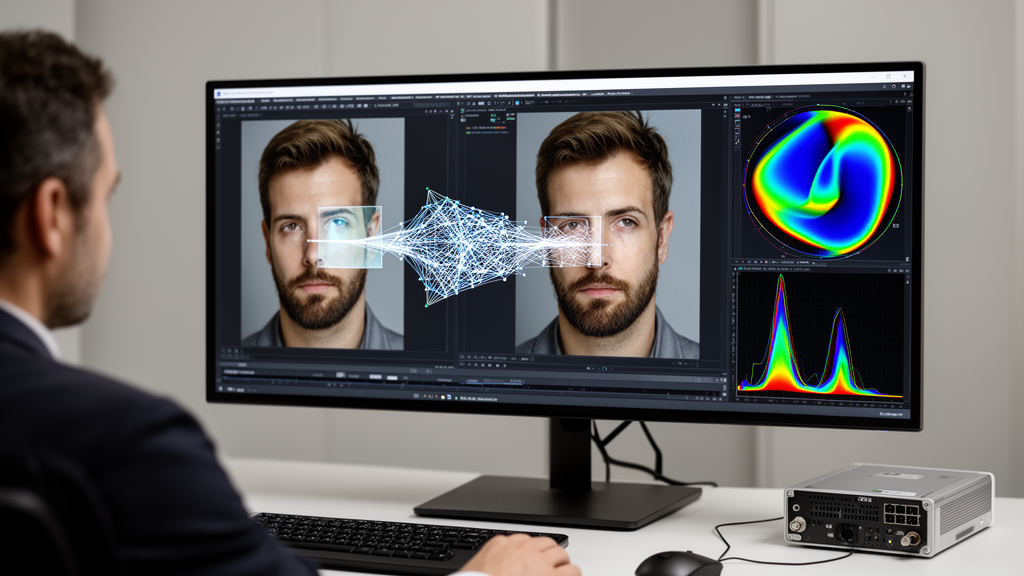
A lightweight neural network that combines Fourier analysis with multi-scale visual features achieved competitive results in detecting manipulated and AI-generated images in a study of image forgery detection. The Multi-Scale Fourier Enhancement Network, or MSFEN, was tested on edited-image benchmarks and synthetic images from three generative models. It produced the strongest reported results on the unseen VQDM generator, while also offering pixel-level maps of suspected forged regions.
The researchers describe the work as evidence that frequency-domain information can complement conventional spatial features, although their analysis identifies important limitations in cross-dataset generalization and baseline comparisons. Modern image generators and editing tools can produce forgeries whose visible imperfections are subtle or absent, making it increasingly difficult to distinguish synthetic material from authentic photographs. Existing detectors often concentrate on spatial cues such as inconsistent textures, illumination, edges and object boundaries.
Those signals can be effective, but they may not transfer well when a detector encounters a generator or manipulation process that it did not encounter during training. The new study focuses on frequency-domain anomalies, patterns that can be difficult to see in the image itself but become accessible after converting feature maps into their spectral representation. MSFEN is built on a pretrained ConvNeXt-Tiny encoder with four stages.
A Fourier Enhancement Module is placed after each stage, giving the network access to both spatial and frequency-domain information at several levels of abstraction. For an input feature map, the module applies a real fast Fourier transform, separates the real and imaginary components of the resulting spectrum, and concatenates them along the channel dimension. A learnable 1-by-1 grouped convolution then modulates the two components independently.
The transformed representation is reconstructed as a complex signal and returned to the spatial domain with an inverse real fast Fourier transform, preserving the original height and width. The module does not stop at the inverse transform. Its output passes through depthwise convolution, a GELU activation and a channel-mixing sequence that expands the number of channels fourfold before compressing them again.
A residual connection combines this result with the original feature map. In this way, the module can amplify potentially informative spectral patterns while retaining the local spatial information carried by the original representation. The design treats frequency and space as complementary rather than competing views of an image: high-frequency components are associated with fine detail and texture, while lower-frequency components provide broader structural information.
Because manipulated regions can range from a small edited object to an entirely synthetic image, MSFEN combines representations from all four ConvNeXt stages. Its Multi-Scale Feature Fusion Module uses 1-by-1 convolutions to align channel dimensions, upsamples the feature maps to a common resolution and concatenates them. Two 3-by-3 convolutional layers then produce a unified representation containing both local texture evidence and higher-level semantic context.
An analysis using one to four backbone stages found that average detection accuracy improved as more scales were incorporated, although the gains began to saturate at four stages. The authors suggest that a three-stage configuration could offer a better balance between accuracy and computational cost in resource-constrained deployments. The fused features feed two related outputs.
One head classifies the entire image as authentic or forged, combining pooled statistical features with a flattened spatial representation. A second head generates a pixel-level forgery mask by convolving and upsampling the fused map to the input resolution. The final training objective combines binary cross-entropy losses for image classification, pixel localization and auxiliary image-level predictions attached to each of the four encoder stages.
These learnable loss weights all began at 1.0 and converged after 100,000 training steps to a ratio of approximately 1:1.07:0.92, indicating that the three objectives contributed at similar levels during optimization. For training and evaluation, the researchers used more than 5,000 forged images from CASIAv2, which includes splicing and copy-move manipulations, and generated 10,000 synthetic images each with ADM and BigGAN. The test sets consisted of the edited-image datasets CASIAv1, Columbia and NIST16, together with 3,000 generated images from ADM, BigGAN and VQDM.
CASIAv2 served as the image-editing dataset used in the experimental setup, whereas the reported editing-benchmark results came from CASIAv1, Columbia and NIST16. The model was trained for 100 epochs on two NVIDIA RTX 3090 graphics processors, using 512-by-512 inputs, AdamW, cosine annealing and a batch size of eight. Baseline models were retrained with the same data split, preprocessing, augmentation and optimization protocol as MSFEN.
Image-level and pixel-level outputs were thresholded at 0.5. The comparison included F3Net, MVSS, PSCC, TruFor, Mesorch and NFA-ViT. The experimental design therefore measured performance under a common training and evaluation setup, although the methods retained their original architectural differences.
The study also supplied pixel-level supervision: public editing datasets used their provided binary masks, fully synthetic images received masks containing all ones, and authentic images received masks containing all zeros. On the unseen VQDM dataset, MSFEN achieved an F1 score of 0.571, accuracy of 0.625 and area under the receiver operating characteristic curve of 0.848. The next-best reported AUC was 0.641 for NFA-ViT, illustrating that performance fell sharply for every tested method when the generative source changed.
The authors characterize the result as preliminary evidence of cross-generator generalization rather than proof that the system is robust to all new generators. On the editing benchmarks, MSFEN achieved the best reported accuracy on NIST16, at 0.634, while Mesorch performed slightly better on CASIAv1. The relatively low absolute performance on NIST16 shows that regional editing remained more difficult than recognition of fully synthetic images.
Stress tests applied Gaussian blur, Gaussian noise and JPEG compression to ADM-generated images. The network reported average accuracies of 0.967 under Gaussian blur, 0.993 under Gaussian noise and 0.993 under JPEG compression, the highest averages among the compared systems for each perturbation. Under particularly strong blur with a kernel size of 23, its accuracy remained 0.914.
The authors caution that these comparatively stable results partly reflect the nature of the test set: generative traces are distributed throughout the image rather than concentrated in a small edited region. At 512-by-512 resolution with a batch size of one, MSFEN contained 46.9 million parameters, required 121.7 billion floating-point operations and ran at 33 frames per second. It used about 45% fewer parameters than Mesorch at comparable FLOPs.
Several qualifications limit how broadly the findings can be interpreted. The baseline systems originated with different backbone architectures, and the proposed Fourier and fusion modules were integrated into a strong ConvNeXt backbone, so the observed gains cannot be completely separated from the benefits of that architecture. Failure cases on NIST16 showed that MSFEN can suppress background responses more effectively than several baselines, yet it still misses highly subtle edits or mistakes natural high-contrast textures for manipulation.
The authors identify broader cross-domain testing, emerging diffusion models and temporal analysis for video as future directions rather than demonstrated capabilities of the present system. Overall, the results support the approach as a promising computational trade-off, while leaving open how it will perform against future generators and more difficult forms of localized manipulation.
Subject of Research: A multi-scale Fourier neural network for detecting and localizing edited and AI-generated image forgeries
Article Title: A lightweight multi-scale fourier enhancement network for image forgery detection
Article References: Hou, Y., Miao, Z., Wang, J., Lu, X., Zhang, R., & Li, Y. (2026). A lightweight multi-scale fourier enhancement network for image forgery detection. Cybersecurity, 9(1), Article 244. https://doi.org/10.1186/s42400-026-00681-5
Image Credits: AI Generated
DOI: 10.1186/s42400-026-00681-5
Keywords: image forgery detection, Fourier analysis, multi-scale learning, ConvNeXt, generative AI, digital forensics, synthetic images, robustness, network efficiency, localization, lightweight, multi-scale
News Source: Blake Davidson. (October 20, 2026). Research report: A lightweight multi-scale fourier enhancement network for image forgery detection. Scienmag.