A parasitoid wasp, Psyttalia carinata, has been confirmed in China for the first time and shown to develop inside the sea buckthorn fruit fly, Rhagoletis batava, according to a field, laboratory and mitochondrial-genome study conducted in Xinjiang from 2023 to 2025. Researchers detected the wasp at 12 of 30 surveyed sites, identified specimens morphologically and through independent expert examination, and recorded adults emerging from fly puparia of known origin. Their findings provide the first reliable formal Chinese distribution record for P. carinata, establish R. batava as a verified host and document a seasonal association that may inform future assessments of the wasp’s ecological role in sea buckthorn plantations.
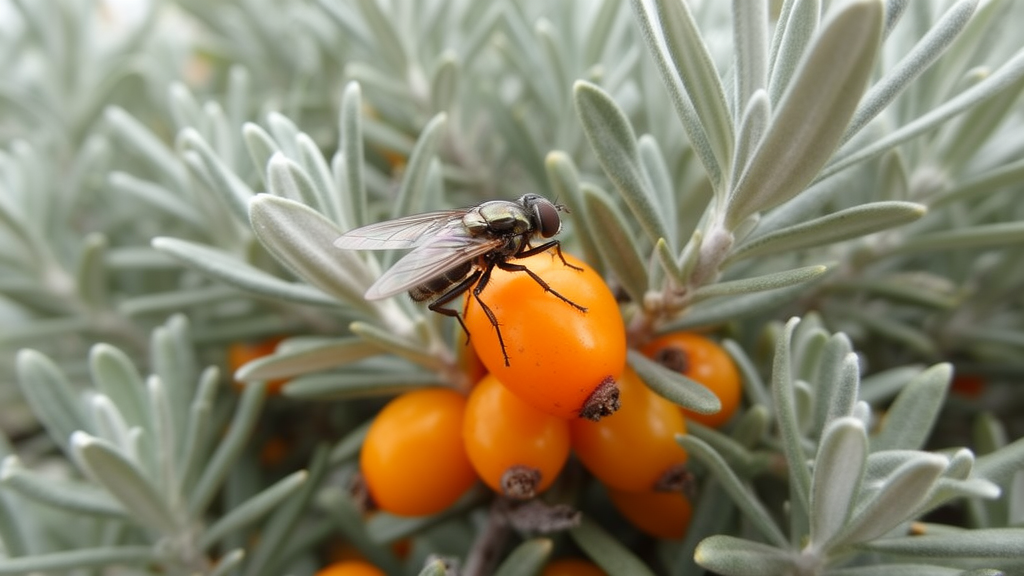
Sea buckthorn, Hippophae rhamnoides, is a woody plant of ecological and economic importance across temperate Eurasia, and the fruit fly R. batava is a highly specialized pest whose larvae feed inside its fruits. Females insert eggs into developing berries, and the resulting larvae damage the pulp, contributing to softening, deformation, discoloration and desiccation. In severe outbreaks reported for susceptible cultivars and poorly managed orchards, infestation can exceed 80%, with nearly all marketable fruit lost under the worst conditions.
The regional survey examined natural stands, ecological plantations and cultivated orchards across Altay, Aksu, Kizilsu Kirgiz, Kashgar, Urumqi, Ili and Changji, with 2,700 plants inspected using three plots at each of 30 sites. The species identification combined measurements of females from geographically separated Altay and Akqi populations with the diagnostic characters used for P. carinata, including the shape of the head behind the compound eyes, antennal structure, forewing venation, the first metasomal tergite, hind legs and ovipositor sheath. The measured ranges overlapped extensively between the two populations.
Independent examination by Cornelis van Achterberg confirmed the identification, and a search of regional revisions, catalogues and public biodiversity databases found no reliable prior record from China. This identification matters because P. carinata resembles the related P. concolor but can be distinguished through a combination of structural characters rather than a single trait. Host association was demonstrated more directly than through collection alone.
All tephritid adults emerging from the relevant rearing batches were identified as R. batava, and no other tephritid species were recovered. Adult P. carinata emerged from those puparia, while a separate dissection series of more than 900 fly larvae and puparia repeatedly revealed parasitoid immature stages inside intact hosts. These observations showed that P. carinata is a solitary larval–pupal koinobiont endoparasitoid: its host continues feeding and developing after parasitism, leaves the fruit and forms a puparium, within which the wasp completes its immature development.
Dissections before and after winter also established that the parasitoid overwinters as a pupa inside the fly puparium. Of 8,260 R. batava puparia maintained from Altay and Akqi, 457 produced adult P. carinata, and another 138 contained immature parasitoids when the remaining puparia were opened. The resulting apparent parasitism estimate was 7.57% in Altay, 6.50% in Akqi and 7.20% across the pooled sample.
At a fixed 12-hectare plantation in Burqin County, where no chemical insecticides were applied, Malaise traps operated from April through November in 2024 and 2025. Both the fly and wasp showed one concentrated period of adult activity in each year, with the parasitoid peak occurring later than that of its host. That timing does not necessarily indicate a mismatch between host and parasitoid.
Adult fly emergence and oviposition precede the larval period in which parasitism occurs, so later wasp activity can reflect the arrival of suitable host stages. Together with the fly’s known univoltine cycle in the study region, pupal overwintering by the wasp and the single annual activity period, the two-year monitoring supported a univoltine life cycle for P. carinata at the Altay site. The study was designed around sea buckthorn habitats in Xinjiang, however, and did not test whether the wasp has other hosts there or occurs outside this host–plant system.
The regional parasitism percentages describe apparent infection in collected puparia and should not be interpreted as a measured reduction in fruit damage. A fully factorial laboratory experiment involving 720 wasps examined how temperature, diet and sex affected adult longevity. Newly emerged adults were held individually at four separate temperature treatment levels—15°C, 20°C, 25°C and 30°C—with water or one of two honey concentrations supplied continuously.
Longevity declined consistently as temperature rose from 15°C to 30°C. Model-estimated longevity at 20°C, 25°C and 30°C was 63.0%, 35.2% and 23.2% of the estimate at 15°C, respectively. Females generally outlived males, and all three factors had significant effects on log-transformed longevity.
A diet-by-sex interaction was also significant, while the temperature-by-diet, temperature-by-sex and three-way interactions were not. Carbohydrate access produced a marked difference. At 15°C, females given water lived an average of 12.40 ± 0.70 days, compared with 45.80 ± 1.96 days under 15% honey and 46.17 ± 2.38 days under 30% honey.
Males given water averaged 10.20 ± 0.61 days, versus 28.40 ± 1.75 and 29.30 ± 2.01 days under the two honey diets. Mean survival was broadly similar between 15% and 30% honey, indicating little additional longevity benefit from the higher concentration under laboratory conditions. The experiment measured survival rather than reproductive output or host-searching performance, so the field significance of these nutritional and thermal effects remains to be established.
Whole-genome sequencing of a morphologically confirmed female produced a complete, circular mitochondrial genome of 15,633 base pairs, deposited as GenBank accession PX579120. The genome contained the standard 37 insect mitochondrial genes—13 protein-coding genes, 22 transfer RNA genes and two ribosomal RNA genes—plus an 809-base-pair control region. Its overall adenine-plus-thymine content was 82.7%, with thymine more abundant than adenine and guanine more abundant than cytosine.
The control region had the highest adenine-plus-thymine content at 91.4%, followed by the ribosomal RNA genes at 88.9%, transfer RNA genes at 86.8% and protein-coding genes at 80.1%. All 13 protein-coding genes used canonical initiation codons, and the relative use of synonymous codons was strongly biased toward those ending in A or U. Comparisons with the available mitogenomes of P. concolor, P. humilis, P. lounsburyi and P. incisi showed that protein-coding and ribosomal RNA genes retained the same relative positions and transcriptional orientations in the homologous regions examined.
Intrageneric variation instead centered on transfer RNA genes. All five Psyttalia species shared the cox2–trnD–trnH–trnK–atp8 and nad2–trnW–trnY–trnC–cox1 clusters, but the nad4L–nad6 region contained two local arrangements. P. carinata and P. incisi shared nad4L–trnT–trnP–nad6, whereas P. concolor, P. humilis and P. lounsburyi shared nad4L–trnP–trnT–nad6.
These differences identify candidate structural characters for studying mitochondrial evolution, but their direction cannot be resolved from the five sampled species. Maximum-likelihood and Bayesian analyses of all three codon positions in the 13 mitochondrial protein-coding genes produced identical relationships within Psyttalia. The sampled species formed a strongly supported monophyletic group, and P. carinata was recovered as the sister lineage to the clade containing P. concolor, P. humilis and P. lounsburyi, with a posterior probability of 0.97 and 100% maximum-likelihood bootstrap support.
P. incisi was placed as sister to the other four species. The discordance between sequence relationships and gene order—P. carinata shared the complete trnT–trnP arrangement with P. incisi but was not its closest sampled relative—shows that local gene-order similarity need not identify the closest relationship. Denser species sampling and independent nuclear markers will be needed to distinguish ancestral retention, lineage-specific change and independent convergence.
Subject of Research: First Chinese record, host association, biology and comparative mitogenomics of the parasitoid wasp Psyttalia carinata
Article Title: Biology and Comparative Mitogenomics of Psyttalia carinata, Newly Recorded From China as a Parasitoid of Rhagoletis batava
Article References: Li, K., Ge, Z., Zhang, Z., Guo, W., & Hu, H. (2026). Biology and Comparative Mitogenomics of Psyttalia carinata , Newly Recorded From China as a Parasitoid of Rhagoletis batava. Ecology and Evolution, 16(10), Article e74415. https://doi.org/10.1002/ece3.74415
Image Credits: AI Generated
DOI: 10.1002/ece3.74415
Keywords: Psyttalia carinata, Rhagoletis batava, parasitoid wasp, Xinjiang, sea buckthorn, host association, overwintering, adult longevity, mitochondrial genome, gene order, phylogenetics, biological control
News Source: Juliet Wilcox. (October 20, 2026). Psyttalia carinata confirmed in China as sea buckthorn fly parasitoid. Scienmag.