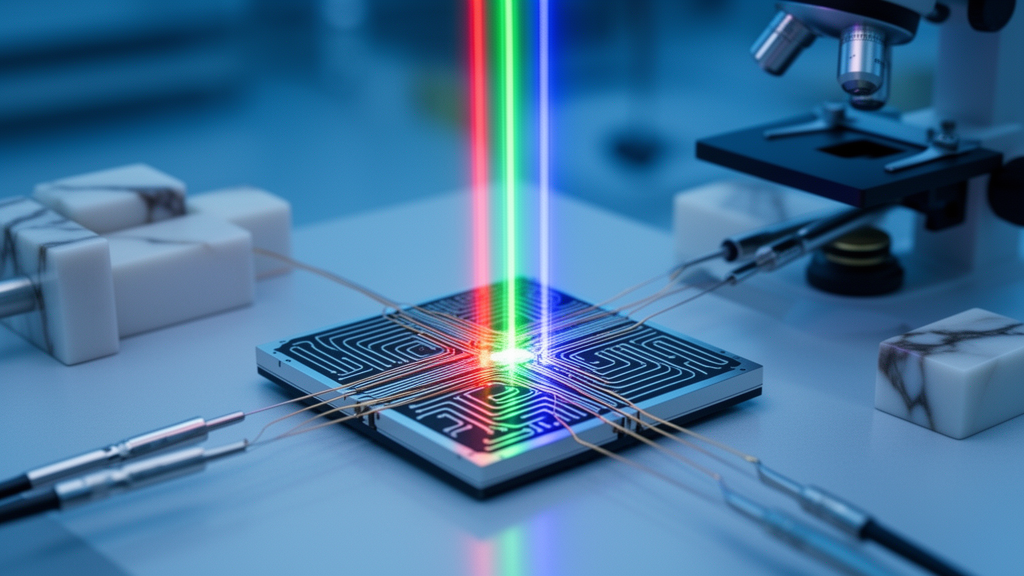
A thin-film lithium niobate photonic circuit developed by Yasuhiro Takagi and colleagues at TDK Corporation can regulate red, green and blue laser light with applied voltage, producing full-color output with a measured modulation bandwidth of 10 gigahertz. In experiments, the researchers integrated the chip with a microelectromechanical-systems scanning mirror, demonstrating a potential route to compact laser beam-scanning displays for smart glasses. The peer-reviewed study reported that the approach cut overall power consumption by more than 75% compared with conventional direct-current modulation, although the authors said further gains require reducing optical losses in the waveguides and color-combining network.
Laser beam-scanning displays steer a laser across a field of view and form images point by point rather than illuminating a fixed pixel array. High-resolution imaging depends partly on how rapidly the display can change laser color, particularly when red, green and blue light are combined into a single beam. Conventional systems vary the current supplied to each laser diode to control its intensity. Direct-current modulation has limited bandwidth, and the laser must remain above a threshold current to generate adequate light, increasing power demand. The new circuit instead applies voltage to optical structures that regulate the light before the three channels are combined.
The researchers fabricated the device with a thin film of lithium niobate, whose optical properties can be altered electrically. The chip contains three Mach–Zehnder interferometers, one for each primary color. These structures split and recombine the light so that voltage applied to each channel controls the intensity that passes through it. Lithium niobate waveguides then form a multiplexer that merges the separately controlled red, green and blue outputs into one beam. By shifting this intensity control from the laser diodes to the photonic circuit, the design avoids operating the diodes at continuously high currents and also eliminates a need for neutral-density filters used to attenuate excess laser output.
The experimental system achieved 10 GHz of modulation bandwidth, which the researchers report is sufficient for 4K resolution and higher. They also generated full-color output by combining the three controlled channels and connected the device to a MEMS scanning mirror to demonstrate its operation within a laser beam-scanning architecture. These results provide laboratory evidence that voltage-based control can support fast color switching in compact displays, but they do not yet establish performance in a complete smart-glasses product. The researchers identified lower optical losses in the lithium niobate waveguides and the three-color combiner as priorities for further improvement, since reducing those losses could increase system efficiency. Overall, the study tested a device-level solution to three interconnected challenges in miniaturizing laser-scanning displays: modulation speed, electrical power consumption and the number of optical components required.
Subject of Research: Voltage-controlled lithium niobate photonic circuits for efficient full-color laser beam-scanning displays
Article Title: Voltage-controlled photonic chip could make smart-glasses displays more efficient
Article References: Voltage-controlled photonic chip could make smart-glasses displays more efficient. Original publication (Bibliographic details unavailable.)
Image Credits: AI Generated
DOI: Not provided
Keywords: photonic integrated circuits, lithium niobate, laser beam scanning, smart glasses, voltage modulation, full-color displays, MEMS mirrors, optical communication, energy efficiency, Voltage-controlled, photonic, chip
News Source: Denise Maddox. (October 20, 2026). Voltage-controlled lithium niobate chip advances compact full-color laser displays. Scienmag.