Credit: Photo by Steven O. Shattuck
CHAMPAIGN, Ill. — Researchers provide the first mechanical description of the jaws of a group of trap-jaw ants that can snap their spring-loaded jaws shut at speeds of up to 50 miles per hour – just fast enough to capture their elusive prey.
The new report appears in the Journal of Experimental Biology.
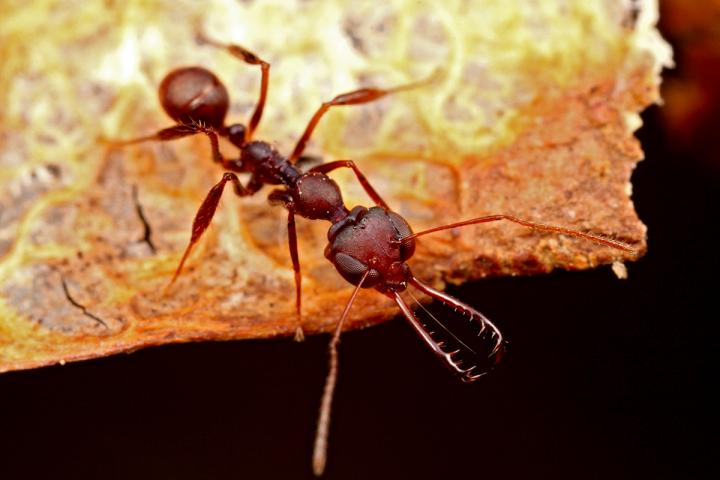
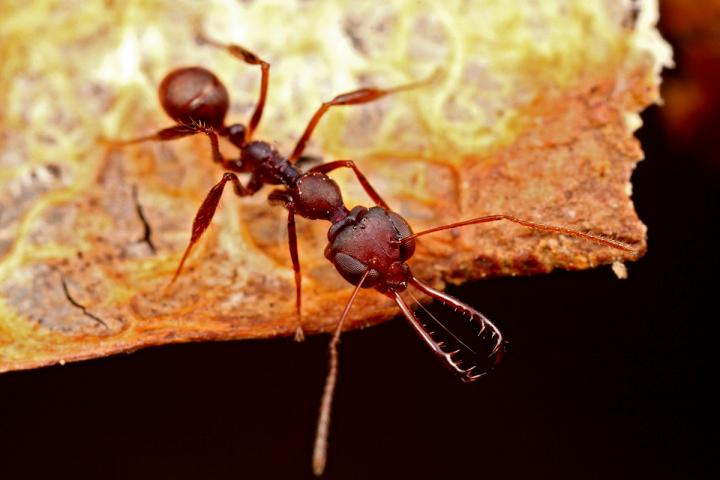
The ants belong to the genus Myrmoteras, and are one of four groups of ants that have independently evolved the ability to quickly snap their powerful jaws shut to capture speedy prey. They feed primarily on springtails, tiny arthropods that fling themselves away from danger when they detect a threat. Until they encounter their prey, Myrmoteras ants hold their jaws open at a 280-degree angle. Latched in this position, the jaws store elastic energy which, when released, snaps the jaws shut in a fraction of a second. (See video.)
"These ants are rarely seen in nature and almost impossible to keep alive in the lab," said University of Illinois animal biology professor Andrew Suarez, who led the study with former graduate student Frederick Larabee, now a postdoctoral researcher at the Smithsonian Institution's National Museum of Natural History.
"Each group of trap-jaw ants has a different way to store and release energy. Working with this genus has been sort of a holy grail for us," Suarez said.
Myrmoteras jaws can snap shut in half a millisecond, much faster than the human eye can perceive, the researchers report. Such speed cannot be attained by muscle strength alone, Larabee said.
However, this is considerably slower than the jaw strikes of other known trap-jaw ants. The mandibles of the distantly related Odontomachus ants are twice as fast, making their strikes among the fastest animal movements ever recorded, he said.
The jaws of the Myrmoteras ants are only as fast as they need to be, Larabee said.
"They just need to be faster than the critters they're trying to eat, and their jaws are plenty fast for capturing springtails," he said.
To visualize the ants' jaws, Larabee used a microscope and microcomputed tomography, which exposes tiny specimens to X-rays to discern their internal structures. His observations allowed him to determine how the jaws likely work.
Larabee detected a feature of the ant's mandible that allow it to lock its jaws open. Just before a strike, a lobe on the back of the ant's head compresses. A trigger muscle releases the jaws, executing the strike.
"What's interesting is that the arrangement of the muscles and how the jaws are locked open are completely different from other trap-jaw ants that have been studied," Larabee said. "It seems like it's a completely unique evolution of this system."
"Studying these ants gives us insight into solutions for real-world issues related to energy storage and high-speed systems," Suarez said.
###
The National Science Foundation, Peter Buck Fellowship and the National Geographic Society supported this research.
Editor's notes:
To reach Andrew Suarex, call 217-390-1407; email [email protected].
The paper "Performance, morphology and control of power-amplified mandibles in the trap-jaw ant Myrmoteras" is available online and from the U. of I. News Bureau.
Media Contact
Diana Yates
[email protected]
217-333-5802
@NewsAtIllinois
http://www.illinois.edu
Related Journal Article
http://dx.doi.org/10.1242/jeb.156513