• HOME
  • NEWS
  • EXPLORE
    • CAREER
      • Companies
      • Jobs
    • EVENTS
    • iGEM
      • News
      • Team
    • PHOTOS
    • VIDEO
    • WIKI
  • BLOG
  • COMMUNITY
    • FACEBOOK
    • INSTAGRAM
    • TWITTER
Tuesday, October 20, 2026
BIOENGINEER.ORG
No Result
View All Result
  • Login
  • HOME
  • NEWS
  • EXPLORE
    • CAREER
      • Companies
      • Jobs
        • Lecturer
        • PhD Studentship
        • Postdoc
        • Research Assistant
    • EVENTS
    • iGEM
      • News
      • Team
    • PHOTOS
    • VIDEO
    • WIKI
  • BLOG
  • COMMUNITY
    • FACEBOOK
    • INSTAGRAM
    • TWITTER
No Result
View All Result
Bioengineer.org
No Result
View All Result
Home NEWS Science News Technology

Self-supervised deep learning enables reliable 20-fold accelerated fMRI mapping

by
October 20, 2026
in Technology
Reading Time: 2 mins read
0
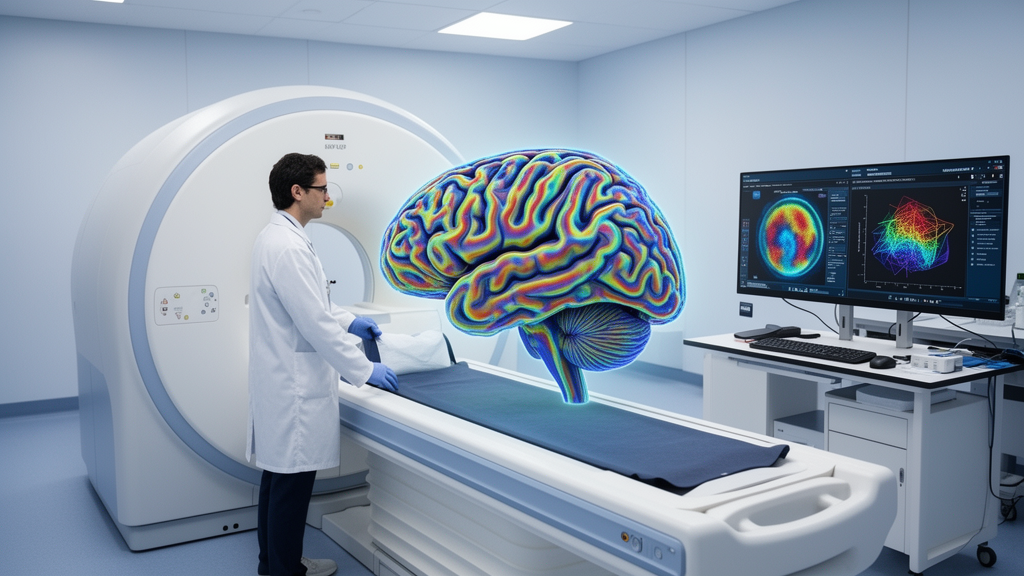
Self-supervised deep learning enables reliable 20-fold accelerated fMRI mapping

Self-supervised deep learning enables reliable 20-fold accelerated fMRI mapping

Share on FacebookShare on TwitterShare on LinkedinShare on RedditShare on Telegram

A multi-slice, self-supervised, physics-driven deep-learning method enabled reliable functional human brain mapping with 20-fold accelerated functional MRI acquisitions, according to a study evaluating both retrospective and prospective acceleration. The reconstructed images substantially improved on conventional approaches and supported attainable spatiotemporal resolutions at an acceleration level previously described as unachievable for functional mapping. Functional MRI often relies on accelerated acquisitions to obtain broad brain coverage and high spatiotemporal resolution, particularly when imaging the whole brain.

Greater acceleration, however, can leave residual aliasing and amplify noise in reconstructed data, creating a barrier as researchers seek increasingly demanding imaging performance. Physics-driven deep learning has shown promise in the wider MRI reconstruction community at high acceleration rates, where conventional methods can struggle to maintain output quality, but its application to fMRI presents additional challenges. One of those challenges is the need for fully sampled reference data when training supervised reconstruction models.

Such references are not readily available for high-resolution fMRI studies, limiting the practical use of conventional supervised deep learning. The reported results indicate that this approach reconstructed highly accelerated fMRI data while preserving functional maps that remained reliable at a 20-fold acceleration factor. The work assessed reconstruction under 20-fold retrospective and prospective accelerations, finding that the physics-driven deep-learning method substantially outperformed conventional reconstructions in the tested setting.

The findings therefore connect reconstruction performance directly to the practical objective of functional human brain mapping and indicate that high acceleration need not preclude usable maps in the evaluated acquisitions. The evidence comes from an accepted, open-access research article in Communications Engineering that was shared early for faster access and remains subject to further edits before the final version of record. The reported performance is specific to the evaluated retrospective and prospective 20-fold acceleration conditions; it does not establish that the same reliability will occur across every MRI system, acquisition protocol or application.

Within those limits, the study identifies self-supervised, physics-driven reconstruction as a possible route to more efficient high-resolution fMRI acquisitions that conventional approaches cannot readily achieve.

Subject of Research: Self-supervised deep-learning reconstruction for highly accelerated functional human brain mapping

Article Title: Overcoming MRI data acceleration barriers in functional human brain mapping with physics-driven deep learning

Article References: Demirel, Ö. B., Vizioli, L., Yaman, B., Moeller, S., Yacoub, E., Uğurbil, K., & Akçakaya, M. (2026). Overcoming MRI data acceleration barriers in functional human brain mapping with physics-driven deep learning. Communications Engineering. https://doi.org/10.1038/s44172-026-00784-4

Image Credits: AI Generated

DOI: 10.1038/s44172-026-00784-4

Keywords: functional MRI, brain mapping, deep learning, self-supervised learning, MRI reconstruction, data acceleration, spatiotemporal resolution, neural imaging, noise amplification, Overcoming, data, acceleration

News Source: Colin Clarke. (October 20, 2026). Self-supervised deep learning enables reliable 20-fold accelerated fMRI mapping. Scienmag.

Tags: accelerationbrain mappingdatadata accelerationdeep learningfunctional MRIMRI Reconstructionneural imagingnoise amplificationOvercomingSelf-Supervised Learningspatiotemporal resolution
Share12Tweet7Share2ShareShareShare1

Related Posts

Sustained exosome delivery improves bone formation in p75NTR-deficient mice

Sustained exosome delivery improves bone formation in p75NTR-deficient mice

October 20, 2026
Review links critical inclusions to fatigue in high-strength steels

Review links critical inclusions to fatigue in high-strength steels

October 20, 2026

Research report: KAIST develops AI that reconstructs cloud-covered ground in satellite images with photo-like clarity

October 20, 2026

Captive ducks break species barriers with surprising hybrids

October 20, 2026

POPULAR NEWS

  • Survival remains limited in older transplant-ineligible mantle cell lymphoma

    Survival remains limited in older transplant-ineligible mantle cell lymphoma

    29 shares
    Share 12 Tweet 7
  • Self-supervised deep learning enables reliable 20-fold accelerated fMRI mapping

    29 shares
    Share 12 Tweet 7
  • SWAP70 promotes liver cancer growth through CPT1A-dependent fatty acid oxidation

    29 shares
    Share 12 Tweet 7
  • Machine learning links immune-cell measures to resected lung cancer prognosis

    29 shares
    Share 12 Tweet 7

About

We bring you the latest biotechnology news from best research centers and universities around the world. Check our website.

Follow us

Recent News

Survival remains limited in older transplant-ineligible mantle cell lymphoma

Self-supervised deep learning enables reliable 20-fold accelerated fMRI mapping

SWAP70 promotes liver cancer growth through CPT1A-dependent fatty acid oxidation

Subscribe to Blog via Email

Enter your email address to subscribe to this blog and receive notifications of new posts by email.

Join 85 other subscribers
  • Contact Us

Bioengineer.org © Copyright 2023 All Rights Reserved.

Welcome Back!

Login to your account below

Forgotten Password?

Retrieve your password

Please enter your username or email address to reset your password.

Log In
No Result
View All Result
  • Homepages
    • Home Page 1
    • Home Page 2
  • News
  • National
  • Business
  • Health
  • Lifestyle
  • Science

Bioengineer.org © Copyright 2023 All Rights Reserved.