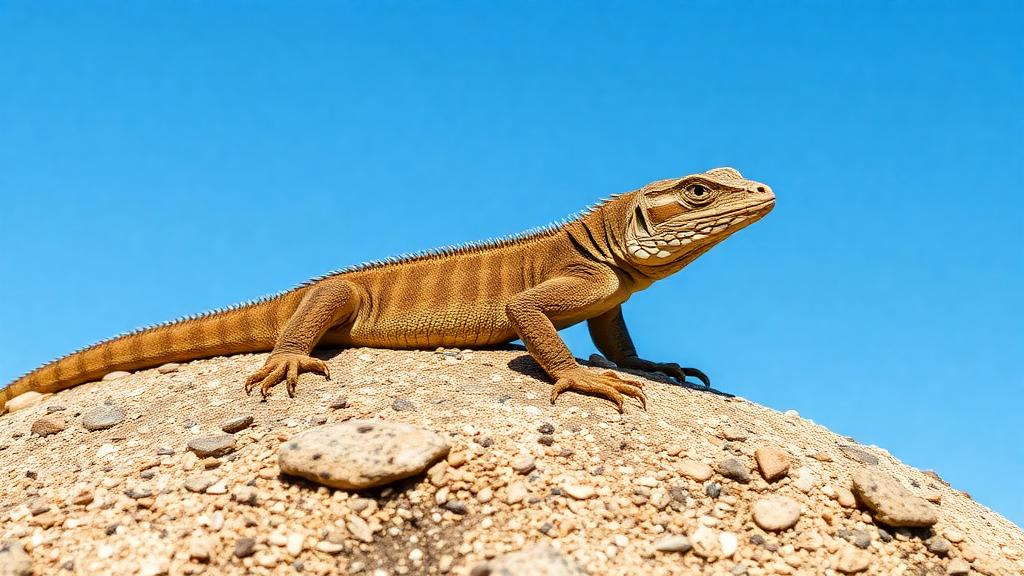
A species-distribution modeling study of the Chilean sky island lizard Liolaemus nigroviridis projects that its climatically suitable range could contract by 42.5% under the RCP 8.5 climate scenario for 2080, with the modeled area above a presence probability of 0.6 falling from 3,576.9 square kilometres to 2,058.0 square kilometres. The projection places the strongest change in central Chile: no high-probability climate envelope remains in Coquimbo, while suitable conditions extend farther south in the Andes. Human land use adds a separate constraint because croplands and built environments are more extensive in the Coastal Mountain Range than in the Andes. These are model-based projections rather than direct observations of population decline.
The species is an endemic reptile occupying isolated high-elevation habitats in the Coastal and Andean mountain ranges of central Chile, from southern Coquimbo to northern O’Higgins. It generally occurs between 2,000 and 2,800 metres above sea level. Such sky-island populations are separated from one another by warmer, drier valleys and have progressively less connected habitat as temperature and precipitation patterns change. The International Union for Conservation of Nature lists L. nigroviridis as Least Concern, although earlier work has identified potential risks from climate change and anthropization. The new analysis examined how the species’ climate envelope might change and where human occupation could constrain movement between mountain areas.
For the analysis, researchers used 199 georeferenced presence records from 53 localities, compiled from literature, museum catalogues, GBIF and iNaturalist and filtered for geographic precision. They generated 597 pseudoabsences with the BIOMOD2 package. A preliminary sensitivity analysis using the True Skill Statistic indicated that this number maintained accuracy without overfitting. The final modelling used a Random Forest algorithm in five repeated runs, dividing the records into 80% training and 20% testing sets in each run. The best-performing model achieved a True Skill Statistic of 0.86 and a receiver operating characteristic value of 0.98, metrics interpreted in the study as indicating good discrimination between presence and absence.
Six variables from WorldClim 2 were retained: mean diurnal temperature range, temperature seasonality, minimum temperature of the coldest month, annual precipitation, precipitation during the driest quarter and precipitation during the warmest quarter. Their selection combined the species’ thermal ecology, previous modelling work on Liolaemus, tests of multicollinearity through the Variance Inflation Factor, and Random Forest importance scores. Future layers came from the CMIP6 MPI-ESM1-2-HR model under RCP 4.5 and RCP 8.5 for 2040 and 2080. High-suitability areas were defined as those with a predicted presence probability greater than 0.6. The analysis then compared their area and mapped projected gains and losses across the study region.
The range contraction varied markedly among scenarios. The high-probability area was 3,538.2 square kilometres under 2040 RCP 4.5, 3,465.7 under 2040 RCP 8.5, 3,336.3 under 2080 RCP 4.5 and 2,058.0 under 2080 RCP 8.5. Relative to current conditions, the corresponding total changes were −1.1%, −3.1%, −6.7% and −42.5%. In the most severe scenario, 59.1% of the current area was projected to be lost and 16.6% gained. The sharp contrast between the 2080 scenarios indicates that the model outcome depended strongly on the greenhouse-gas pathway used to generate the future climate layers.
Geographically, the 2080 RCP 8.5 projection contained no high-probability climate envelope in Coquimbo, where the species is currently present. A small area around the mountains near Coltauco remained in the Coastal Range, limiting southward expansion in that part of the distribution. In the Andes, however, the southern limit shifted toward Chimbarongo–Las Peñas, north of the Alto Huemul nature sanctuary. The maximum southward displacement was 33.8 kilometres in the 2040 RCP 8.5 projection and 60.6 kilometres in the 2080 RCP 8.5 projection. The model therefore supported the study’s expectation of a southward movement and reduced geographic range, but it did not project the anticipated shift to higher elevations through 2080.
The absence of an altitudinal displacement may reflect both the species’ biology and the limits of the modelled period and scenarios. In the Coastal Range, the available habitat already reaches 2,281 metres, leaving limited space for an uphill move. The Andes contain many peaks above 4,000 metres, but the model did not identify high-probability conditions there under the scenarios examined. The authors suggest that the magnitude of climatic change through 2080 may be insufficient to reveal a significant altitudinal shift for this species. They also note that the timing of such movements varies among taxa and can extend from decades to centuries, with rapid shifts more readily observed in highly mobile organisms.
Land-use information was added after the climate models were produced, using a WorldCover layer that mapped croplands and built environments. It was not a forecast of future urban expansion and therefore represented a conservative account of the barriers the species could encounter. The mapped human footprint was greater in the Coastal Range than in the Andes. This contrast matters for the projected difference between the two mountain systems: Andean populations had a potential route toward newly suitable southern areas without the same concentration of croplands and buildings, while Coastal populations would face a denser network of human land uses if suitable conditions eventually shifted beyond Coltauco. River basins can also impede dispersal among Andean populations, although the study did not identify a comparable concentration of cropland and buildings along that route.
The climate variables used in the model point toward warming and drying in the study area. Under 2080 RCP 8.5, minimum temperature of the coldest month increased by 70.97%, annual precipitation decreased by 28.90%, and precipitation during the driest and warmest quarters remained unchanged. The authors connect these patterns with reduced humidity in central Chile and potential changes in the shrub habitats used by Liolaemus for thermoregulation. Field observations cited in the study describe lizards basking in the morning and retreating into shaded vegetation to avoid overheating and dehydration. The projections do not directly demonstrate changes in plant recruitment, activity time or population survival, but they identify climatic variables that could affect the conditions on which the species depends.
Humidity may also influence the insect prey of this mainly insectivorous lizard. The evidence reviewed by the authors links humidity with insect survival, reproduction, movement and migration, while low humidity can constrain some insect species. For the lizard, these relationships provide a possible route by which climatic drying could affect food resources in addition to direct thermal stress. The study did not measure prey abundance, feeding success or reproduction, however, so these remain ecological mechanisms discussed in relation to the model rather than quantified outcomes. The robust findings are the projected contraction and southward movement of the climate envelope, the regional disappearance of high-probability conditions in Coquimbo, and the differing land-use constraints facing Coastal and Andean populations.
The authors present assisted migration as a possible future option, particularly for Coastal populations that may be unable to cross human barriers while tracking shifting climate conditions. Human-assisted translocation is generally discussed for species with limited dispersal capacity, but it may also be considered when otherwise mobile species cannot reach newly suitable habitat because of anthropogenic barriers. The modelling study did not implement or evaluate a translocation, establish that one would be necessary or safe, or test possible ecological and genetic consequences. Its broader contribution is to show how climate projections and land-use maps can be combined to identify differing vulnerability among populations of the same species. The authors suggest that this approach could also inform research on other central Chilean reptiles with similar habitat requirements, including Liolaemus bellii, Liolaemus leopardinus and Pristidactylus volcanensis, for which additional ecological and physiological work would be needed.
Subject of Research: Modelled climate and land-use vulnerability of the Chilean sky island lizard Liolaemus nigroviridis
Article Title: Assessing the vulnerability of a sky island lizard to climate and land-use change
Article References: Mella-Romero, J., Maya-Miranda, S., Véliz, D., & Simonetti, J. A. (2024). Assessing the vulnerability of a sky island lizard to climate and land-use change. Herpetozoa, 37, 257-267. https://doi.org/10.3897/herpetozoa.37.e125163
Image Credits: AI Generated
DOI: 10.3897/herpetozoa.37.e125163
Keywords: Liolaemus nigroviridis, species distribution modelling, climate change, land-use change, sky islands, central Chile, Andean Range, Coastal Range, Random Forest, conservation, Assessing, vulnerability
News Source: Drew Townsend. (October 20, 2026). Distribution model projects narrower future range for Chilean sky island lizard. Scienmag.