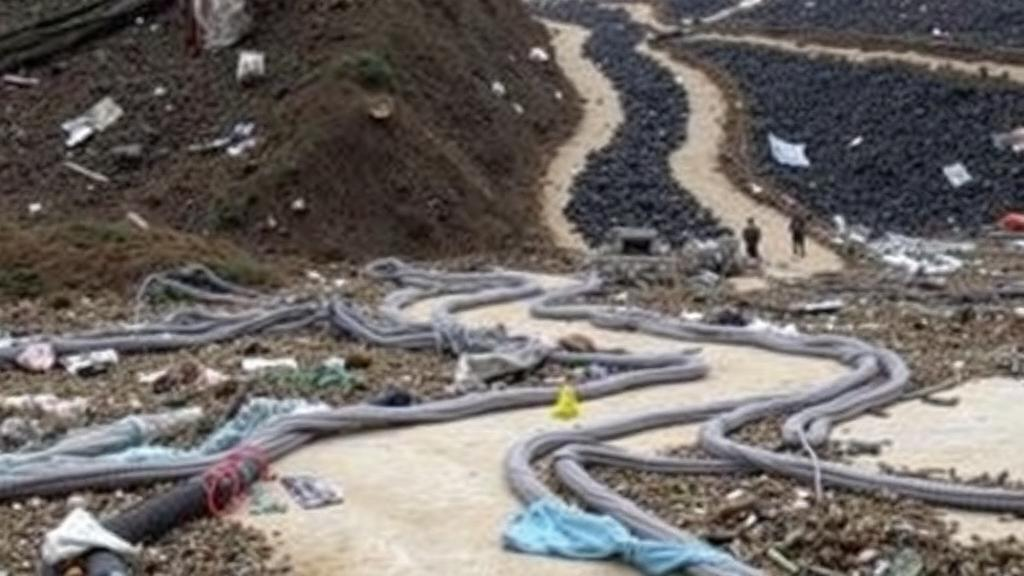
A high-resolution magnetic survey of the Benowo municipal landfill in Surabaya, Indonesia, identified subsurface zones that may be associated with leachate migration, according to a study published in Scientific Reports. Researchers collected 246 magnetic measurements across the site with a proton precession magnetometer, then combined several data-processing and modeling techniques to localize anomalies and estimate the geometry and depth of their likely magnetic sources. The work offers a rapid, non-invasive way to prioritize areas for more detailed investigation, although it did not directly detect or chemically identify contaminants.
Leachate can transport toxic metals and organic contaminants from landfill waste into surrounding soil and groundwater, making the movement and extent of subsurface leakage an environmental concern. The Benowo investigation focused on mapping magnetic anomalies that might mark preferential subsurface pathways or structures relevant to that process. After acquisition, the measurements underwent diurnal correction and removal of the International Geomagnetic Reference Field. Researchers also applied upward continuation, Reduction-to-the-Pole transformation, analytic signal, first vertical gradient and horizontal gradient analyses to improve anomaly localization and delineate source boundaries.
After processing, the Reduction-to-the-Pole magnetic anomalies ranged from −8,000 to +7,200 nT. They were concentrated mainly in the northern and western sectors of the landfill. The study then selected representative anomalies for quantitative interpretation through forward modeling, using a simplified representation of subsurface magnetic bodies. A Flower Pollination Algorithm, a metaheuristic optimization method, was used to adjust the modeled sources and reproduce the observed magnetic responses.
The optimized models identified simplified spherical and cylindrical magnetic source bodies at approximate depths of 11–29 meters. The optimization converged consistently, with residual misfits below 0.1 nT, indicating close numerical agreement between observed and modeled magnetic responses. The resulting distribution of interpreted sources was spatially consistent with the known geological and hydrogeological framework of the study area. That agreement does not establish that every magnetic source represents pollution, but it supports using the anomalies as indicators of where further investigation may be most useful.
Magnetic surveying alone cannot confirm the presence, composition or movement of landfill leachate, and the interpreted bodies are simplified models rather than direct images of buried waste or contamination plumes. The researchers therefore treated the anomaly zones as targets for subsequent hydrochemical sampling, borehole work or complementary geophysical surveys. By integrating high-resolution magnetic measurements with transformation-based processing and metaheuristic forward modeling, the study demonstrates a scalable, non-invasive approach to identifying subsurface features that could guide environmental risk assessment and groundwater protection at municipal landfills.
Subject of Research: High-resolution magnetic surveying and metaheuristic modeling of possible leachate pathways at the Benowo municipal landfill in Surabaya, Indonesia.
Article Title: Integrating high-resolution magnetic surveys and metaheuristic optimization for quantitative characterization of subsurface magnetic sources in a municipal landfill
Article References: Minarto, E., & Lesar, Z. R. A. (2026). Integrating high-resolution magnetic surveys and metaheuristic optimization for quantitative characterization of subsurface magnetic sources in a municipal landfill. Scientific Reports. https://doi.org/10.1038/s41598-026-76581-y
Image Credits: AI Generated
DOI: 10.1038/s41598-026-76581-y
Keywords: landfill leachate, magnetic surveying, Benowo landfill, metaheuristic optimization, groundwater protection, magnetic anomalies, forward modeling, environmental geophysics, Integrating, high-resolution, magnetic, surveys
News Source: Denise Maddox. (October 20, 2026). Magnetic Survey Identifies Potential Leachate Pathways in Indonesian Landfill. Scienmag.