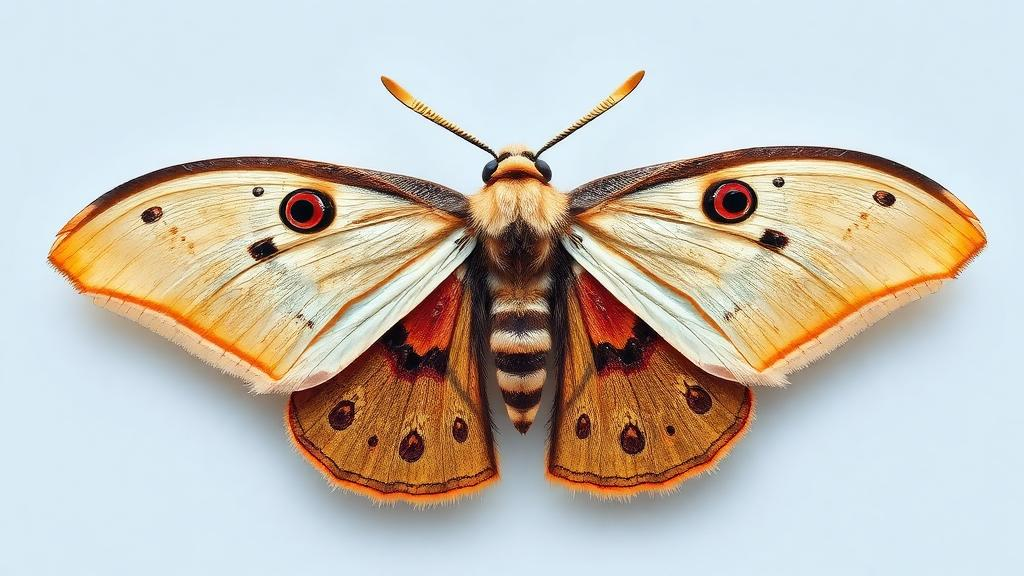
An unusual silkmoth from the eastern Himalayas has begun to revise one of the most persistent puzzles in saturniid biology. Researchers have documented the full life cycle of Antheraea compta, a scarce Himalayan species whose appearance, feeding behavior, larval anatomy and silk construction suggest that it is more closely related to American silkmoths than earlier classifications allowed. The finding places an “American” lineage in a landscape of oaks, monsoon forests and alpine foothills, raising questions about how the moth reached the region and how isolated its populations have become.
The moth was first described in 1899 from a series collected in the Khasia Hills of Assam, now part of Meghalaya. For much of the following century, naturalists associated it with Antheraea assamensis, the local golden muga silkmoth, because the two share conspicuous eyespots and occupy the same general region. Dissimilar details, however, accumulated around A. compta. The male genitalia closely resemble those of A. godmani from Central America, and later researchers also recognized affinities with other New World species. A 2023 study in Deutsche Entomologische Zeitschrift now places the Himalayan moth within the subgenus Telea, whose main representatives are native to North and Central America.
To obtain the missing stages of its life history, the researchers collected adults in Mêdog County, southeastern Tibet, where the species occurs at about 2,122 metres. Females were taken from the natural habitat and their descendants were reared on Yunnan oak, Quercus yunnanensis. This was the first report of the complete pre-adult development of A. compta, including its egg, six larval instars, pupa and cocoon. The achievement matters because adults are rare in museum collections, leaving earlier scientists with very little material on which to test competing taxonomic and evolutionary hypotheses.
The eggs are flattened, three-axis ellipsoids measuring about 3.71 millimetres long, 3.32 millimetres wide and 2.18 millimetres high. Their chorion carries a reticular sculpture of polygonal ridges, spongiform structures around the circumference and scattered aeropyles, or breathing openings. A dry shell appears mostly opaque white, but wetting makes it translucent and reveals the embryo. Newly hatched caterpillars commonly consume the empty eggshell before searching for food. The larvae also drank water directly and required leaves to be sprayed repeatedly during rearing, although they tolerated a wide range of relative humidity, from roughly 64 to 98 percent.
Development through six larval instars transformed the head capsule from 1.78 millimetres wide in the first instar to 10.32 millimetres in the sixth. The early caterpillar had a shiny black head, a bright yellow body and conspicuous scoli, or clusters of setae, on its thorax and abdomen. Later instars developed a green ground color, dark markings and unusually reflective silvery bases on many scoli. Some bristles grew long, helically twisted stems with flattened, reflective tips. Under ultraviolet light, a bright yellow ring around the front of the first thoracic segment fluoresced strongly, although the silvery bases did not. Two female larvae were generally more yellow than three males, while the reflective scoli of females tended toward purple-red and those of males toward purple-blue.
The caterpillars showed weak positive phototaxis, generally resting beneath leaves and moving toward their edges to feed. They were not gregarious, although two to five first-instar larvae could sometimes occupy one leaf. Later, they fed along the midrib and increasingly rested close to the petiole. In late stages, they sometimes severed leaf stalks, apparently removing visible evidence of feeding that might otherwise guide predators to them. Mature larvae fed mainly at night and were highly sensitive to disturbance. When alarmed, they released their feet, sometimes clicked their mouthparts, swung from side to side or bit, behaviors that may have helped them resemble disturbed foliage or startle an attacker. No irritating secretion or urticating reaction was observed.
Rearing was nevertheless demanding, with heavy mortality among newly hatched larvae. Temperature was critical: the caterpillars tolerated conditions up to 28 degrees Celsius, but at 26 degrees they often detached themselves from the plant and hung in the air to dissipate heat, sometimes falling to the ground. Among five individuals that reached the second instar, developmental times varied despite similar food and weather. Dates from oviposition to cocoon construction ranged from 76 days for one male to 91 days for one female. Mature caterpillars stopped feeding, moved away from the oak and remained restless for about a day before spinning. In captivity, some produced cocoons attached to upright vegetation, while others spun among fallen leaves and branches on the ground.
The cocoons are closed, single-layered structures without a preformed exit. Exterior floss attached the cocoon to its support, while the smoother inner layer enclosed the pupa. Microscopy showed that each silk filament consisted of a flattened double-stranded belt, with an outer layer of sericin surrounding a densely packed, nearly nonporous fibroin core. Filaments on the exterior measured roughly 84 to 94 micrometres across and 5 to 9 micrometres thick, while those inside were generally narrower and thinner. Calcium oxalate crystals from the liquid discharged before pupation became scattered through the silk and accumulated more heavily on the side facing the ground. The cocoons were white when dry and turned brown when wet.
Yunnan oak supported the caterpillars in captivity, but the species rejected several common alternatives. Newly hatched larvae refused Lauraceae, including multiple camphor, Machilus, Lindera, Neolitsea and Litsea species, as well as Magnolia delavayi, cherry, willow and sweetgum. They also rejected Quercus schottkyana, while only one experimental larva nibbled Quercus variabilis without continuing to feed. The authors therefore caution against assuming that all cycle-cup oaks are suitable hosts and point to other regional oaks, including Quercus lodicosa, Q. lanata and Q. griffithii, as plausible natural food plants that still require testing. The authors also reject an old identification of empty Assamese cocoons spun on Litsea monopetala as A. compta; those were probably made by muga silkmoths or a close relative.
Known populations are confined to three tropical ecoregions: the Meghalaya subtropical forests, the northern triangle subtropical forests extending into Myanmar, and the eastern Himalayan broadleaf forests of southeastern Tibet. Historical material came from the Khasia and Jaintia Hills in Meghalaya, Kambaiti in present-day Kachin State in Myanmar, and Mêdog. Recent surveys have not recovered the moth in its type locality, raising concern that the Indian population may have been nearly extirpated. Its taxonomic name is also unsettled. Moths from Mêdog were described in 2015 as Antheraea discata, but the study found morphological and mitochondrial-DNA differences from the Meghalaya population while noting that samples from mountainous Myanmar could help define the boundary. The authors therefore treated the three populations as potentially transitional or separate but declined to synonymize them without further evidence.
For now, the clearest conclusion is biogeographic rather than merely descriptive: A. compta appears to be a Himalayan member of a mainly American silkmoth lineage. Its striped mature larvae resemble the North American polyphemus moth and A. oculea, while the scale and placement of their shiny spots recall the Mexican A. montezuma and A. meridiana. The tricolored lateral plates of the anal prolegs closely match those of A. godmani. These shared traits, combined with oak-based feeding and the complete developmental record, make A. compta a key piece of evidence for reconstructing the evolutionary history of Antheraea and the wider Saturniidae family. The moth’s rarity also turns conservation from a general concern into a practical test: without better surveys of Meghalaya, Myanmar and Tibet, its present range and evolutionary continuity may remain impossible to establish.
Subject of Research: The life history, distribution, taxonomy and evolutionary affinities of the Himalayan silkmoth Antheraea compta
Article Title: An “American” silkmoth endemic to Himalayas, part I: life history and natural distribution of Antheraea compta Rothschild, 1899 ( Lepidoptera , Saturniidae )
Article References: Liu, Z. (2023). An “American” silkmoth endemic to Himalayas, part I: life history and natural distribution of Antheraea compta Rothschild, 1899 (Lepidoptera, Saturniidae). Deutsche Entomologische Zeitschrift, 70(2), 261-282. https://doi.org/10.3897/dez.70.102952
Image Credits: AI Generated
Keywords: Antheraea compta, Himalayan silkmoth, Saturniidae, Telea, larval morphology, oak-feeding caterpillars, Meghalaya, southeastern Tibet, Myanmar, taxonomic revision, biodiversity conservation, silk cocoons
News Source: Margaret Porter. (October 19, 2026). Himalayan silkmoth reveals unexpected links to American species. Scienmag.