• HOME
  • NEWS
  • EXPLORE
    • CAREER
      • Companies
      • Jobs
    • EVENTS
    • iGEM
      • News
      • Team
    • PHOTOS
    • VIDEO
    • WIKI
  • BLOG
  • COMMUNITY
    • FACEBOOK
    • INSTAGRAM
    • TWITTER
Friday, January 2, 2026
BIOENGINEER.ORG
No Result
View All Result
  • Login
  • HOME
  • NEWS
  • EXPLORE
    • CAREER
      • Companies
      • Jobs
        • Lecturer
        • PhD Studentship
        • Postdoc
        • Research Assistant
    • EVENTS
    • iGEM
      • News
      • Team
    • PHOTOS
    • VIDEO
    • WIKI
  • BLOG
  • COMMUNITY
    • FACEBOOK
    • INSTAGRAM
    • TWITTER
  • HOME
  • NEWS
  • EXPLORE
    • CAREER
      • Companies
      • Jobs
        • Lecturer
        • PhD Studentship
        • Postdoc
        • Research Assistant
    • EVENTS
    • iGEM
      • News
      • Team
    • PHOTOS
    • VIDEO
    • WIKI
  • BLOG
  • COMMUNITY
    • FACEBOOK
    • INSTAGRAM
    • TWITTER
No Result
View All Result
Bioengineer.org
No Result
View All Result
Home NEWS Science News Biology

How invasive species threaten bats

Bioengineer by Bioengineer
August 30, 2017
in Biology
Reading Time: 1 min read
0
Share on FacebookShare on TwitterShare on LinkedinShare on RedditShare on Telegram
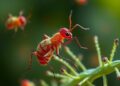
IMAGE

Credit: Julia Boland

A new review is the first to describe the scope of threats to bats by invasive species.

The review summarizes the threats according to four categories: predation, disease, competition, and indirect interactions. The investigators identified threats of 37 invasive species to 40 bat species. Ten bat species were threatened by more than one invasion pathway. About 38 percent of cases are speculative and 18 percent circumstantial, and most accounts do not provide enough information needed to forecast bat population impacts.

Over 60 percent of bat species reviewed are island dwelling, corresponding with evidence indicating that most extinctions occur on islands and that invasive species' impacts are worse for island than mainland populations.

"Evidence of cat predation was the most frequently cited threat. But the most interesting threat to me involved invasive burdock, a plant with prickly flower heads with hooked bracts, that entangle bats," said Dr. Jessica Nicole Welch, co-author of the Mammal Review study.

"We often think of the impact that bats have on invertebrates that transmit disease to humans, like mosquitoes, but it is much less broadly known that venomous giant centipedes kill bats and competition from cavity nesting, feral honeybees, and little fire ants exclude bats from tree hollows where they raise their young," added co-author Dr. Christy Leppanen.

###

Media Contact

Penny Smith
[email protected]

http://newsroom.wiley.com/

Related Journal Article

http://dx.doi.org/10.1111/mam.12099
Share12Tweet7Share2ShareShareShare1

Related Posts

Addendum: Cryo-EM Reveals RNA-Rich Plant Mito Ribosome

Addendum: Cryo-EM Reveals RNA-Rich Plant Mito Ribosome

January 2, 2026
Phage Cas12p Nucleases Need Thioredoxin to Cut DNA

Phage Cas12p Nucleases Need Thioredoxin to Cut DNA

January 2, 2026

Foreign Bodies in Sheep and Goats: Prevalence and Risks

December 31, 2025

Rethinking Gender Inference from Health Record Algorithms

December 31, 2025
Please login to join discussion

POPULAR NEWS

  • blank

    PTSD, Depression, Anxiety in Childhood Cancer Survivors, Parents

    115 shares
    Share 46 Tweet 29
  • NSF funds machine-learning research at UNO and UNL to study energy requirements of walking in older adults

    71 shares
    Share 28 Tweet 18
  • Exploring Audiology Accessibility in Johannesburg, South Africa

    52 shares
    Share 21 Tweet 13
  • SARS-CoV-2 Subvariants Affect Outcomes in Elderly Hip Fractures

    44 shares
    Share 18 Tweet 11

About

We bring you the latest biotechnology news from best research centers and universities around the world. Check our website.

Follow us

Recent News

IL-10 Targeting LDL Lowers Vascular Inflammation in Atherosclerosis

Insights on Eco-Friendly Cataract Surgery Practices

Reinforcing Neural Connectivity: A New Spike Prediction Model

Subscribe to Blog via Email

Enter your email address to subscribe to this blog and receive notifications of new posts by email.

Join 71 other subscribers
  • Contact Us

Bioengineer.org © Copyright 2023 All Rights Reserved.

Welcome Back!

Login to your account below

Forgotten Password?

Retrieve your password

Please enter your username or email address to reset your password.

Log In
No Result
View All Result
  • Homepages
    • Home Page 1
    • Home Page 2
  • News
  • National
  • Business
  • Health
  • Lifestyle
  • Science

Bioengineer.org © Copyright 2023 All Rights Reserved.