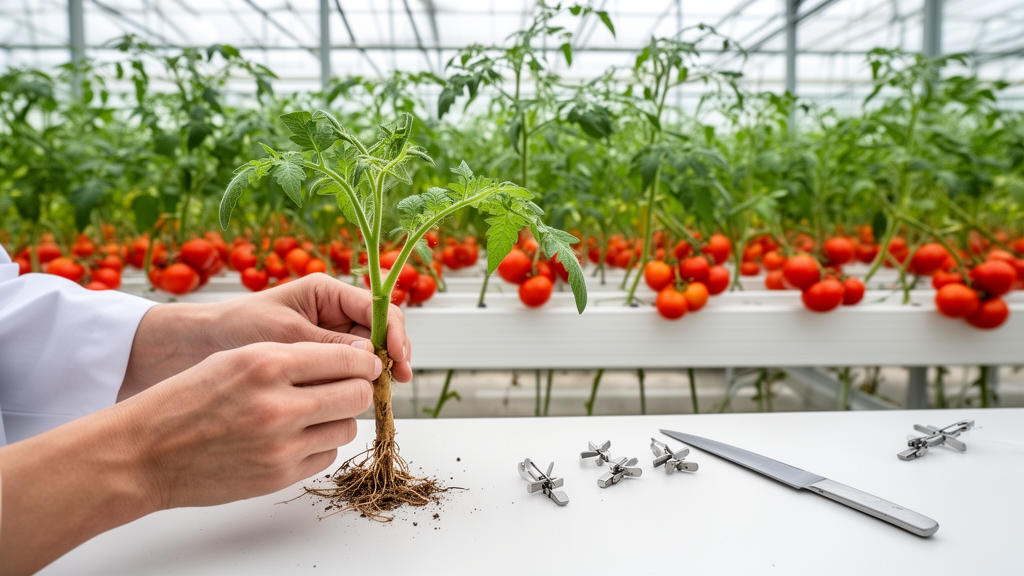
Tomato growers around the world graft their high-value scions onto rootstocks chosen from a remarkably short list of commercial cultivars, and that dependence is becoming a liability. As soilborne pathogens evolve and overcome the resistance genes carried by these few established rootstocks, the search for fresh genetic material has taken on real urgency. A new open-access study in BMC Plant Biology reports the evaluation of six experimental interspecific tomato rootstocks derived from crosses between cultivated tomato, Solanum lycopersicum, and the wild green-fruited species Solanum habrochaites, a wild relative long prized by breeders as a reservoir of disease resistance. The work, led by Hatice Şeyma Yücel of Ondokuz Mayıs University and Ahmet Seçim of Genetika Seeds, was supported by TÜBİTAK under project grant 710745 and screened the candidates for molecular resistance markers, graft compatibility, yield, and fruit quality against three commercial standards.
The breeding logic behind the study rests on a well-established principle in modern horticulture: the rootstock controls the root system and much of the plant’s interaction with the soil, while the scion determines the fruit. By combining the fruit quality of a commercial cultivar with the defensive arsenal of a wild species below ground, breeders can protect a crop without altering what the consumer eats. Solanum habrochaites, native to the Peruvian and Ecuadorian Andes, carries resistance alleles against a suite of devastating soilborne and vascular diseases, including Fusarium wilt, Fusarium crown and root rot, Verticillium wilt, and root-knot nematodes. Interspecific hybridization between the two species allows those resistance alleles to be captured in hybrid rootstock lines while retaining the graft compatibility that comes from the cultivated tomato genome.
From an initial pool of fifteen hybrid combinations developed under the TÜBİTAK project, the team selected six candidates, designated RSH-6, RSH-16, RSH-17, RSH-18, and two additional lines, for detailed evaluation. Each was compared with the commercial rootstocks Beaufort F1, Arazi F1, and Balance F1, widely used in greenhouse tomato production. The scion in every combination was Fulya F1, a commercial Turkish greenhouse cultivar, and an ungrafted Fulya F1 control was included to isolate the rootstock effect. All plants were propagated by tube grafting, a technique that joins scion and rootstock segments in small plastic tubes until the vascular tissues fuse, and then grown through a full spring greenhouse cycle where graft success, yield, and fruit quality could be measured under realistic production conditions.
The molecular component of the study used DNA markers linked to known resistance genes to determine which defensive alleles each rootstock carried. Marker-assisted selection of this kind allows breeders to identify resistance without waiting for pathogen challenge tests, which are slow, expensive, and dependent on seasonal conditions. The analysis revealed that all six candidates carried resistance-associated alleles for Fusarium wilt, Fusarium crown and root rot, Verticillium wilt, and root-knot nematode resistance, but four lines stood out. RSH-6, RSH-16, RSH-17, and RSH-18 carried the most complete set of resistance-associated alleles across the four disease targets, a breadth of coverage that few commercial rootstocks can match as soilborne pathogens continue to evolve and erode established resistances.
Graft success, the proportion of grafted plants that survive and grow normally, ranged from 93.33 percent to 100.00 percent across the interspecific candidates, figures that place them squarely within the range expected of commercial rootstocks. Graft compatibility is a critical practical filter in rootstock breeding, because a rootstock that carries superb resistance genes is worthless if it cannot form a functional vascular connection with the scion. The high success rates observed here suggest that the interspecific hybrids, despite their wild parentage, have retained the anatomical and physiological compatibility needed for commercial propagation, a result the authors attribute to the careful selection of hybrid combinations during the earlier breeding phases.
Yield performance told a more nuanced story. Total yield per plant differed significantly among the rootstock-scion combinations, ranging from 4.70 to 6.46 kilograms per plant, with a statistical significance threshold of p less than 0.05. The top performer was RSH-6, which achieved the highest total yield in the trial and was statistically comparable to the commercial rootstocks Beaufort F1, Arazi F1, and Balance F1. This result matters because it demonstrates that a newly developed interspecific hybrid, carrying a broader set of resistance alleles than the commercial standards, can match them in raw productivity during a spring greenhouse cycle. The remaining candidates showed varying yield levels, some of which fell below the commercial range, indicating that not every resistance-rich hybrid translates into horticultural excellence.
Fruit quality measurements added a further layer of evaluation. Several of the grafted combinations produced fruit with greater width and firmness than the ungrafted Fulya F1 control, suggesting that the rootstocks were not merely supporting the scion but actively enhancing certain physical fruit traits. Fruit firmness in particular is a commercially valuable attribute, affecting shelf life, transport tolerance, and consumer perception. Other quality traits were largely comparable among treatments, indicating that grafting onto the interspecific rootstocks did not compromise the essential eating quality of the scion cultivar. The absence of significant negative effects on fruit quality is a key finding, because rootstocks with wild parentage sometimes introduce off-flavors or altered fruit morphology that render them commercially unacceptable.
To integrate the molecular, yield, and quality data into a single performance picture, the team applied multivariate statistical analyses, including principal component analysis, to the full dataset. These methods reduce many correlated traits into a smaller number of independent axes of variation, allowing researchers to visualize which rootstock-scion combinations cluster together and which stand apart. The analyses placed RSH-6 close to the commercial standards and supported its favorable overall profile of yield and fruit quality, confirming that the experimental candidate performs on par with established rootstocks while carrying a more complete set of resistance-associated alleles. The multivariate framework also highlighted the trade-offs among the remaining candidates, some of which excelled in individual traits but fell short in overall balance.
The authors conclude that several of the newly developed interspecific hybrid rootstocks combine a broad set of resistance-associated alleles with high graft success and satisfactory horticultural performance, and they single out RSH-6 as the most promising candidate overall. Its yield and fruit-quality characteristics were comparable to established commercial rootstocks, while its molecular profile suggested superior defensive coverage against the major soilborne and vascular diseases of tomato. The team recommends that RSH-6 proceed to multi-location and multi-season validation trials, the standard next step before a new rootstock can be released commercially. Such trials will test whether the performance observed in a single spring greenhouse cycle holds across different environments, seasons, and pathogen pressures, and whether the resistance alleles identified by molecular markers translate into durable field-level protection.
The broader significance of the work lies in its demonstration of a complete breeding pipeline, from wild-species hybridization through molecular marker screening to greenhouse evaluation of agronomic performance. As climate change and evolving pathogens place increasing pressure on global tomato production, which depends on a narrow genetic base for its defensive genes, the ability to rapidly develop and validate new rootstocks carrying diverse resistance alleles becomes a strategic asset. The study also illustrates the value of public-private collaboration, combining academic expertise at Ondokuz Mayıs University with the commercial breeding capacity of Genetika Seeds under TÜBİTAK funding. If RSH-6 and its sibling candidates pass the upcoming validation trials, growers may soon have access to rootstocks that offer both the disease resistance needed for sustainable production and the yield and fruit quality demanded by modern markets, reducing the industry’s dependence on a handful of aging commercial cultivars whose immunity is steadily being compromised.
Subject of Research: Evaluation of promising interspecific tomato rootstocks (Solanum lycopersicum × Solanum habrochaites) for molecular marker-based resistance screening, yield, and fruit quality
Article Title: Evaluation of promising interspecific tomato rootstocks (Solanum lycopersicum × Solanum habrochaites) for molecular marker-based resistance screening, yield, and fruit quality
Article References: Yücel, H. Ş., & Seçim, A. (2026). Evaluation of promising interspecific tomato rootstocks (Solanum lycopersicum × Solanum habrochaites) for molecular marker-based resistance screening, yield, and fruit quality. BMC Plant Biology. https://doi.org/10.1186/s12870-026-10192-7
Image Credits: AI Generated
DOI: 10.1186/s12870-026-10192-7
Keywords: tomato rootstocks, Solanum habrochaites, grafting, disease resistance, molecular markers, plant breeding, BMC Plant Biology, Evaluation, promising, interspecific, tomato, rootstocks
News Source: Alan Morgan. (October 19, 2026). New Interspecific Tomato Rootstocks Pack Disease Resistance Genes and Match Commercial Yields. Scienmag.