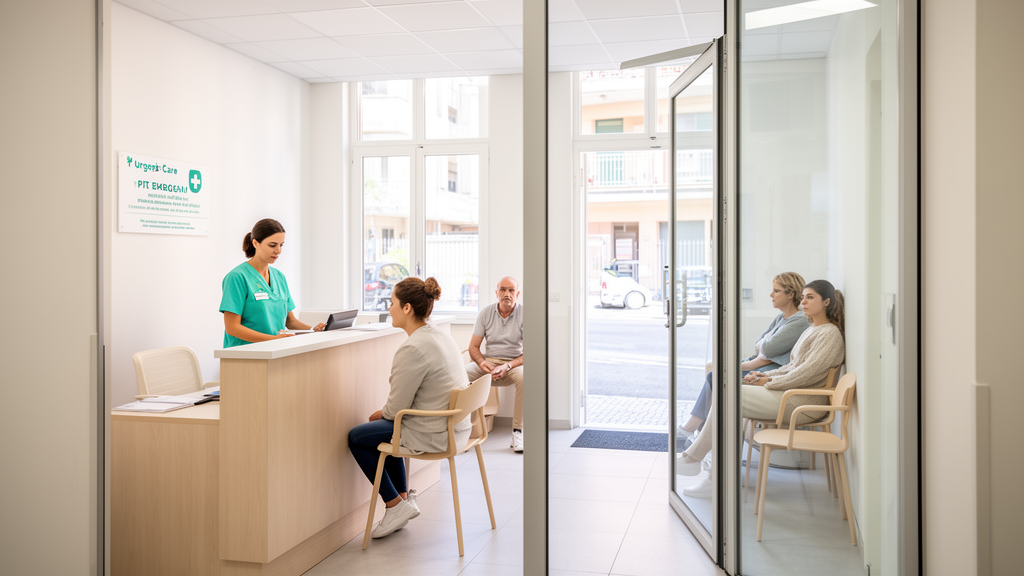
Emergency departments across the world are drowning in patients who do not need them. A large real-world evaluation from Italy’s Emilia-Romagna region now offers some of the strongest evidence yet that community-based urgent care centers, when woven into a region’s primary care network, can meaningfully drain that pressure. The study, published in BMC Health Services Research, tracked daily emergency department activity across 32 health districts over more than three years and found that low-acuity emergency visits fell well below expected levels after urgent care centers opened, with the size of the reduction depending heavily on how the centers were organized.
The scale of the problem the region set out to solve is familiar to health systems everywhere. Emergency department overcrowding is driven in large part by high volumes of low-complexity cases, patients with conditions that need prompt attention but not the full apparatus of a hospital emergency service. In 2023, Emilia-Romagna launched a network of community-based Urgent Care Centers, or UCCs, designed to intercept these visits before they reached hospital doors. By April 2025, 43 such centers were operating across the region, and the new study set out to measure what happened to emergency department traffic as they came online.
The research team, led by Daniela Fortuna and Dario Tedesco of the Emilia-Romagna regional health directorate along with collaborators from the universities of Bologna and Parma, took advantage of a natural experiment. Because the centers opened at staggered times across different districts, the investigators could apply an interrupted time-series design, using segmented regression models to compare observed daily low-acuity emergency visit volumes against the trajectory that would have been expected based on pre-opening trends, while adjusting for annual and weekly seasonality. The data came from routinely collected regional health databases spanning January 2022 to April 2025.
The headline finding is striking. On average, after the opening of the first urgent care center in a district, daily low-acuity emergency department visits ran 13.5 percent lower than expected, with a confidence interval running from minus 13.9 to minus 13.0 percent. And the effect grew as the regional network expanded. In the later periods of the study, the shortfall deepened to 22.5 percent and then 23.6 percent below expected levels, suggesting that the centers became more effective at diverting appropriate patients as coverage and public familiarity spread.
But the most consequential result is not the average. It is the enormous spread across organizational models. Urgent care centers that shared a pre-triage pathway with the emergency department, so that patients arriving at the hospital could be redirected on the spot to the adjacent urgent care service, cut low-acuity emergency visits by 42.2 percent. Community-based centers located far from hospitals, without that shared access point, achieved only a modest 9.5 percent reduction. And centers physically adjacent to hospitals but lacking the shared pre-triage arrangement showed essentially no reduction at all, at minus 0.7 percent, a figure statistically indistinguishable from zero.
That pattern carries a clear message for planners: physical proximity to a hospital is not enough, and neither is simply adding urgent care capacity somewhere in the community. What appears to matter is integration, the deliberate engineering of a single front door through which patients with urgent but low-complexity needs are sorted and routed. A shared pre-triage model means the patient who shows up at the emergency department with a sprained ankle or a fever does not need to know in advance where to go; the system redirects them. Community sites, by contrast, depend on patients self-selecting, which the data suggest happens far less reliably.
The study’s multilevel logistic regression analysis reinforced that point from the patient side. The strongest predictor of whether a resident used an urgent care center rather than an emergency department was simply whether a center existed in the municipality of residence, which raised the odds of urgent care use roughly sevenfold. Convenience and geographic access, in other words, shape urgent care behavior powerfully, but they operate most effectively when combined with system-level routing rather than left to individual navigation.
The case mix comparison between urgent care centers and low-acuity emergency visits adds further texture. The centers, nearly half of which were embedded in Community Health Centers and roughly 37 percent located within hospitals, with 46.5 percent offering round-the-clock coverage, were handling precisely the kind of urgent-but-not-emergent presentations that clog emergency departments. That alignment between what the centers treat and what the emergency departments were shedding is what makes the volume shifts interpretable as diversion rather than mere displacement.
The authors are appropriately careful about causal claims. Because no contemporaneous untreated comparator region was available, they caution that the observed differences should not be interpreted as effects attributable solely to the urgent care implementation. Secular trends, concurrent policy changes, or shifts in patient behavior could in principle contribute to the pattern. Still, the dose-response relationship, with effects strengthening as the network expanded and concentrating where integration was deepest, is difficult to explain without invoking the centers themselves.
For health systems grappling with emergency department overcrowding, the Emilia-Romagna experience offers a concrete design lesson wrapped in rigorous time-series evidence. Urgent care centers are not interchangeable widgets; their impact on emergency department load depends on whether they are stitched into a shared access and pre-triage pathway or left as isolated alternatives. As regions elsewhere consider similar investments, the Italian data suggest that the architecture of the network, not just the number of centers, will determine whether the emergency department finally gets the relief it needs.
Subject of Research: Effect of urgent care center integration into primary care networks on low-acuity emergency department utilization
Article Title: Integrating urgent care centers into primary care networks to reduce emergency department overcrowding: a real-world implementation and evaluation
Article References: Fortuna, D., Golinelli, D., Caranci, N., Grilli, R., Donatini, A., Alberani, M., Marinelli, S., Berti, E., Tedesco, D., Emilia-Romagna UCC Working Group, Barbagallo, V., Bartoli, S., Casoni, F., Cisbani, L., Clo, M., Fabbri, E., Gentili, A., Lama, B., Marino, M., … Camplone, I. (2026). Integrating urgent care centers into primary care networks to reduce emergency department overcrowding: a real-world implementation and evaluation. BMC Health Services Research. https://doi.org/10.1186/s12913-026-15566-z
Image Credits: AI Generated
DOI: 10.1186/s12913-026-15566-z
Keywords: emergency department overcrowding, urgent care centers, primary care, interrupted time series, health services research, pre-triage, Emilia-Romagna, low-acuity visits, health policy, community health centers, patient diversion, Italy
News Source: Ophelia Keating. (October 19, 2026). Urgent Care Centers Cut Low-Acuity Emergency Department Visits by Up to 42 Percent in Italian Region. Scienmag.