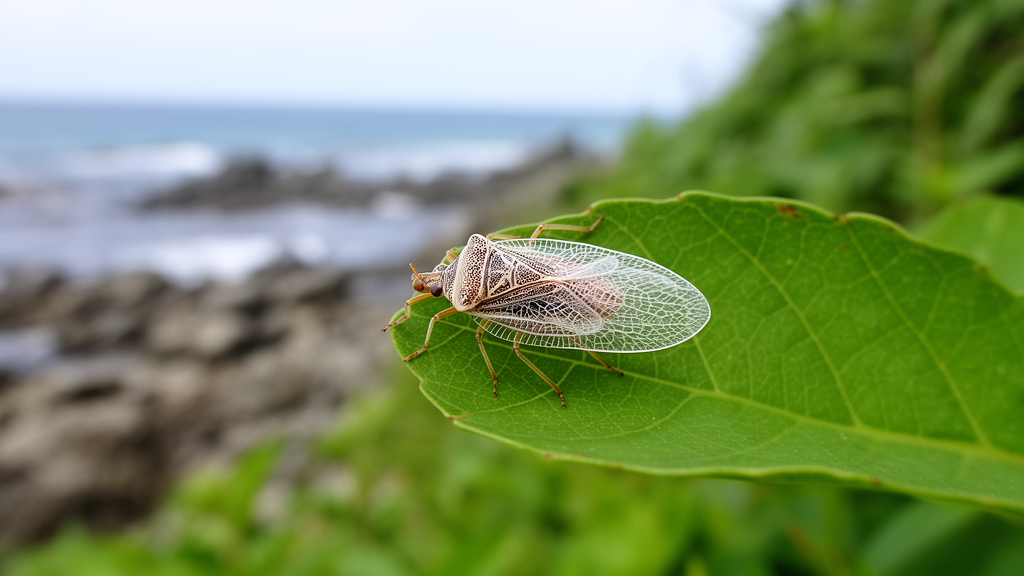
On two tiny islands of Japan, entomologists have uncovered two lace bug species that were hiding in plain sight — one of them misidentified for decades, the other so unusual that it breaks a defining rule of its own genus. The discoveries, published in the Deutsche Entomologische Zeitschrift, bring the number of Japanese species of the genus Agramma to four and hint at how small islands can quietly manufacture new species from isolated populations that rarely, if ever, take to the air.
Lace bugs, the family Tingidae, are true bugs named for the delicate, net-like pattern of veins and cells that covers their wings and bodies. They are plant feeders, and most pierce the underside of leaves with slender mouthparts. The genus Agramma is an Old World group with 88 extant and one fossil species in three subgenera, and many of its members feed on monocotyledons — grasses, sedges, rushes and their relatives. In Japan, only two species had been recognized: Agramma abruptifrons, found on rushes, and Agramma japonicum, found on sedges, both known mainly from the four main islands and their immediate surroundings.
The first hint of something new came from Hachijo Island in the Izu Islands, a Palaearctic island chain south of Tokyo. A population there had been recorded in the literature as Agramma japonicum, but its general appearance never quite matched the original description from Sapporo, Hokkaido. Careful morphological study now shows it is an independent species, formally named Agramma izuense. The second surprise came from Aka and Geruma islands in the Kerama Group of the subtropical Ryukyu Islands, where an unidentified Agramma with a completely spineless head was collected — a feature so atypical that the species does not fully match the existing diagnosis of the genus itself, and is provisionally placed in Agramma on general similarity. It is now named Agramma keramense.
To test whether the Hachijo population was truly a separate species or merely geographic variation of Agramma japonicum, the researchers turned to molecular data. They sampled 18 operational taxonomic units from four Japanese tingid species, using two other lace bug genera as outgroups. Partial sequences of four gene markers were analyzed: the mitochondrial COI (742 base pairs), COII (765 bp) and 16S (361 bp), plus the nuclear 28S (444 bp). DNA was extracted nondestructively from specimen abdomens, which were then preserved in polyethylene vials mounted on the pins alongside the dried bodies — a technique that keeps both the genetic evidence and the morphological voucher intact for future study.
The concatenated dataset of all four genes yielded 2,312 base pairs and was analyzed with Bayesian inference. The resulting trees supported the monophyly of Agramma izuense, of Agramma japonicum, and of the combined clade of the two species, each with Bayesian posterior probabilities of 100 percent. Pairwise genetic distances of the COI gene, calculated with the Kimura two-parameter model, added further weight: divergence between the two species ranged from 9.16 to 10.29 percent, well above the threshold the authors treated as large. For context, previous work on Heteroptera reported average interspecific COI distances of 6.3 percent and intraspecific distances of just 0.4 percent. With both morphological and molecular lines of evidence aligned, the case for two independent species was closed.
The molecular data also revealed something unexpected about Agramma japonicum itself. Populations from Hokkaido, Honshu and Kyushu formed separate clades with high posterior probabilities, and interpopulation COI divergences reached up to 2.62 percent — large by the study’s criteria — while divergence within each island was essentially zero. Yet no morphological differences could be found among the specimens from the three islands, so they were treated as one species. The authors suggest a plausible explanation: Agramma japonicum is usually submacropterous, with only rare fully winged macropterous morphs, so opportunities for long-distance flight dispersal are scarce. Populations on each island evolve genetic differences in isolation, while gene flow within each island keeps local divergence low.
Both new species share this apparent reluctance to fly. Every one of the dozens of type specimens collected — 46 males and 36 females of Agramma izuense from Hachijo Island, and 13 males and 19 females of Agramma keramense from Aka and Geruma islands — was submacropterous, meaning the wings are somewhat reduced relative to the abdomen. No fully winged morph has ever been confirmed in either species, leading the authors to suggest both are flightless. This pattern fits a well-known island phenomenon: on small, isolated landmasses, insects that can disperse by air risk being blown out to sea, so selection often favors reduced wings and grounded populations that specialize on local host plants.
The host plant relationships of the two new species reinforce that specialization. Agramma izuense feeds on the underside of leaves of an unidentified sedge of the genus Carex, and appears to be monophagous, confined to that single cyperaceous herb on the warm-temperate forest floor of Hachijo Island. Agramma keramense, in contrast, feeds on an unidentified grass of the family Poaceae in the subtropical grasslands of the Kerama Group — a notable shift, since the other Japanese Agramma species feed on sedges or rushes. Adults and nymphs of Agramma izuense were collected in May and July, while Agramma keramense adults were found in May, July and November, with nymphs in May and November, suggesting year-round activity in the subtropical climate.
Telling the four Japanese species apart is now possible with an illustrated identification key provided in the study. Agramma keramense stands out immediately: its head bears no spine at all, its rostrum reaches only the posterior part of the prosternum, and the anterior margin of its hemelytron is nearly straight. The remaining three species all carry a pair of frontal spines on the head. Among them, Agramma abruptifrons has a black fourth antennal segment, an indistinct median carina on the pronotal posterior process, and no radiomedial vein in the apical part of the hemelytron, and it feeds on rushes. The two sedge-feeding species, Agramma izuense and Agramma japonicum, are the most similar pair — which is exactly why the Hachijo population was misidentified for so long — but Agramma izuense can be distinguished by its sometimes irregularly dark hemelytron, hemelytral apices that separate from each other at rest, a radiomedial vein carinate along its full length, and a costal area usually with two rows of cells at its widest part.
The two new species also carry lessons for conservation and biogeography. Agramma izuense inhabits the forest floor of a single Palaearctic island, and Agramma keramense the grasslands of two Oriental islands, each apparently restricted to one host plant species. Flightless, host-specific insects confined to small islands are inherently vulnerable: any disturbance to their habitat or host plants could eliminate an entire species that has no ability to recolonize from elsewhere. The study also documents living individuals and nymphs of all four Japanese species in photographs, offering a rare visual record of these minute insects — adults measure barely 2.1 to 2.6 millimeters in body length — as they go about their lives on the leaves of sedges, rushes and grasses. For a genus that had been rather unevenly investigated on Japan’s small islands, the work suggests that many more such hidden species may await discovery wherever isolated populations of tiny, flight-prone bugs have been quietly grounded by evolution.
Subject of Research: Taxonomy and molecular phylogeny of lace bug species of the genus Agramma in Japan
Article Title: Two new species of the genus Agramma ( Hemiptera , Heteroptera , Tingidae ) from small islands of Japan, with an illustrated key to the Japanese species of the genus
Article References: Souma, J. (2024). Two new species of the genus Agramma (Hemiptera, Heteroptera, Tingidae) from small islands of Japan, with an illustrated key to the Japanese species of the genus. Deutsche Entomologische Zeitschrift, 71(1), 49-65. https://doi.org/10.3897/dez.71.108270
Image Credits: AI Generated
Keywords: Agramma, lace bugs, Tingidae, new species, Japan, island biogeography, flightlessness, molecular phylogeny, COI barcoding, host plants, species, genus
News Source: Gavin Prescott. (October 19, 2026). Two new flightless lace bug species discovered on small Japanese islands. Scienmag.