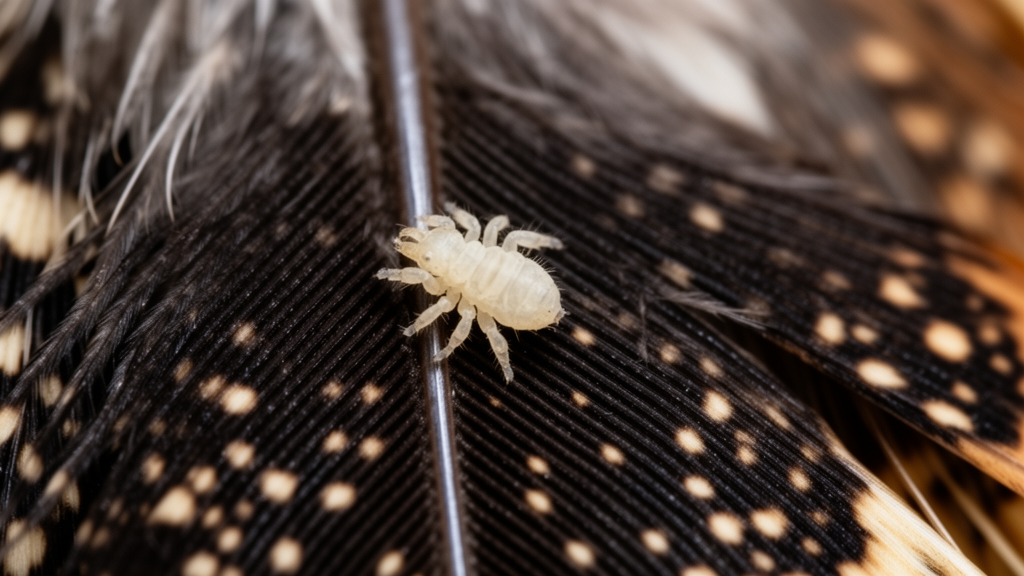
Deep in the mountain forests of Asia, tragopans — those spectacular, high-elevation pheasants whose males flash brilliant blue facial patches during display — carry on their feathers a hidden menagerie of parasites. A new study in the Deutsche Entomologische Zeitschrift has now formally described a new genus of chewing lice from these birds, Pelecolipeurus, and in doing so has opened a window onto one of the most strikingly disproportionate parasite faunas known from any group of birds. The work, led by Daniel Gustafsson and colleagues, combines classical taxonomy with a broad overview of how louse communities are distributed across the world’s landfowl, and the results suggest that host phylogeny, biogeography, biotope and elevation have all conspired to structure the lice that live on galliform birds.
Chewing lice in the Oxylipeurus-complex are wing lice that parasitise mainly gamefowl, and most species are known from Asian galliforms. For decades, nearly all of these lice were lumped into a single genus, Oxylipeurus, a classification that later researchers challenged repeatedly. Since 2009, a large number of new genus-level taxa have been established within this complex, and the new study adds a third genus described in recent years from the same host group. The new genus, Pelecolipeurus, is separated from other members of the complex by a unique combination of characters, including the distinctive shape of the male subgenital plate and stylus, the structure of the male genitalia, and details of the abdominal sclerites.
The name Pelecolipeurus is derived from the Greek word pélekus, meaning two-headed axe, combined with Lipeurus, the traditional name for long slender lice. The reference is to the shape of the male subgenital plate, which bears lateral extensions at the base of the stylus. The only previously known species in the genus is Lipeurus longus, described by Piaget in 1880, which the authors tentatively re-describe as Pelecolipeurus longus based on specimens from Temminck’s tragopan, Tragopan temminckii. In addition, they describe a new species, Pelecolipeurus fujianensis, based on specimens from Cabot’s tragopan, Tragopan caboti, collected in Fujian Province, China.
Assessing taxon limits in this complex is notoriously difficult. The overall chaetotaxy and morphology, including that of the male genitalia, are conserved in many genera, and species are often delimited by more nebulous characters such as head shape, mesosome shape and the degree of reticulation of the cuticle. Many species are poorly known and have not been fully described or illustrated; the last detailed revisions of the complex were published by Clay in 1938 and von Kéler in 1958. The new study examined slide-mounted specimens deposited at the National Natural History Museum of Natural History, China, using a Nikon Eclipse Ni microscope with a drawing tube attached for making illustrations, and measurements were made in the digital measuring software ImageJ.
The diagnosis of Pelecolipeurus rests on a suite of morphological characters. The frons is rounded to slightly flattened; the dorsal pre-antennal suture is present but transversal, not reaching the lateral margins of the head; the marginal mesometathoracic setae are gathered into a single sublateral bunch; the male tergopleurites II–VII are medianly interrupted and intertergal sclerites are absent; the male tergopleurites IX–XI are fused to form a single plate, while in the female they are fused laterally but not medianly, forming two distinct plates. The male subgenital plate has a unique shape with lateral extensions at the base of the stylus, and the stylus is subterminal and elongated, reaching beyond the distal margin of the abdomen. The female vulval margin is narrowly concave, without lateral accessory vulval plates, and the male genitalia are very long, reaching anteriorly to abdominal segment III, with a denticulate genital sac.
Pelecolipeurus fujianensis can be separated from Pelecolipeurus longus by several characters, including the shape of the male fused abdominal segments IX–XI, which have concave lateral margins in the new species but more or less straight lateral margins in the older species, and the shape of the proximal mesosome, which has a medianly pointed anterior end in the new species but a flattened anterior margin in the older species. The parameres are also more curved in the older species than in the new one. Unfortunately, no specimens from the type host of Pelecolipeurus longus, the satyr tragopan, were found at the Chinese museum, and the lectotype and paratypes at the Natural History Museum in London could not be examined or borrowed. A photo of the lectotype female available online confirms that the species belongs to Pelecolipeurus, but is insufficiently detailed to compare adequately with the specimens examined in China.
Beyond the description of the new genus, the study presents an overview of the distribution patterns of ischnoceran lice on galliforms, and the patterns that emerge are remarkable. Galliforms have some of the most diverse chewing louse faunas of any bird order. In the checklist of Price and colleagues from 2003, lice on galliform hosts represent almost 10 percent of all avian louse genera accepted as valid. If genera accepted by Mey in 2009 and those described from other host groups since 2003 are added, over 23 percent of the known louse genera occur on galliform hosts, despite Galliformes itself comprising only about 2.66 percent of bird diversity. The reasons for this over-diversity are unclear, and the ancient lineage of galliforms, with fossil records going back perhaps to the late Cretaceous, does not by itself explain the pattern, since the closely related anseriforms are only parasitised by a small fraction of louse genera.
The overview reveals a clear division in the Oxylipeurus-complex between genera occurring mainly on New World host groups and those occurring mainly on Old World hosts. With the exception of one species, all members of the genera Chelopistes, Eiconolipeurus, Epicolinus, Labicotes, Trichodomedea and Valimia are found only on New World hosts. In contrast, the genera Megalipeurus, Pelecolipeurus, Calidolipeurus, Cataphractomimus, Gallancyra and Sinolipeurus are only found on Old World hosts. The genera Oxylipeurus and Talegallipeurus are exclusively known in Australia and Wallacea. That leaves only one cosmopolitan genus, Reticulipeurus, which is known both in the Old and New Worlds, and whose distribution on two distinct host groups — mainly Asian phasianids and almost entirely Neotropical cracids — requires further study to understand.
Of particular interest are the lice of the tragopan group, comprising the genera Lophophorus, Tetraophasis and Tragopan, which together form a monophyletic clade with no close relatives. These high-elevation birds are collectively parasitised by at least three genera of Oxylipeurus-complex lice that are so far not known from hosts outside that clade — Cataphractomimus, Pelecolipeurus and Sinolipeurus — as well as a morphologically distinct group of Lagopoecus, four genera within the Goniodes-complex and almost all the known species of Dictyocotes. With the exception of Dictyocotes, all these genera and groups are unique to hosts in the tragopan group. Despite comprising only ten species in three genera, the species in this group are hosts to a considerable diversity of lice, and the relevant factors structuring these host associations appear to be a mixture of host phylogeny and habitat factors, since all the hosts are high-elevation birds.
The study also transfers the genus Afrilipeurus from the Oxylipeurus-complex to the Lipeurus-complex, where it is probably closely related to Numidilipeurus, which occurs on the same host group. This transfer is based on detailed morphological comparisons, including the presence of multiple sternal setae and tergal posterior setae on segments II–VIII, medianly continuous tergopleurites, intertergal plates on male segments III–IV, and numerous vulval oblique setae forming roughly convergent rows — all characters typical of the Lipeurus-complex but absent in the Oxylipeurus-complex. The authors include an emended key to the Oxylipeurus-complex, updating the genus-level key previously published by Gustafsson and colleagues in 2020. Overall, the study suggests that no single factor can be used to explain distribution patterns amongst the Ischnocera that parasitise galliform hosts. Host phylogeny, host biogeography and host ecology all appear to influence the known host associations, and in some cases it is not clear which factors are most important, as several factors overlap. Elevation may also influence distribution patterns, with several distinct genera and groups known only or mainly to infest high-elevation hosts, while low-elevation hosts are often parasitised by more widely distributed louse genera. As more becomes known of the lice of galliform hosts, clearer patterns may emerge that could explain the unexpectedly high diversity of lice on landfowl, and future collections from high-altitude galliforms may help determine the extent to which the three genera of Oxylipeurus-complex lice on Temminck’s tragopan co-occur on the same host population, giving insights into the process of microhabitat partitioning in chewing lice and potentially into the process of higher-level radiation of lice on hosts.
Subject of Research: Description of the new louse genus Pelecolipeurus and an overview of ischnoceran chewing lice on galliform hosts
Article Title: New genus and species of lice in the Oxylipeurus -complex ( Phthiraptera , Ischnocera , Philopteridae ), with an overview of the distribution of ischnoceran chewing lice on galliform hosts
Article References: Gustafsson, D. R., Tian, C., Ren, M., Li, Z., Sun, X., & Zou, F. (2024). New genus and species of lice in the Oxylipeurus-complex (Phthiraptera, Ischnocera, Philopteridae), with an overview of the distribution of ischnoceran chewing lice on galliform hosts. Deutsche Entomologische Zeitschrift, 71(1), 85-109. https://doi.org/10.3897/dez.71.111874
Image Credits: AI Generated
Keywords: chewing lice, Phthiraptera, Ischnocera, galliform birds, taxonomy, parasitology, tragopans, coevolution, genus, species, lice, Oxylipeurus
News Source: Drew Townsend. (October 19, 2026). New Genus of Chewing Lice Reveals Hidden Diversity on Tragopan Birds. Scienmag.