

• HOME
  • NEWS
  • EXPLORE
    • CAREER
      • Companies
      • Jobs
    • EVENTS
    • iGEM
      • News
      • Team
    • PHOTOS
    • VIDEO
    • WIKI
  • BLOG
  • COMMUNITY
    • FACEBOOK
    • INSTAGRAM
    • TWITTER
Friday, January 2, 2026
BIOENGINEER.ORG
No Result
View All Result
  • Login
  • HOME
  • NEWS
  • EXPLORE
    • CAREER
      • Companies
      • Jobs
        • Lecturer
        • PhD Studentship
        • Postdoc
        • Research Assistant
    • EVENTS
    • iGEM
      • News
      • Team
    • PHOTOS
    • VIDEO
    • WIKI
  • BLOG
  • COMMUNITY
    • FACEBOOK
    • INSTAGRAM
    • TWITTER
  • HOME
  • NEWS
  • EXPLORE
    • CAREER
      • Companies
      • Jobs
        • Lecturer
        • PhD Studentship
        • Postdoc
        • Research Assistant
    • EVENTS
    • iGEM
      • News
      • Team
    • PHOTOS
    • VIDEO
    • WIKI
  • BLOG
  • COMMUNITY
    • FACEBOOK
    • INSTAGRAM
    • TWITTER
No Result
View All Result
Bioengineer.org
No Result
View All Result
Home NEWS Science News Biology

Obese people lack cells with satiety hormones

Bioengineer by Bioengineer
August 29, 2017
in Biology
Reading Time: 2 mins read
0
Share on FacebookShare on TwitterShare on LinkedinShare on RedditShare on Telegram
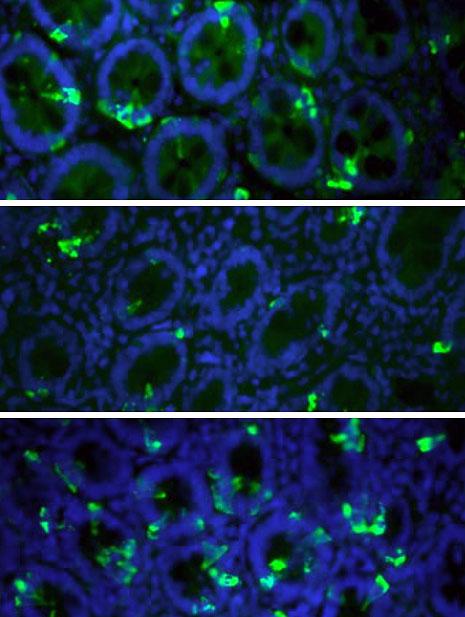
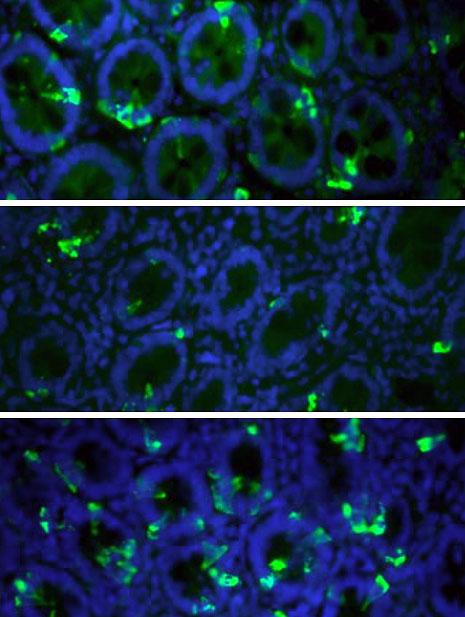
IMAGE

Credit: University of Basel

Individuals with severe overweight have an inhibited sense of satiation – they release fewer satiety hormones than people of normal weight. The reason: the responsible cells in the gastrointestinal tract of obese people are severely reduced. This report Swiss doctors in the journal Scientific Reports. Surgical weight-loss procedures can repair this disorder.

The mucous membrane of the upper gastrointestinal tract is home to highly specified cells, the so-called enteroendocrine cells, that constantly analyze our intestinal contents. During a meal, they release satiety hormones into the bloodstream. This signalizes to the body that enough food has been taken in and that the meal can be ended. The sense of satiation is created in the central nervous system.

Tissue samples removed

Compared to lean people, the release of satiety hormones is reduced in obese people. After bariatric surgeries, such as a gastric bypass or sleeve gastrectomy the release of these hormones increases again.

Researchers from the Department of Biomedicine at the University and University Hospital Basel and the St. Claraspital Basel together with colleagues from the University of Liverpool have studied the reasons for this reduced release of satiety hormones. They examined tissue samples of the gastrointestinal tract in 24 lean volunteers and 30 obese patients before and after weight-loss surgery.

"Unfortunately often stigmatized"

The team of researchers led by Dr. Bettina Wölnerhanssen was able to show that the number of enteroendocrine cells in obese people is significantly lower than in people with normal weight. This leads to a reduced release of satiety hormone which in turn leads to altered appetite. The obese also showed alterations in the pattern of the so-called transcription factors which are responsible for the development of enteroendocrine cells from stem cells. After surgery, the number of enteroendocrine cells and the pattern of transcription factors were almost entirely restored.

"Unfortunately, obese people are often stigmatized, and it is a common belief that the reason for obesity lies in a lack of self-control and discipline," comments Wölnerhanssern the study's results. However, there is no doubt that metabolic factors are playing an important part. The study shows that there are structural differences between lean and obese people, which can explain lack of satiation in the obese.

###

Original source

Bettina K. Wölnerhanssen, Andrew W. Moran, Galina Burdyga, Anne Christin Meyer-Gerspach, Ralph Peterli, Michael Manz, Miriam Thumshirn, Kristian Daly, Christoph Beglinger & Soraya P. Shirazi-Beechey
Deregulation of transcription factors controlling intestinal epithelial cell differentiation; a predisposing factor for reduced enteroendocrine cell number in morbidly obese individuals.
Scientific Reports (2017), doi:10.1038/s41598-017-08487-9

Media Contact

Cornelia Niggli
[email protected]
@UniBasel_en

http://www.unibas.ch/

Original Source

https://www.unibas.ch/en/News-Events/News/Uni-Research/Obese-People-Lack-Cells-with-Satiety-Hormones.html http://dx.doi.org/10.1038/s41598-017-08487-9

Share12Tweet8Share2ShareShareShare2

Related Posts

Foreign Bodies in Sheep and Goats: Prevalence and Risks

Foreign Bodies in Sheep and Goats: Prevalence and Risks

December 31, 2025
Rethinking Gender Inference from Health Record Algorithms

Rethinking Gender Inference from Health Record Algorithms

December 31, 2025

Mapping RNA Editome Development in Ningxiang Pig Fat

December 31, 2025

Revealing Chloroplast Genomes: Insights on Plant Evolution

December 31, 2025
Please login to join discussion

POPULAR NEWS

  • blank

    PTSD, Depression, Anxiety in Childhood Cancer Survivors, Parents

    113 shares
    Share 45 Tweet 28
  • NSF funds machine-learning research at UNO and UNL to study energy requirements of walking in older adults

    71 shares
    Share 28 Tweet 18
  • Exploring Audiology Accessibility in Johannesburg, South Africa

    52 shares
    Share 21 Tweet 13
  • SARS-CoV-2 Subvariants Affect Outcomes in Elderly Hip Fractures

    44 shares
    Share 18 Tweet 11

About

We bring you the latest biotechnology news from best research centers and universities around the world. Check our website.

Follow us

Recent News

Laser-Printed Metasurfaces Enable Advanced Light Conversion, Detection

Reprogrammable Nonlinear Optics with Ferroelectric Liquid Crystals

Advancements in Droplet Microfluidics for Biomaterials

Subscribe to Blog via Email

Enter your email address to subscribe to this blog and receive notifications of new posts by email.

Join 71 other subscribers
  • Contact Us

Bioengineer.org © Copyright 2023 All Rights Reserved.

Welcome Back!

Login to your account below

Forgotten Password?

Retrieve your password

Please enter your username or email address to reset your password.

Log In
No Result
View All Result
  • Homepages
    • Home Page 1
    • Home Page 2
  • News
  • National
  • Business
  • Health
  • Lifestyle
  • Science

Bioengineer.org © Copyright 2023 All Rights Reserved.
