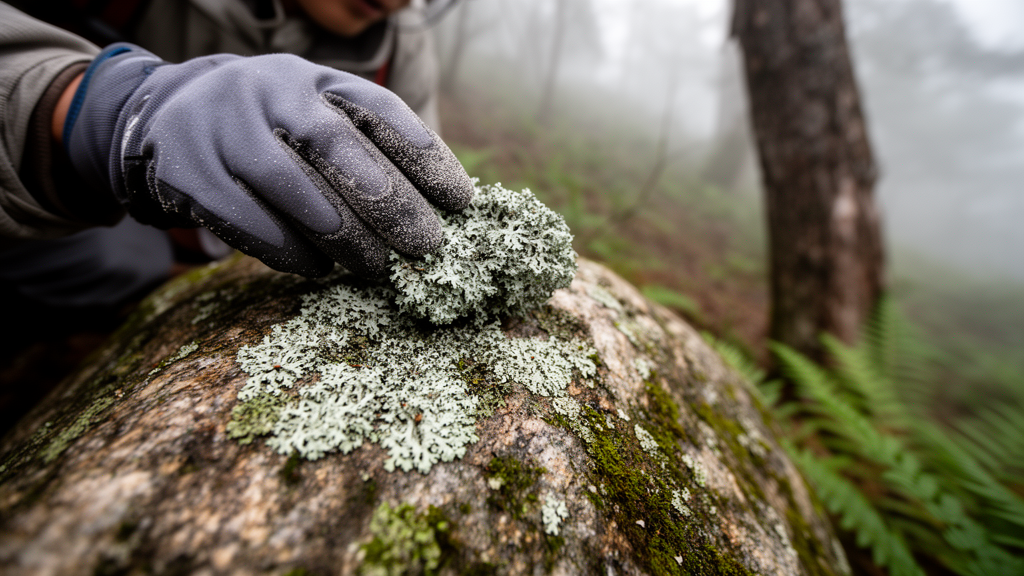
Deep in the montane forests of Anhui Province, China, a team of lichenologists has uncovered three lichen species previously unknown to science, all of which reproduce through tiny vegetative propagules called soredia rather than through spore-producing fruiting bodies. The discoveries, published in the journal MycoKeys, were made possible by combining painstaking morphological examination, chemical analysis, and DNA sequencing, an integrated approach that has become the gold standard for untangling difficult groups of lichenized fungi. Two of the new species belong to the sprawling genus Lecanora, while the third joins the small genus Verseghya, and together they significantly expand the known diversity of these organisms in a region that sits at the transition between temperate and subtropical climates.
The genus Lecanora in its broad, historical sense once encompassed roughly one thousand species worldwide, making it one of the largest and most taxonomically challenging groups in the family Lecanoraceae. For decades, lichenologists have worked to split this heterogeneous assemblage into more natural units, carving out genera such as Glaucomaria, Myriolecis, Protoparmeliopsis, Straminella, Verseghya, and Zeora. Despite these efforts, Lecanora in the broad sense remains paraphyletic, meaning it does not include all descendants of a common ancestor, and it continues to shelter several distinct lineages including the Lecanora subfusca group, the L. albella-subcarnea group, the L. fuscescens group, and others. This unresolved structure underscores why continued morphological and phylogenetic investigation remains essential for clarifying the evolutionary positions of its members.
Most species of Lecanora in the broad sense reproduce sexually, but vegetative reproduction through soredia, small clusters of fungal hyphae wrapped around algal cells that break away from the thallus to disperse, is also common. Sorediate species present particular challenges for identification because they often lack the apothecia, the cup-shaped fruiting bodies whose anatomical details traditionally anchor lichen taxonomy. Over the past five years, repeated field surveys across Anhui Province collected numerous sorediate Lecanora specimens that could not be confidently assigned to any known species, prompting the detailed investigation that has now yielded three new species descriptions.
The first of the new species, Lecanora apicifarinacea, was collected on bark at 1,377 meters elevation in the Tianzhushan World Geopark. Phylogenetic analysis places it within the Lecanora subfusca group, where it emerges as the sister species to L. kenyana, a sorediate species recently described from Kenya. Lecanora apicifarinacea is characterized by a thin, crustose thallus with an irregular, diffuse outline and by raised, erumpent soralia that aggregate into irregular patches and become apically white and farinose, or mealy, in texture. Chemically, the species produces atranorin and usnic acid, a combination that helps distinguish it from close relatives such as L. barkmaniana and L. neobarkmaniana, which contain zeorin instead, and from L. variolascens, which has discrete rather than aggregated soralia.
The second new species, Lecanora pseudolayana, was found in the Dabie Mountains of Lu’an City, where it grows on the bark of broadleaved trees at altitudes between 500 and 1,219 meters. Molecular data place it in a well-supported subclade of the L. subfusca group alongside L. baekdudaeganensis, L. layana, and L. loekoesii, with the new species resolved as sister to L. baekdudaeganensis. Unlike its two esorediate relatives in that subclade, L. pseudolayana produces soralia that are small and dispersed near the thallus margin but large and aggregated toward the center. The species also shows distinctive anatomical features: an epihymenium free of crystals, small amphithecial crystals that are insoluble in potassium hydroxide but soluble in nitric acid, and a prothallus that appears blackish or white depending on whether the thallus contacts other lichens. It contains atranorin and zeorin, differing chemically from the true L. layana, which produces stictic acid.
The third species, Verseghya megasorediata, belongs to a genus established only in 2016 and currently comprising just two recognized species. The genus is characterized by a leprose, or powdery, thallus, a fibrous prothallus, and the production of usnic acid, although its precise phylogenetic position within Lecanoraceae remains uncertain. Verseghya megasorediata, found on bark and rotting wood at elevations of 496 to 1,354 meters in Anhui, is distinguished by its coarse and unusually large soredia, measuring from 22.5 to 87.5 micrometers in diameter with a mean of 38.9 micrometers, and by a white fibrous prothallus that never develops the blackish pigments often seen in its closest relative, V. thysanophora. The new species is resolved as sister to V. thysanophora in a well-supported monophyletic clade, and it lacks the accessory compounds known as thysanophora unknowns that some specimens of V. thysanophora produce.
Beyond describing new species, the study delivered an unexpected taxonomic conclusion: Verseghya klarae, described from South Korea in 2016, has been reduced to synonymy with V. thysanophora. Specimens identified under both names, collected from China, the Czech Republic, Japan, Poland, South Korea, and the United States, formed a single cohesive and well-supported clade in the phylogenetic tree, with no detectable genetic differentiation between the two taxa. Morphological and chemical evidence pointed the same way: both share a white fibrous prothallus often bearing blackish pigments, lecanorine apothecia, and yellowish-brown discs with white pruina, and both produce zeorin and usnic acid as major compounds. Notably, all specimens examined in the study, whether from South Korea or Japan, exhibited a Lecanora-type ascus, casting doubt on the original claim that V. klarae possessed a Pertusaria-type ascus, a character for which no photographic evidence existed and whose type specimens are unavailable for loan.
The phylogenetic foundation for these conclusions rests on a concatenated dataset of three genetic loci, the nuclear internal transcribed spacer region, the nuclear large subunit, and the mitochondrial small subunit. The alignment comprised 161 sequences, of which 49 were newly generated for the study, drawing on material from eleven specimens of V. megasorediata and six of L. pseudolayana among others. Maximum likelihood analyses with ultrafast bootstrapping and Bayesian inference with posterior probability estimation were used to reconstruct evolutionary relationships, with Protoparmelia badia and P. picea serving as outgroups. Support was considered strong when Shimodaira-Hasegawa-like approximate likelihood ratio tests reached at least 80 percent, ultrafast bootstrap values at least 95 percent, and Bayesian posterior probabilities at least 0.90.
The methodological toolkit behind the work reflects the practical realities of lichen taxonomy. Genomic DNA was extracted from soredia or apothecia taken from dried herbarium specimens using a Chelex resin method, and targeted regions were amplified with standard primer pairs before sequencing. Chemistry was assessed through spot tests and thin-layer chromatography in solvent system C, while crystal solubility in the apothecial tissues was probed with nitric acid and potassium hydroxide under polarized light. Measurements of soredia and ascospores were reported with means, standard deviations, and sample sizes, a convention that allows future researchers to compare populations quantitatively rather than relying on vague qualitative descriptions.
The practical outcome for field biologists is a new identification key to all Lecanora sensu lato species recorded in Anhui Province, which previously listed 15 species including only two sorediate ones, L. layana and Verseghya thysanophora. The key now guides users through characters such as prothallus type, soredium size, and secondary chemistry to separate the three new species from their relatives. Because some sorediate Lecanora species cannot be unambiguously identified by phenotype alone, as earlier European work has shown, the availability of reference sequences for the Anhui material will be critical for researchers across East Asia. The discoveries also highlight how much cryptic diversity may remain in lichenized fungi even in well-surveyed temperate regions, and how vegetative reproduction, long treated as a secondary curiosity, may be a more evolutionarily significant strategy within Lecanora than its predominantly sexual relatives suggest.
Subject of Research: Taxonomy and phylogeny of newly discovered sorediate lichen species of Lecanora and Verseghya from Anhui Province, China
Article Title: Three new sorediate species of Lecanora sensu lato ( Ascomycota , Lecanoraceae ) from Anhui Province, China
Article References: Feng, Y.-S., Li, L.-J., & Zhang, Y.-Y. (2026). Three new sorediate species of Lecanora sensu lato (Ascomycota, Lecanoraceae) from Anhui Province, China. MycoKeys, 136, 301-322. https://doi.org/10.3897/mycokeys.136.191950
Image Credits: AI Generated
DOI: 10.3897/mycokeys.136.191950
Keywords: Lecanora, Verseghya, Lecanoraceae, lichenized fungi, soredia, new species, Anhui Province, phylogenetics, nrITS, taxonomy, MycoKeys, China
News Source: Drew Townsend. (October 19, 2026). Three New Sorediate Lichen Species Discovered in China’s Anhui Province. Scienmag.