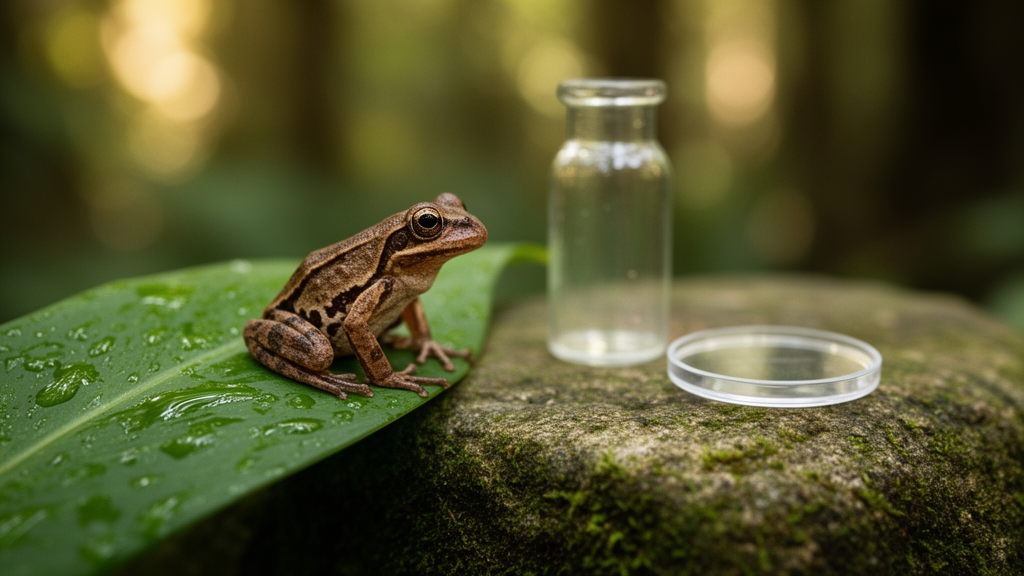
Deep in the Atlantic Forest of southern Bahia, Brazil, a group of small, cryptically colored frogs has been quietly challenging taxonomists for decades. Now, for the first time, scientists have peered into the chromosomes of these elusive amphibians, providing a crucial piece of the puzzle that could help untangle one of the most stubborn species complexes in Neotropical herpetology. In a study published in Comparative Cytogenetics, researchers describe the karyotype—the complete set of chromosomes—of frog species belonging to the thomei clade of the genus Adenomera, a lineage whose boundaries have remained frustratingly blurred despite years of molecular and morphological scrutiny.
The genus Adenomera, established in 1867, currently comprises 29 recognized species distributed across tropical South America east of the Andes. These frogs, commonly known as foam-nesting terrestrial breeders, are notorious for their high intra- and interspecific similarity, a trait that has spawned numerous cryptic species complexes—groups of organisms that look nearly identical but may represent distinct evolutionary lineages. The thomei clade, which encompasses Adenomera thomei and two unnamed lineages designated Adenomera sp. L and Adenomera sp. M, is restricted to Brazil’s Atlantic Forest biome, one of the world’s most biodiverse and most threatened tropical forests.
Adenomera thomei was formally described in 2006 from specimens collected in a cocoa plantation in the municipality of Linhares, in the state of Espírito Santo. Since then, records of the species have surfaced in the states of Rio de Janeiro, São Paulo, Minas Gerais, and Bahia. However, the specific boundaries among the lineages within the thomei clade remain unclear, largely because Adenomera sp. L and Adenomera sp. M—both found only in southern Bahia—are so poorly characterized. Bioacoustic, morphological, and cytogenetic data for representatives of this clade are scarce, and until now, none of these data streams had been applied to distinguish between the two unnamed lineages.
Cytogenetic studies on the genus Adenomera date back to the 1970s, when the karyotypes of Adenomera andreae, Adenomera hylaedactyla, Adenomera lutzi, and Adenomera marmorata were first described. Yet in the five decades since, the volume of chromosomal information for the genus has not significantly advanced. A 2009 study by Campos and colleagues added karyotypes for populations from western São Paulo, and the karyotype of Adenomera diptyx was described in 2011. In total, cytogenetic information existed for only five of the 29 described species—a paucity that has made it extraordinarily difficult to understand chromosomal evolution within the genus or to delimit species with confidence.
The new study, led by researchers working at the Universidade Estadual de Santa Cruz in Ilhéus, Bahia, analyzed 12 specimens collected from three sites in the state of Bahia under license SISBIO 62181. Six specimens, identified as Adenomera cf. thomei based on bioacoustic data matching patterns recorded for populations in the thomei clade, were collected in the municipality of Ilhéus. The remaining six, identified as Adenomera sp. L, were collected in Igrapiúna. The specimens—including adult males, females, and juveniles—were deposited in the UESC Herpetological collection as vouchers for future reference.
To visualize the chromosomes, the team followed a modified protocol originally developed by Schmid in 1978. Specimens were treated with a 2% colchicine solution to arrest cells in metaphase, the stage of cell division when chromosomes are most condensed and visible. Chromosomal preparations were then obtained from intestinal epithelial cells, which were kept in a hypotonic solution of 0.075 M potassium chloride for 40 minutes before fixation in Carnoy solution—a classic mixture of methanol and acetic acid. Cell suspensions were placed on slides, dried at room temperature in the dark, and stained with 3% Giemsa for 10 minutes to reveal chromosome composition and morphology.
The results were strikingly uniform. All 12 individuals, regardless of species designation or collection site, showed a diploid number of 2n = 24 with a fundamental number (FN) of 34. The karyotypic formula—4 metacentric + 6 submetacentric + 14 telocentric chromosomes—was identical across every specimen analyzed. In practical terms, this means the frogs carry two pairs of metacentric chromosomes (pairs 1 and 5), three pairs of submetacentric chromosomes (pairs 2, 3, and 4), and seven pairs of telocentric chromosomes (pairs 6 through 12). No heteromorphic sex chromosomes—differences in chromosome form between males and females—were detected in any of the individuals examined.
When compared with previously published karyotypes for the genus, the new data reveal intriguing patterns. The karyotype of Adenomera cf. thomei and Adenomera sp. L is identical to that of Adenomera marmorata (2n = 24, FN = 34) and to certain populations previously designated A. cf. marmorata from São Paulo. It also matches specimens identified as Adenomera sp. J and a specimen from Santa Branca, São Paulo. Meanwhile, Adenomera diptyx, A. andreae, and A. hylaedactyla all show diploid numbers of 2n = 26, with varying fundamental numbers. One particularly unusual case is A. aff. bokermanni, which displayed an odd diploid number of 2n = 23—most likely the result of a centric fusion involving telocentric chromosome pairs 7 and 9, a hypothesis proposed by Campos and colleagues but never definitively confirmed.
The researchers note that chromosome pair 8 in their specimens is telocentric, whereas in A. aff. bokermanni it is subtelocentric—a difference that could reflect genuine evolutionary divergence or simply variation within a single specimen. Because of this ambiguity, pairs 7 and 9 were excluded from comparative analyses. The team also emphasizes that no bioacoustic, molecular, or morphological data are currently available for the Ilhéus population of Adenomera cf. thomei, and that a comprehensive taxonomic review—including all species within the thomei clade—is urgently needed to clarify their specific limits.
Comparative cytogenetics has proven to be a powerful tool for recovering phylogenetic relationships and confirming taxonomic identity across a wide range of organisms, from mammals to insects to plants. In the case of Adenomera, chromosomal data previously provided support for taxonomic decisions in a broad species delimitation study of A. marmorata that integrated DNA sequences, morphology, and bioacoustics. The new karyotype descriptions for the thomei clade represent a first step toward applying the same integrative approach to this enigmatic group. Further morphological, bioacoustic, and cytogenetic analyses—including C-banding to reveal heterochromatin distribution and silver staining (AgNor) to identify nucleolar organizer regions—are needed to better delineate the lineages within the clade. For now, the chromosomes of these Atlantic Forest frogs stand as a testament to how much remains hidden beneath the surface of even the most familiar-looking species, and how the tiniest cellular structures may hold the key to understanding the grand sweep of amphibian evolution in one of the planet’s most imperiled biomes.
Subject of Research: Cytogenetics of Adenomera frogs in the Atlantic Forest
Article Title: First karyotype description of the species of Adenomera Steindachner, 1867 ( Anura , Leptodactylidae ) in the “ thomei ” clade
Article References: Dominato, R. C., de Oliveira, G. C., Cassini, C. S., Orrico, V. G. D., Mariano, C. D. S. F., & Silva, J. G. (2022). First karyotype description of the species of Adenomera Steindachner, 1867 (Anura, Leptodactylidae) in the “ thomei” clade. Comparative Cytogenetics, 16(3), 151-159. https://doi.org/10.3897/compcytogen.v16.i3.82641
Image Credits: AI Generated
DOI: 10.3897/compcytogen.v16.i3.82641
Keywords: Adenomera, karyotype, cytogenetics, Atlantic Forest, amphibians, cryptic species, thomei clade, Bahia, Leptodactylidae, chromosomes, First, description
News Source: Margaret Porter. (October 19, 2026). First Karyotype Revealed for Mysterious Atlantic Forest Frogs in the thomei Clade. Scienmag.