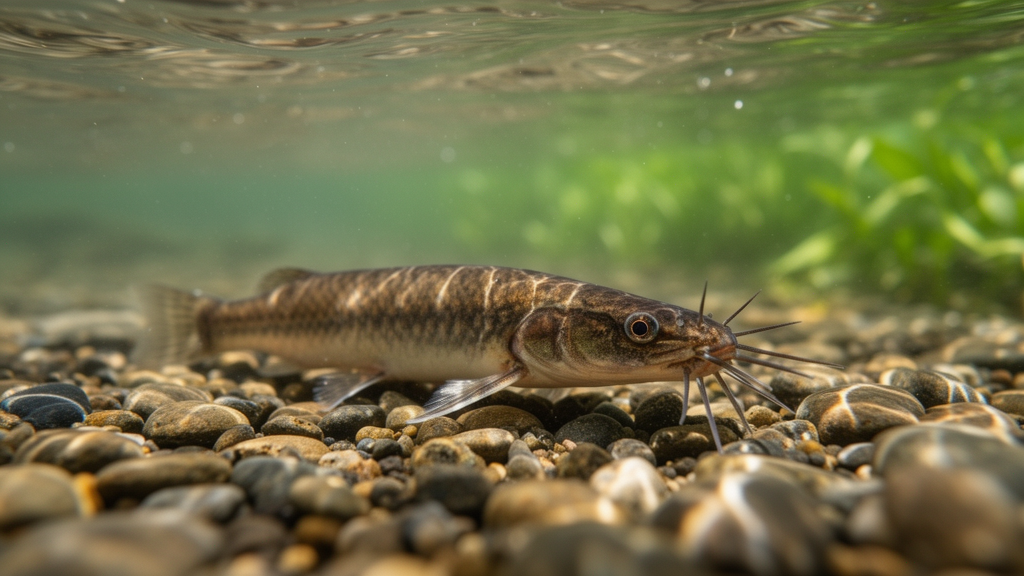
Deep in the mountain streams of Fukui Prefecture, central Japan, a small brown fish has been hiding in plain sight. Scientists have now formally described it as a new species of eight-barbel loach, Lefua nishimurai, after an integrative taxonomic study combining nuclear genetic analysis with detailed morphological comparisons. The discovery, published in the journal Evolutionary Systematics, raises the number of accepted species in the genus Lefua to seven and adds a strikingly distinctive branch to the evolutionary tree of East Asian freshwater fishes.
The genus Lefua belongs to the loach family Nemacheilidae and is easily recognized by its rounded caudal fin, elongated anterior nostrils that form long nasal barbels, and the absence of certain bones found in related fishes. Members of the genus are distributed across Mongolia, Russia, China, Korea, and Japan. For decades, Japanese Lefua species were distinguished mainly by coloration of the caudal fin base, dorsal fin, and mature males, as well as vertebral counts and head size. Two new species, L. torrentis and L. tokaiensis, were described from Japan in 2018 and 2019 respectively, bringing the accepted count to six before the latest find.
The trail to the new species began when a previously unknown population of Lefua was discovered in the Kuzuryu River drainage system of Fukui Prefecture. Preliminary studies of morphology and mitochondrial phylogeny had suggested the population was distinct, initially identifying it as L. torrentis. However, because historical mitochondrial introgression is known to occur among Japanese Lefua congeners, the research team recognized that mitochondrial DNA alone could give a misleading picture. To resolve the population’s true evolutionary position, they turned to a nuclear locus, sequencing approximately 750 base pairs of non-coding sections of the ribosomal S7 subunit gene, a marker previously used to clarify relationships within the genus.
The genetic analysis was substantial. The team newly collected 92 Lefua specimens from across Japan, including 25 individuals of the new species from the Kuzuryu River system, and sampled L. torrentis and L. tokaiensis across their full distributions. Genomic DNA was extracted from pectoral fin tissue, amplified with step-down polymerase chain reaction using specific primers, and sequenced on an ABI 3130xl Genetic Analyzer. Phylogenetic trees were then reconstructed from 452 base pair alignments using both maximum-likelihood methods with IQ-TREE and Bayesian inference with MrBayes, with L. nikkonis and L. costata set as outgroups. The best-fit models were calculated as HKY for maximum-likelihood and HKY+G for Bayesian inference, and branch support was assessed with 1,000 bootstrap replicates.
The results were unambiguous. Both tree-building approaches produced identical topologies and strongly supported the monophyly of L. nishimurai, with bootstrap values of 100 and Bayesian posterior probabilities of 1.00. The statistical parsimony network, built from 33 haplotypes, separated the new species from L. torrentis by 31 mutational steps and from L. tokaiensis by 27 steps, indicating deep genetic isolation. Mean genetic distances, calculated with the Kimura two-parameter model, reached 8.2 percent between the new species and L. torrentis, 7.8 percent with L. tokaiensis, and 9.9 percent with L. echigonia, while the new species showed only 0.1 percent intraspecific divergence. This long-branched clade suggests the new species diverged early from the common ancestor it shares with L. torrentis, L. tokaiensis, and L. echigonia in central Japan.
Morphology told the same story. The researchers examined 18 external morphometric characters, including a newly measured head width and the ratio of interorbital width to body width, using calipers accurate to 0.1 millimeters. Principal component analysis explained 81.8 percent of total variation in the first two components, with PC2 scores primarily separating the three species. A machine learning approach using the Random Forest algorithm, which generated 100,000 trees, correctly classified 79.1 percent of specimens into their species. The most discriminating characters, ranked by mean decrease in Gini coefficients, were interorbital width, snout length, orbit diameter, preanal length, body width, and head width. The new species stands out with more dorsally positioned, smaller eyes, a shorter snout, a longer preanal region, and a body and head width intermediate between its two closest relatives.
In life, the fish is light brown with a strong yellowish tinge and a whitish gray ventral surface. Its most conspicuous feature is a narrow black longitudinal stripe running between the base of the outer rostral barbel and the eye. Small dark brown spots, roughly the same size as its eyes, are scattered from snout to caudal peduncle and appear on the dorsal and caudal fins, while dark spots mark the dorsal and ventral surfaces of the caudal fin base. The species can be diagnosed by combining these coloration traits with its dorsally located eyes, small dorsal fin, small orbit diameter of 6.3 to 11.2 percent of head length, and interorbital width of 28.1 to 39.4 percent of body width. The specific name honors Toshiaki Nishimura, who first morphologically distinguished the population, and the standard Japanese name is Reihoku-nagare-hotoke-dojyô.
The evolutionary history of the new species is intertwined with the complex geography of the Sea of Japan coast. Previous studies have documented mitochondrial introgression among Japanese Lefua, with the Nihonkai Population of L. torrentis carrying mitochondrial haplotypes closely related to L. echigonia and L. tokaiensis, evidence of past hybridization. Because the distribution of L. echigonia extends along the Sea of Japan, mitochondrial phylogenies in Fukui Prefecture could easily be distorted by introgression. The fact that the genetic distinctiveness of the Kuzuryu River population was confirmed independently by both mitochondrial and nuclear genes strengthens the case for its status as an independent species. The restricted distribution of the new species in the Reihoku Region may reflect the high altitudes surrounding it, a pattern similar to that seen in other freshwater fish populations geographically isolated between northern and southern Fukui Prefecture.
The species inhabits small mountain streams surrounded by natural or planted forests, preferring sandy or gravelly bottoms. It typically hides under rocks and stones at the river edge or under sediments such as fallen leaves, and spawning is estimated to occur from late April to mid-June. The observed low haplotypic diversity, with only three haplotypes differing by single-base substitutions detected among nine specimens, may indicate past population size declines. Prefectural surveys have documented decreasing numbers of freshwater fishes and salamanders whose habitats potentially overlap with the new species, including Cottus pollux, Hynobius abei, and Hynobius kimurae, due to recent habitat degradation in the Reihoku Region.
Given its narrow, fragmented distribution and vulnerable habitats, the researchers emphasize that understanding the natural history of Lefua nishimurai and implementing conservation measures are crucial. The discovery demonstrates the power of integrative taxonomy, which combines nuclear phylogenetics, statistical parsimony networks, machine learning classification, and traditional morphometrics to reveal biodiversity that has escaped detection until now. As habitat degradation continues across Japan’s mountain streams, formally recognizing species like this new loach is the first step toward ensuring they do not disappear before science even knows they exist.
Subject of Research: New loach species discovered in Japan
Article Title: Integrative taxonomy revealed a new species of Lefua ( Teleostei , Nemacheilidae ) from Fukui Prefecture, Japan
Article References: Katayama, Y., & Sawada, N. (2024). Integrative taxonomy revealed a new species of Lefua (Teleostei, Nemacheilidae) from Fukui Prefecture, Japan. Evolutionary Systematics, 8(2), 247-260. https://doi.org/10.3897/evolsyst.8.131002
Image Credits: AI Generated
DOI: 10.3897/evolsyst.8.131002
Keywords: Lefua nishimurai, eight-barbel loach, Nemacheilidae, new species, integrative taxonomy, Fukui Prefecture, Japan, freshwater fish, phylogenetics, conservation, Random Forest, Kuzuryu River
News Source: Gavin Prescott. (October 19, 2026). New eight-barbel loach species discovered in Japanese river system. Scienmag.