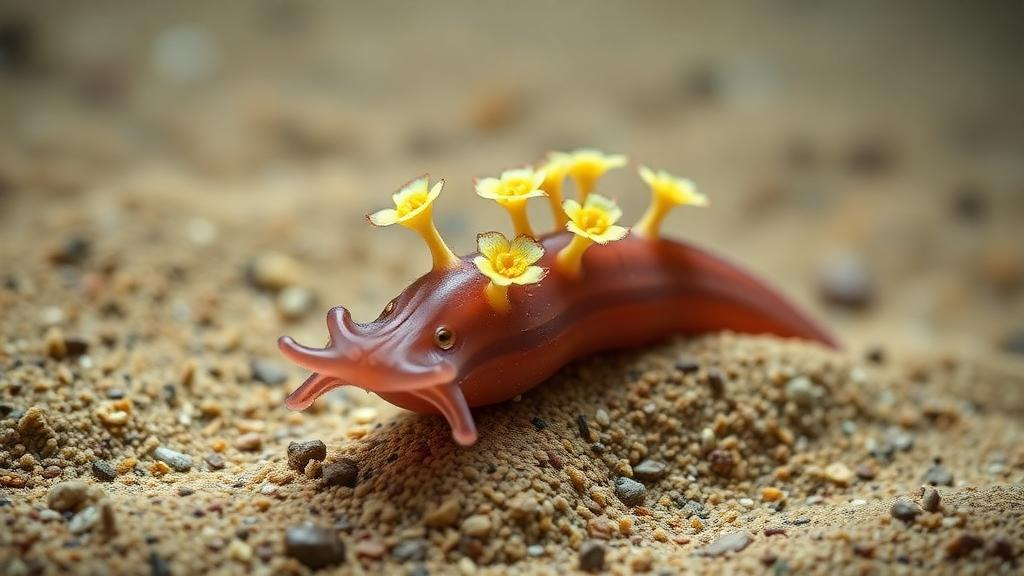
Buried within the coarse-grained sands of a beach in Huidong, Guangdong Province, China, lives a creature so small and slender that most beachgoers would never suspect its existence. Scientists have now formally introduced it to the world: Boninia corolla, a new species of interstitial polyclad flatworm whose name means flower crown in Latin, a nod to the ring of needle-like reproductive organs arranged radially around its male atrium like petals around a blossom. The discovery, published in the journal Zoosystematics and Evolution, marks the first record of boniniid flatworms from the coastal waters of China and adds a striking new member to one of the least explored corners of marine biodiversity.
Boninia corolla belongs to the mesopsammon, the community of meiofaunal organisms that inhabit the microscopic interstitial spaces between sand grains. These animals represent most marine animal phyla, from crustaceans and mollusks to gnathostomulids and kinorhynchs, yet scientific attention on them began only in the early twentieth century, and researchers widely regard current knowledge of their diversity as inadequate. Polyclads, the free-living flatworms to which the new species belongs, range from the intertidal zone to the deep sea, but only 17 polyclad species are recognized as mesopsammic worldwide. Four of those belong to the genus Boninia, making the group a rare and specialized branch of flatworm evolution adapted to life between the grains.
The new species was collected in April 2024 from intertidal coarse sand at Da’ao Village Beach in Huidong. Live individuals were anesthetized with a magnesium chloride solution and photographed under stereomicroscopes, revealing flat, slender, translucent milky-white bodies with tapering posterior ends. Anesthetized specimens measure 14 to 26 millimeters long and only 0.8 to 1.2 millimeters wide, an elongated proportions that suits their narrow habitat. A pair of fine, flexible tentacles roughly half a millimeter long flanks the head, and 28 to 48 marginal eyespots run evenly along the base of the tentacles toward the posterior margin of the brain. Notably, tentacular eyes are absent, and a single pair of cerebral eyespots sits closely together at the anterior margin of the brain.
Internally, the anatomy is equally distinctive. The intestine is highly branched and darkened by gut contents, and a ruffled pharynx 7 to 11 millimeters long occupies the center of the body. The male copulatory apparatus comprises a seminal vesicle, an interpolated prostatoid, an unarmed penis papilla, and 9 to 15 prostatoid organs whose individual ducts are radially arranged into a single girdle around the male atrium. Each pyriform prostatoid organ bears a sclerotized stylet approximately 60 micrometers in length, and extracapsular glands secrete into each organ. On the female side, the ovaries are dorsally arranged in two rows extending from behind the brain nearly to the posterior end, and 10 to 17 uterine vesicles line each side of a pair of uterine canals that connect to the vagina immediately anterior to the entrance of Lang’s vesicle, an elongated, ciliated storage organ 240 micrometers in its long axis.
To establish the species rigorously, the research team integrated classical morphology with DNA-based taxonomy. The anterior part of each specimen was fixed in 95 percent ethanol for molecular analysis, while the posterior part was fixed in formalin seawater, dehydrated, embedded in paraffin, and cut into serial sections at 7-micrometer intervals for histological study. Total DNA was extracted using a commercial kit, and fragments of four gene markers, the ribosomal RNA genes 18S, 28S, and 16S, plus the mitochondrial protein-coding gene cytochrome c oxidase subunit I (COI), were amplified by PCR and verified by double-stranded Sanger sequencing. The resulting sequences were deposited in GenBank, and histological preparations were archived at the Marine Biological Museum of the Chinese Academy of Sciences in Qingdao.
Phylogenetic analyses using both maximum likelihood and Bayesian inference on the concatenated four-gene dataset, with 22 terminal taxa, produced almost identical topologies. All Boninia species formed a clade with maximal support, and Boninia corolla emerged as sister to a clade containing all other species of the genus except Boninia yambarensis and Boninia neotethydis. The new species is thus firmly nested within Boninia, corroborating its generic assignment based on morphology. Two independent species delimitation methods, the Bayesian Poisson Tree Process (bPTP) applied to the concatenated dataset and Automatic Barcode Gap Discovery (ABGD) applied to COI, both consistently supported Boninia corolla as a distinct species, providing convergent lines of molecular evidence for its status.
Genetic distance calculations added further weight. Intraspecific distances ranged from 0.00 to 0.42 percent for COI, 0.24 to 0.47 percent for 16S, and 0.00 to 0.13 percent for 28S, while interspecific distances ranged from 10.72 to 22.14 percent for COI, 2.58 to 21.02 percent for 16S, and 0.50 to 4.01 percent for 28S, with the exception of Boninia uru and Boninia cf. uru, which showed no divergence. The ranges of intra- and interspecific distances for COI and 16S did not overlap, with interspecific divergence more than 20-fold greater than intraspecific variation for COI and more than 10-fold greater for 16S. Distances between Boninia corolla and other examined species ranged from 19.18 to 20.87 percent for COI, 13.92 to 18.72 percent for 16S, and 2.43 to 2.74 percent for 28S, all exceeding the smallest interspecific distances observed among Boninia species. The authors conclude that COI represents the most suitable DNA barcode for distinguishing species within the genus.
Morphologically, Boninia corolla is easily distinguishable from relatives with multiple girdles of prostatoid organs, such as Boninia antillarum with a triple girdle, Boninia divae with a triple girdle, and Boninia mirabilis with a double girdle. Among the five species sharing a single girdle, the new species differs by prostatoid organ number: 9 to 15 in Boninia corolla, compared with 2 to 4 in Boninia uru, 2 in Boninia cf. uru and Boninia panamensis, 16 to 24 in Boninia oaxaquensis, and 21 to 22 in Boninia yambarensis. It also differs from Boninia neotethydis in body size, 14 to 26 millimeters long versus 60 millimeters, and in marginal eyespot number, 28 to 48 versus 10 to 18. The authors caution, however, that the position of uterine canal connections, whether lateral to Lang’s vesicle or immediately anterior to it, should be interpreted carefully, since these positions are spatially very close and histological sections are not available for all species.
The discovery carries significance beyond taxonomy. Boninia corolla is only the ninth valid species in a genus whose members share few diagnostic characters and are often superficially similar, making molecular data crucial for resolving their relationships. Its habitat, intertidal coarse-grained sand, underscores how much undocumented diversity may persist in seemingly ordinary beaches. As researchers continue to sample the mesopsammon with modern molecular tools, creatures like the flower-crowned flatworm of the South China Sea remind us that some of the planet’s most remarkable evolutionary experiments are unfolding in the spaces between sand grains, waiting for anyone patient enough to look.
Subject of Research: Biology
Article Title: An integrative description of a new interstitial species of Boninia ( Platyhelminthes , Polycladida ) from the South China Sea
Article References: Liu, H.-L., He, B.-B., Wang, A.-T., Li, S.-F., & Zhang, Y. (2026). An integrative description of a new interstitial species of Boninia (Platyhelminthes, Polycladida) from the South China Sea. Zoosystematics and Evolution, 102(1), 97-105. https://doi.org/10.3897/zse.102.175615
Image Credits: AI Generated
Keywords: Boninia, Polycladida, flatworm, meiofauna, interstitial fauna, South China Sea, DNA barcoding, species delimitation, marine biology, taxonomy, integrative, description
News Source: Drew Townsend. (October 19, 2026). New flower-crowned flatworm species discovered in South China Sea sands. Scienmag.