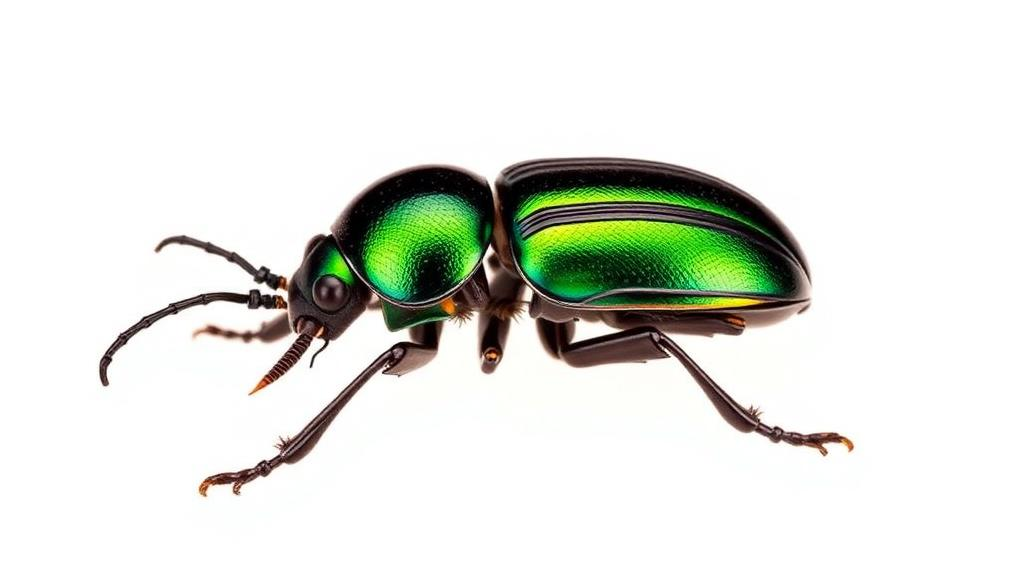
High in the Andean highlands of southern Colombia, entomologists have uncovered a small black scarab beetle that doubles the known membership of one of the least familiar genera in the tribe Macrodactylini. The beetle, formally described as Manodactylus paramicola sp. nov., was collected in the Páramo ecosystem of the departments of Nariño and Cauca, and its description in the Deutsche Entomologische Zeitschrift also untangles a nomenclatural knot that has tied together two species names for more than a century.
The story behind Manodactylus begins more than a century ago, and it illustrates how easily a beetle’s identity can become entangled in the paperwork of history. In 1909, the German entomologist Friedrich Ohaus described a striking black scarab with reddish legs under the name Macrodactylus gaujoni, basing his account on specimens sent from Loja in the southern Ecuadorian Andes. The collector was Abbé Gaujon, whose material had been gathered in the field by an Ecuadorian native named Angelo Ordoñez. Ohaus himself later traveled to Loja and, while walking with Ordoñez toward the collector’s home, encountered one of these black, long-legged beetles alive in the field, an experience that evidently shaped his decision to name the species. A decade later, in 1919, Julius Moser examined similar specimens from the same region and concluded that they represented not just a new species but an entirely new genus, which he called Manodactylus, apparently unaware or unconvinced that his insects were the same as Ohaus’s earlier species.
For decades the two names coexisted in the literature, a situation that taxonomists call a nomenclatural problem waiting to be resolved. The difficulty was compounded by the fate of Ohaus’s original type specimens, which have never been located and are presumed lost. Without a physical specimen to anchor a name, later researchers cannot verify which beetle the original author actually had in hand. The authors of the new study addressed this by formally designating the lectotype of Manodactylus gaujoni Moser, 1919, a male specimen preserved in the Museum für Naturkunde in Berlin, as the neotype of Macrodactylus gaujoni Ohaus, 1909. A neotype serves as a replacement name-bearer when the original types are missing, and its selection here rests on the congruence between the type localities of the two names and the diagnostic characters recorded in the original descriptions. This act stabilizes the older name and establishes that Manodactylus gaujoni Moser, 1919 is a junior objective synonym, meaning the two names refer to the same species and the earlier name takes precedence.
The designation of a neotype is more than a bureaucratic formality. It provides a single, fixed physical reference point against which future specimens can be compared, which is especially important for a genus that has been redescribed and re-diagnosed multiple times without ever being firmly anchored. The Berlin lectotype now carries an additional red label recording its new status, a small piece of paper that resolves a century of ambiguity.
With the nomenclature settled, attention turns to the new species itself. Manodactylus paramicola was collected in the Páramo, a tropical alpine ecosystem found at high elevations in the northern Andes, characterized by tussock grasses, cushion plants, giant rosettes, and a climate of near-daily frost and intense ultraviolet radiation. Páramos are recognized as among the most biodiverse and most threatened tropical mountain habitats on Earth, and their insect faunas remain incompletely documented. The discovery of a second Manodactylus species in this ecosystem suggests that the genus may be more diverse than the single-species picture that prevailed for a hundred years, and that high-elevation Andean habitats continue to yield surprises even for relatively well-studied beetle groups such as scarabs.
Morphologically, M. paramicola shares with its Ecuadorian relative the overall habit that makes Manodactylus so distinctive: a shiny black body with bicolored legs, a trapezoidal clypeus, small eyes with an interocular distance roughly six to seven times the dorsal width of the eye, and elytra each bearing five striae between the suture and the humeral callus, ten in total, with convex intervals between them. The two species can nonetheless be separated by consistent differences. The new Colombian species differs in the shape of the clypeus, which is more deeply emarginate at the middle, and in the pattern of punctation on the pronotum and elytra. In M. gaujoni the body is more lustrous, the femora and tarsi are reddish-brown with darker tibiae, the pronotal punctures are confined to the borders, and the elytral striae are shallow with punctures spaced one to four puncture diameters apart. These characters, while subtle to the untrained eye, are the kind of fine-grained morphological evidence on which scarab taxonomy has long depended.
The study also contributes to a broader unresolved question in the classification of the tribe Macrodactylini, a diverse Neotropical radiation of melolonthine scarabs. Manodactylus has long been recognized as morphologically similar to two other genera, Chariodactylus and Macrodactylus, and previous authors have noted that identification keys treat them as close relatives. All three share a trapezoidal clypeus, nine-segmented antennae, a pronotum that is strongly widened at the middle, an indistinct boundary between the mesoscutum and scutellar shield, a prosternum with two anterior longitudinal sulci, a protibia with two teeth on the outer edge, no protibial spur, and an unarmed inner surface of the fifth metatarsomere. Earlier workers suggested that a cladistic analysis including these three genera is needed to confirm whether they are truly distinct lineages, and the present authors have chosen to retain each as valid until that analysis is carried out.
Nevertheless, the new work sharpens the diagnosis of Manodactylus by proposing additional characters that separate it from its relatives. The genus has small eyes, with an interocular distance exceeding six times the dorsal eye width, whereas Chariodactylus has large eyes with an interocular distance of less than three and a half times that measure. The pronotum of Manodactylus is glabrous and wider than long, while in Chariodactylus it is setose and in Macrodactylus it is longer than wide or about as long as wide. The protibia of Manodactylus widens gradually from base to apex but narrows from the inner edge in the apical third, a shape that differs from Macrodactylus, where the protibia widens near the base and narrows from the inner edge around the middle of its length. The authors also identified features that may prove useful once they can be examined across more species: males of both Manodactylus species have the inner angle of the protibia slightly projected downward, a condition reminiscent of the polex seen in some members of the family Ochodaeidae, and males of M. paramicola bear two mesotibial spurs and a single metatibial spur, whereas Colombian Macrodactylus males have two spurs at the apex of the mesotibiae.
The type material of the new species is deposited in several institutions, including the Colección Entomológica de la Universidad de Nariño in Pasto, the Canadian Museum of Nature in Ottawa, the Instituto de Investigación de Recursos Biológicos Alexander von Humboldt in Villa de Leyva, and the Museum für Naturkunde in Berlin. This distribution of specimens across multiple repositories reflects standard practice in modern taxonomy, ensuring that type material is accessible to researchers worldwide and protected against loss at any single institution, a lesson made vivid by the presumed disappearance of Ohaus’s original types.
The historical record surrounding the genus also offers a glimpse into the networks of collectors and naturalists that underpinned Neotropical entomology in the late nineteenth and early twentieth centuries. Abbé Gaujon, after whom the species is named, sent specimens from Loja to Europe, where they circulated among specialists in Berlin and elsewhere. Angelo Ordoñez, the local collector whose fieldwork supplied much of this material, remains a largely uncredited figure in the published record, though Ohaus’s account of their joint excursion preserves a rare first-hand description of how these beetles were encountered in the wild. Such stories remind us that every type specimen represents not only a scientific reference point but also a chain of human labor spanning continents and generations.
From a biogeographic perspective, the confirmation of Manodactylus in southern Colombia extends the known range of the genus northward from the southern Ecuadorian Andes, where it was originally collected, and from a single unconfirmed record in the Peruvian department of Piura reported in 2015. That Peruvian record had been overlooked in a subsequent review of the tribe, and its confirmation remains an open question for future fieldwork. The pattern suggests that Manodactylus may occupy a disjunct distribution along the high Andes, with populations separated by intervening valleys and drier inter-Andean habitats. Whether additional species await discovery in the intervening stretches of Páramo and montane forest is unknown, but the fact that a second species came to light only now, more than a century after the first, indicates that the genus has been under-collected rather than genuinely rare in the region.
The work also underscores the continuing value of museum collections. The lectotype examined in this study had been photographed rather than physically re-examined in some earlier treatments, and the new neotype designation was made possible by revisiting material housed in Berlin alongside fresh specimens from Colombia. Digital imaging with high-resolution macro photography and stereomicroscopy allowed the authors to document habitus, male genitalia, mouthparts, and diagnostic morphological details, and a distribution map was produced from label data and literature records using online mapping tools. These methods, now routine in taxonomic revisions, make it possible for future researchers to verify identifications without traveling to distant collections, accelerating the pace at which nomenclatural problems can be detected and resolved.
Finally, the description of M. paramicola contributes to a growing body of evidence that the Páramo ecosystems of the northern Andes harbor distinctive lineages of scarab beetles adapted to cold, high-elevation conditions. As climate change and agricultural expansion continue to reshape these habitats, documenting their fauna before it is altered becomes an increasingly urgent task. Each new species description, however small the beetle, adds a piece to the puzzle of how Andean biodiversity is organized and how it responds to environmental change, and it provides the taxonomic foundation without which ecological monitoring and conservation planning cannot proceed.
Subject of Research: Taxonomy and systematics of the scarab beetle genus Manodactylus in the Colombian Andes
Article Title: A second species of the genus Manodactylus Moser, 1919 ( Coleoptera , Scarabaeidae , Melolonthinae , Macrodactylini ) from the highlands of Colombia
Article References: Clavijo-Bustos, J., Castro-Vargas, M. I., & Neita Moreno, J. C. (2024). A second species of the genus Manodactylus Moser, 1919 (Coleoptera, Scarabaeidae, Melolonthinae, Macrodactylini) from the highlands of Colombia. Deutsche Entomologische Zeitschrift, 71(1), 209-217. https://doi.org/10.3897/dez.71.118923
Image Credits: AI Generated
Keywords: Manodactylus, Scarabaeidae, Melolonthinae, Macrodactylini, Colombia, Andes, Páramo, taxonomy, new species, neotype, Ecuador, entomology
News Source: Gavin Prescott. (October 19, 2026). New Páramo Beetle Species Doubles a Century-Old Genus from the Andes. Scienmag.