• HOME
  • NEWS
  • EXPLORE
    • CAREER
      • Companies
      • Jobs
    • EVENTS
    • iGEM
      • News
      • Team
    • PHOTOS
    • VIDEO
    • WIKI
  • BLOG
  • COMMUNITY
    • FACEBOOK
    • INSTAGRAM
    • TWITTER
Saturday, February 7, 2026
BIOENGINEER.ORG
No Result
View All Result
  • Login
  • HOME
  • NEWS
  • EXPLORE
    • CAREER
      • Companies
      • Jobs
        • Lecturer
        • PhD Studentship
        • Postdoc
        • Research Assistant
    • EVENTS
    • iGEM
      • News
      • Team
    • PHOTOS
    • VIDEO
    • WIKI
  • BLOG
  • COMMUNITY
    • FACEBOOK
    • INSTAGRAM
    • TWITTER
  • HOME
  • NEWS
  • EXPLORE
    • CAREER
      • Companies
      • Jobs
        • Lecturer
        • PhD Studentship
        • Postdoc
        • Research Assistant
    • EVENTS
    • iGEM
      • News
      • Team
    • PHOTOS
    • VIDEO
    • WIKI
  • BLOG
  • COMMUNITY
    • FACEBOOK
    • INSTAGRAM
    • TWITTER
No Result
View All Result
Bioengineer.org
No Result
View All Result
Home NEWS Science News Biology

New study provides high-resolution insights into plants’ light harvesting process under low light

Bioengineer by Bioengineer
August 25, 2017
in Biology
Reading Time: 2 mins read
0
Share on FacebookShare on TwitterShare on LinkedinShare on RedditShare on Telegram
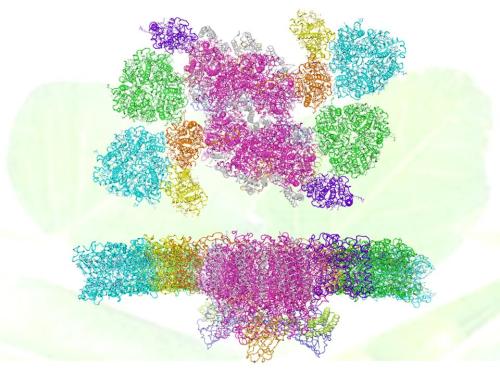
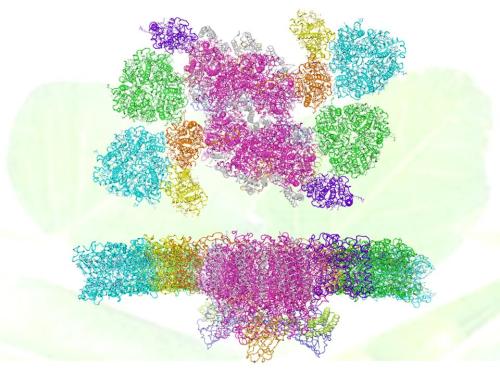
IMAGE

Credit: Image by IBP

Photosynthesis is a biological process mediating the conversion of solar energy into chemical energy. The so-called oxygenic photosynthesis, performed by plants, algae and cyanobacteria, is one of the most amazing chemical reactions on the planet. It provides food and energy for nearly all living organisms, and also contributes to the formation of the atmosphere and maintenance of the carbon-oxygen balance on the earth.

In plants, the primary light reaction of photosynthesis initiates at photosystem II (PSII), a membrane-embedded supramolecular machine responsible for catalyzing the water-splitting reaction. Surrounding the PSII, a number of peripheral antenna complexes dynamically associate with it to form the PSII-LHCII supercomplexes of variable sizes in response to different light conditions.

The C2S2M2-type supercomplex is known as the largest stable form of PSII-LHCII supercomplex isolated from Arabidopsis and pea so far, and crucial for plants to achieve optimal light-harvesting efficiency when they grow under low light conditions. Structural analysis of the C2S2M2 supercomplex is a pivotal step toward our understanding of the molecular mechanisms underlying the processes of light harvesting, energy transfer and PSII functional regulation in plants.

CHANG Wenrui-LI Mei's group, ZHANG Xinzheng's group and LIU Zhenfeng's group from the Institute of Biophysics (IBP) at CAS collaborate and solved two cryo-electron microscopy (cryo-EM) structures of C2S2M2-type PSII-LHCII supercomplex from pea at 2.7 and 3.2 Å resolution, respectively.

The 2.7 Å resolution structure of C2S2M2 supercomplex represents the highest resolution structure of membrane protein complexes solved through single-particle cryo-EM method so far. The supercomplex has a total molecular mass of 1.4 megadalton and forms a homodimer. Each monomeric PSII-LHCII contains 28 or 27 protein subunits, and binds 159 chlorophylls, 44 carotenoids and numerous other cofactors.

The overall structural features and the arrangement of each individual subunits, as well as the sophisticated pigment network and the complete energy transfer pathways within the supercomplex have been revealed in great details through this study.

In addition, comparison of the two C2S2M2 structures solved at different states suggested the potential mechanism of functional regulation on the light-harvesting process and the oxygen-evolving activity of plant PSII.

The research work, entitled "Structure and assembly mechanism of plant C2S2M2-type PSII-LHCII supercomplex", was published in Science on Aug. 25, 2017. The breakthrough is achieved through continuous and persistent efforts by the team from IBP after their previous work on the cryo-EM structure of spinach C2S2-type PSII-LHCII supercomplex was published on Nature last year.

###

The project was supported by grants from the Chinese Academy of Sciences, the Ministry of Science and Technology of China, the National Natural Science Foundation of China and "National Thousand (Young) Talents Program" from the Office of Global Experts Recruitment in China.

Media Contact

LI Mei
[email protected]
86-106-488-8507

http://english.cas.cn/

Related Journal Article

http://dx.doi.org/10.1126/science.aan0327

Share12Tweet8Share2ShareShareShare2

Related Posts

Florida Cane Toad: Complex Spread and Selective Evolution

Florida Cane Toad: Complex Spread and Selective Evolution

February 7, 2026
New Study Uncovers Mechanism Behind Burn Pit Particulate Matter–Induced Lung Inflammation

New Study Uncovers Mechanism Behind Burn Pit Particulate Matter–Induced Lung Inflammation

February 6, 2026

DeepBlastoid: Advancing Automated and Efficient Evaluation of Human Blastoids with Deep Learning

February 6, 2026

Navigating the Gut: The Role of Formic Acid in the Microbiome

February 6, 2026
Please login to join discussion

POPULAR NEWS

  • Robotic Ureteral Reconstruction: A Novel Approach

    Robotic Ureteral Reconstruction: A Novel Approach

    82 shares
    Share 33 Tweet 21
  • Digital Privacy: Health Data Control in Incarceration

    63 shares
    Share 25 Tweet 16
  • Study Reveals Lipid Accumulation in ME/CFS Cells

    57 shares
    Share 23 Tweet 14
  • Breakthrough in RNA Research Accelerates Medical Innovations Timeline

    53 shares
    Share 21 Tweet 13

About

We bring you the latest biotechnology news from best research centers and universities around the world. Check our website.

Follow us

Recent News

Evaluating Pediatric Emergency Care Quality in Ethiopia

TPMT Expression Predictions Linked to Azathioprine Side Effects

Improving Dementia Care with Enhanced Activity Kits

Subscribe to Blog via Email

Enter your email address to subscribe to this blog and receive notifications of new posts by email.

Join 73 other subscribers
  • Contact Us

Bioengineer.org © Copyright 2023 All Rights Reserved.

Welcome Back!

Login to your account below

Forgotten Password?

Retrieve your password

Please enter your username or email address to reset your password.

Log In
No Result
View All Result
  • Homepages
    • Home Page 1
    • Home Page 2
  • News
  • National
  • Business
  • Health
  • Lifestyle
  • Science

Bioengineer.org © Copyright 2023 All Rights Reserved.