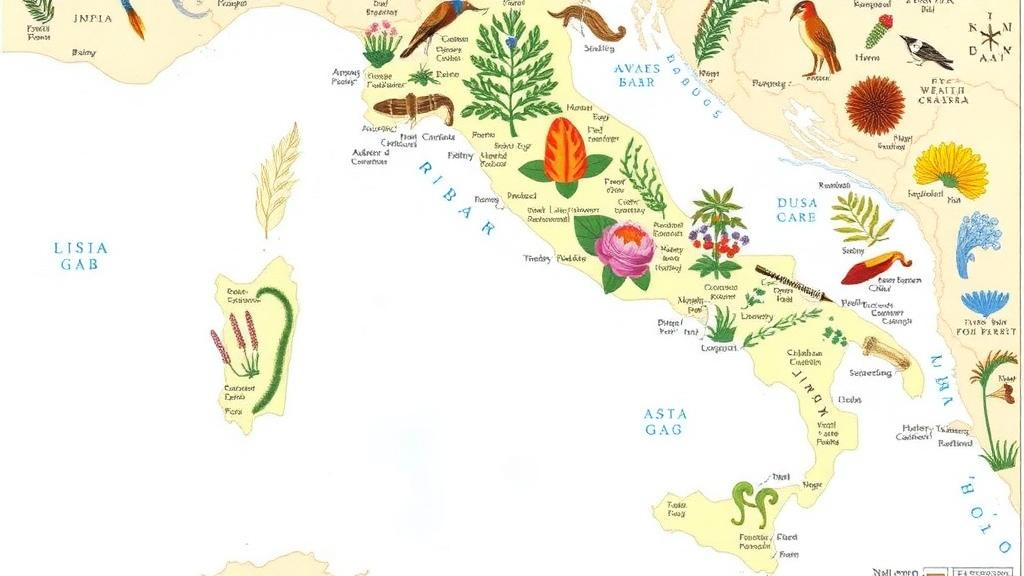
Italy’s native vascular flora has just received one of its periodic health checks, and the results show how much remains to be discovered even in one of the most thoroughly botanized countries in Europe. The seventeenth installment of the Notulae series, published in the journal Italian Botanist, compiles new distribution records, confirmations, and exclusions for native vascular plants across twelve genera, spanning families as different as the orchids, grasses, roses, and sedges. The contribution, dated 22 May 2024, brings together field observations from across the peninsula and the Alps, and it demonstrates both the vitality of Italian field botany and the painstaking herbarium work that underpins every claim of a species being present in a given region.
The format of the Notulae series is deliberately compact. Contributors submit short notes, each within one thousand characters, documenting either a new record for an Italian administrative region, a confirmation of an older record, or an exclusion where a species must be struck from a regional list. Every record must be backed by a specimen, which is deposited or verified at the Herbarium of the Botany Section Filippo Parlatore of the Natural History Museum in Florence, abbreviated FI. This specimen-based discipline is what separates a genuine floristic innovation from a passing observation, and it allows later researchers to re-examine the physical evidence decades or even centuries after the collection was made. Nomenclatural updates and corrigenda to the most recent national inventory are compiled separately as supplementary material.
Among the most striking novelties is the report of Anacyclus clavatus, a daisy-like member of the Asteraceae, new for the flora of Liguria. The species was found at Arma di Taggia in the province of Imperia, in uncultivated flowerbeds along the margin of a parking area beside the coastal cycle path between Imperia and San Remo, at only seven meters above sea level. What makes the record remarkable is not a lone stray individual but a well-established population covering more than one hectare, with several hundreds of individuals in full flowering stage when observed on 1 June 2023. A population of that size suggests the species has been present for some time and had simply been overlooked, a recurring theme in floristic surveys of disturbed Mediterranean habitats.
The Apennine kidney vetch, Anthyllis apennina, provides a different kind of story, one written largely in herbarium cabinets rather than in the field. The species was previously known only from Abruzzo and Lazio, but re-examination of historical collections has now extended it to both Marche and Umbria. The Marche records trace back to specimens gathered as early as 14 July 1960 by V. Marchesoni on the rocky ridge of Conca S. Lorenzo at 1360 meters, followed by numerous collections by S. Ballelli between 1986 and 2003 on Mount Cetrognola, Mount Gioco del Pallone, Mount Vettoretto, and Mount Costa, mostly on calcareous substrates in xeric pastures and Sesleria grasslands between roughly 1100 and 1800 meters. Umbrian material from Mount Castellaccio and the Pian Grande plateau, collected by Marchesoni in 1962 and Ballelli from 1997 to 2020, completes the picture. The lesson is clear: a species described only in recent decades can be hiding in plain sight in museum collections, its true range masked by earlier misidentifications.
Wetland and coastal specialists feature prominently as well. Bolboschoenus planiculmis, a sedge of temporarily flooded habitats, was confirmed for Tuscany after an extraordinary gap: according to a 2020 study, the only previous Tuscan documentation was a single specimen collected by Odoardo Beccari in February 1864 in the Padule di Massaciuccoli marsh, originally filed under the name Scirpus maritimus and later revised. The new population was discovered in September 2023 on the bank of the Sieve River at Pelago in the province of Florence, growing in a small stand within a temporarily wet depression. A gap of nearly 160 years between records illustrates how fragile and localized such wetland populations can be, and how easily a species can slip through the net of regional surveys when its habitat appears only episodically on the landscape.
On the Adriatic coast of Marche, Catapodium pauciflorum, a small grass of subsaline meadows, was recorded for the first time in the region near the Marina Palmense airfield close to the Spinnaker camping site. The authors note that along the Adriatic coast this species shows a patchy distribution, which may reflect identification problems with similar species rather than genuine rarity, a caution that applies to many cryptic grasses. In the same region, Hordeum geniculatum, a barley tolerant of clayey and saline soils, was added to the Marche flora on the basis of collections from Coste di Staffolo at about 250 meters on clayey-silty soil above a gully, and from field margins between Candelara and Ginestreto near Pesaro at about 155 meters. Both records were initially determined under other names, underscoring how taxonomic refinement continually reshapes distribution maps.
Perhaps the most technically interesting contribution concerns Festuca circummediterranea on Monte Baldo, the celebrated mountain ridge rising above Lake Garda. Specimens from the Trentino side at Brentonico, collected in 2007 on calcareous pasture at 1390 meters, establish the species as new for Trentino-Alto Adige, while material from the Veronese side on the western slope of Monte Altissimo confirms its presence in Veneto. The identification hinged on subtle anatomical and cytological characters: the plants resembled the octoploid Festuca laevigata, but leaf cross-sections and sheath anatomy matched the diploid F. circummediterranea, and stomatal length of approximately 25 micrometers clearly indicated a diploid plant, since stomatal size correlates with ploidy level in this group. The Trentino specimen came from an isolated tussock, whereas the Venetian material formed a limited but individual-rich population in a barely impacted area. Together, the records extend the range of this Mediterranean species into the southern Alps, a significant biogeographic shift.
Orchid enthusiasts will welcome the report of Ophrys fusca subsp. forestieri, new for the flora of Calabria. Many individuals were observed in February 2024 growing in a pine plantation and near rock formations at Pitea, in the municipality of Motta San Giovanni in the province of Reggio Calabria, at 826 meters. The subspecies is easily distinguished by its precocious flowering, beginning to bloom in January and reaching full flower in February and March, an adaptation to the mild Mediterranean winters of the far south of the peninsula. In Tuscany, the endemic subspecies Pseudopodospermum hispanicum subsp. neapolitanum, confined to central and southern Italy, was newly documented from three localities in the province of Grosseto along the Albegna valley, on clayey soils between roughly 500 and 600 meters. Specimens collected by F. Selvi between 1999 and 2009, previously reported under the broader name Scorzonera hispanica, were re-identified, and the Tuscan populations now mark the northern distributional limit of this taxon.
The rose genus Rosa also gained ground in the national picture. Rosa nitidula was recorded as new for Umbria on the basis of a 2022 collection from Mount Petria near Gubbio, at 875 meters on calcareous soil at woodland margins, and as new for Molise from three localities in the province of Isernia, including Colle Santa Maria at Fragnete, a hedge on clayey marl at Fornelli, and a roadside shrubland near Colli al Volturno, all between about 450 and 500 meters and all collected in 2005 and 2006. Meanwhile, Spergula arvensis, the corn spurrey, was confirmed for Marche after more than a century: it was recorded at the end of the nineteenth century in the Pesaro area by Paolucci in 1890, and was recently rediscovered at Pian Perduto in the Sibillini Mountains at about 1310 meters, where roughly a hundred individuals grow in resting fields on calcareous soil.
Exclusions are as valuable as additions, because a national flora is only as reliable as its weakest record. Lavandula latifolia has been removed from the flora of Campania: the sole basis for its presence there was an indication for the Alburni massif published in 1977, and field surveys together with pertinent specimens show that the plants in question belong instead to Lavandula austroapennina, a species described only recently from the southern Apennines. Similarly, Sorbus chamaemespilus has been excluded from both Campania and Puglia. The original reports trace back to Michele Tenore, the great nineteenth-century Neapolitan botanist, who cited Montevergine and the Gargano; but Tenore himself later deleted all the southern Italian localities not represented by specimens in the Naples herbarium, and the species has not been found there since. Together, these corrections show that Italian botany is a living discipline, in which modern fieldwork, cytology, and the critical re-reading of historical herbarium specimens continuously refine the map of the country’s wild plant heritage.
Subject of Research: New distribution records, confirmations, and exclusions of native vascular plant taxa in Italian regions
Article Title: Notulae to the Italian native vascular flora: 17
Article References: Bartolucci, F., Domina, G., Ballelli, S., Conti, F., Fortini, P., Del Guacchio, E., Di Iorio, E., Galasso, G., Gubellini, L., Hofmann, N., Laface, V. L. A., Lonati, M., Mazzacuva, G., Nota, G., Pesaresi, S., Pinzani, L., Prosser, F., Quaranta, L., Selvi, F., … Lastrucci, L. (2024). Notulae to the Italian native vascular flora: 17. Italian Botanist, 17, 13-21. https://doi.org/10.3897/italianbotanist.17.126693
Image Credits: AI Generated
DOI: 10.3897/italianbotanist.17.126693
Keywords: Italian flora, vascular plants, floristic records, Anthyllis apennina, Festuca circummediterranea, Ophrys fusca, herbarium specimens, plant distribution, taxonomy, biogeography, Lavandula austroapennina, Sibillini Mountains
News Source: Drew Townsend. (October 19, 2026). Botanists Rewrite Italy’s Wild Plant Map with New Records and Corrections. Scienmag.